A series of blankets with printed images of animals, landscapes, or references to works of art are laid out on the floor. Sewn and patched, they show the sort of stitching that resembles some types of surgical sutures used to close wounds. Are they marks left by accident or the remnants of patterns that appear through use? Other blankets hang on the wall. Their motifs and placement in the space make them look like ancient gobelins. There are also some photographs detailing, both the fragments of a millenary tapestry, as well as the ruins of a place that is very much ours, easily recognizable for its weeds, deteriorated state, or the decipherable surrounding landscape.
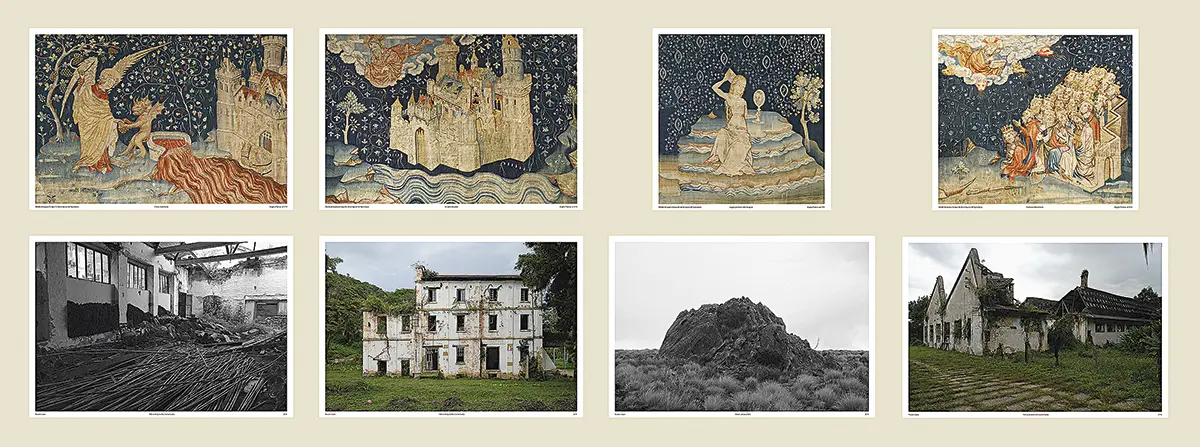
Rosario López has worked in a project that is like a dialog between several people who do not appear to know each other despite sharing many things in common. Her latest solo show evokes the 14th-century tapestries displayed at the Chateau d’Angers (France), which narrate the Apocalypse of Saint John the Divine. Measuring 140 meters long by 6 meters wide, the monumental series of tapestries details the most relevant passages of the Apocalypse. Woven with different types of wool, the images illustrate the way biblical passages used to be depicted. The exhibition also shows commentaries centered on an old cotton weaving factory located in San José de Suaita, in the Department of Santander, Colombia. It outlines associations of form, time, and space between photographic records of the territory where an operational factory once stood and the abandoned ruins that remain, and the tapestries mentioned above, generating an intersection that underscores strange congruencies. Yes, it is that strangeness that opens windows, glimpses of light that help us recognize ourselves as part of those timeless bodies rich in history navigating an infinite present; oddities that turn the Apocalypses into an apology for talking of the eternal present that accompanies us politically in this region, and perhaps across the entire national territory of Colombia. Remnants of old dreams that were never fulfilled but nearly became a national reality had it not been for giving in to partisan pressures and international interests.
López’s work focuses on the sculptural, on that dilemma that emerges from the three-dimensionality, where its forms are seen both in the photographic and in the object, almost without distinction. The exercise consists of forcing the gaze, sharpening the perspective of tapestries that do not have it. How to observe sculptural qualities in images that do not perceive space in a conventional manner? The steps range from resorting to pure two-dimensionality, commenting it with the photographic exercise of San José de Suaita, and contrasting it with moving blankets; a process that allows us to understand that there is something traversing us with forms and voids that have been gestating since the Middle Ages and will end in a moving truck. Because, what is a moving blanket? Is it not a plane that wraps around things and takes different forms depending on the content? Is it not that very blanket the one announcing three-dimensionality even before it is present? Of course, here we gradually encounter Christo’s wrappings, the soft sculptures by Claus Oldenburg, and Robert Morris’s collapsed, folded works. We gradually encounter referents of all sorts, where three-dimensional forms expand into other disciplines, other technical and conceptual resources. A moving blanket with the figure of the “Lady of the Unicorn,” for instance, becomes a sort of flexible container to wrap in any given day an auxiliary table, a flat-screen TV, or a sofa. The “Lady of the Unicorn” erodes like any form over time. It gradually becomes a ruin, similar to that emblematic and meaningful factory in the Department of Santander, in Colombia. Time has destined blankets to witness several forms and multiple changes. One should question if what is being mended is the time that has gone by, change, political or social struggles. What type of landscape appears after the blankets have been mended, considering that we do not know their origin or future? The same way that a mountain wrinkles over time, these blankets gradually became more wrinkled as a result of the sutures that attempt to repair them. Whether we believe it to be possible or not, could forms be born from wounds? Is space created from ruins? Is the “Apocalypse of Saint John the Devine,” represented in the Angers tapestries, about that?