How many Brazilian women artists have circulated in the contemporary art scene? Undoubtedly many, as a result of their participation in solo shows, art fairs, and biennials that continue to grow in numbers across all continents.
Among these, how many are black women? Moreover, if in addition to being black they are also Brazilian, how many have attained a working career that kept them in touch with all the convictions that guided their early interests, their projects at the beginning of their artistic production without any of the shortcuts of convenience?
Not many. As we know, the logic of the contemporary scene involves considering courses of action, the alternating moods of a market that not always promotes critical standards, including those about debates on gender, structural racist manifestations, or the historical wounds of markedly unequal societies.
Inserted in this landscape, as a record of the confrontation of structural scars generated by inequality in Brazilian society in the most diverse fronts, a recent initiative by the Pinacoteca do Estado de São Paulo offered an important exhibition that closed a year of meaningful curatorial decisions.
Entitled “Rosana Paulino: The Sewing of Memory,” the exhibition represented the first grand solo show in more than twenty-five years by a Brazilian artist with a rebellious voice that led her generation and now opens the way for a different understanding of the fractured realities of a country in conflict with its own history.
Doctor in Visual Poetics from the Universidade de São Paulo, with a scholarship from the Ford Foundation and the Bellagio Art Center of the Rockefeller Foundation, Rosana Paulino is a master engraver, and her work can be found in several Latin American collections.
Several public and private institutions have recently shown interest in acquiring works by Paulino, including the Museo de Arte Latinoamericano de Buenos Aires (MALBA)—through an institutional initiative that underscores the incorporation of works by women for the development of equal gender representation in the landscape of that museum’s collection.
Rosana Paulino, a black female artist, born in São Paulo, has stood out in the national and international art scene for the integrity of her projects. All of the convictions that guided the young drawer and engraver, even during the 1990s, have remained alive and active for more than two decades of artistic creation, never deviating from the spirit of her first proposals.
That is, precisely, what makes the career of this Latin American artist different: her decision to stay connected to her roots and loyal to the ethical interests that have always been present in the horizons of her visual explorations. What convictions are we talking about when dealing with Rosana Paulino’s work?
From her incursions into engraving during the beginning of the 1990s, challenging the subordinate place given to black women in Brazilian society, to sculpture, installation, and collage, Paulino has continuously incorporated in her projects the stamp of critical resistance. She insists on looking at the zones of exclusion, which she attempts to critically revert in every intervention proposal developed in her work series.
The anthological exhibition occupied three exhibition areas on the first floor of the Pinacoteca—giving continuity to the yearly program of exhibitions that showcased works by female artists—and was presented in the same space used earlier for the group exhibition titled “Radical Women: Latin American Art 1960–1987,” which closed last November. The show offers visitors an immersive experience through the broad context of the racist scars still present in Brazilian society.
Including pieces created between 1993 and 2018, the selection presented 140 works developed with the lucidity of an interlocutor who is well aware of her social and political surroundings; an author of inquiries that incorporates the place occupied by the black population in the constitution of a social fabric still torn by exclusion and the apathy of the state.
Works like Parede da memória (Memory Wall, 1994-2015) and Bastidores (Embroidery Hoops, 1997)—widely shown projects featured in important group exhibition in Brazil, including, “Territories: Artist of African Descent in the Collection of the Pinacoteca” (2016), and, “MAM 70; MAMA and MAC USP” (2018)—wrote a new chapter in the history of Brazilian art, materializing an urgent visibility that questions cultural representations of negritude in Brazil.
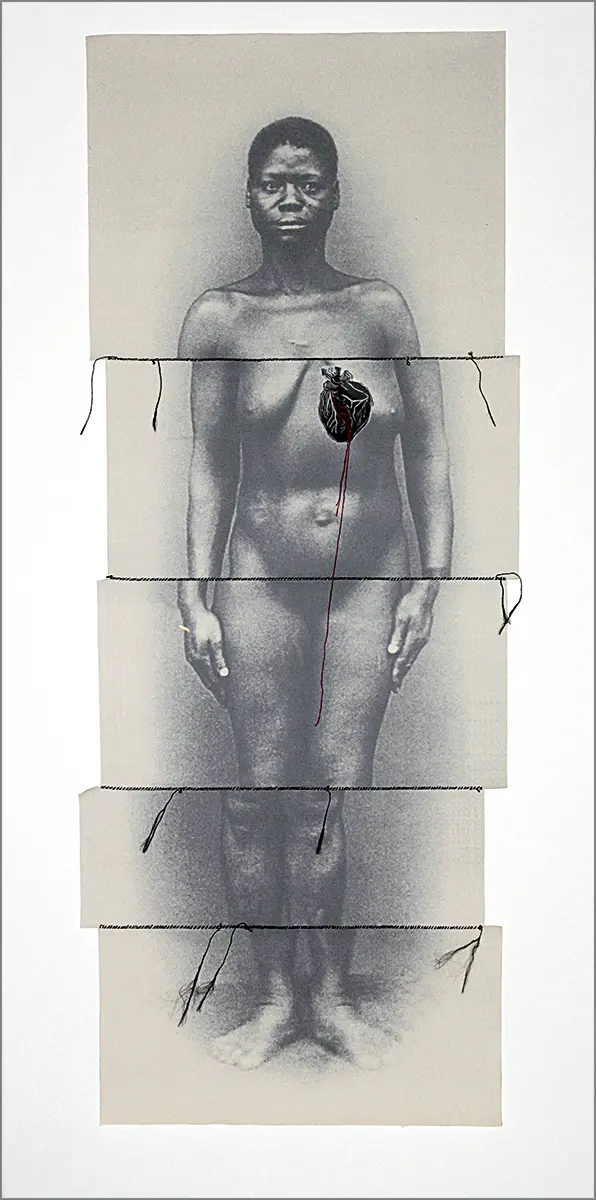
Notable among the sections of the exhibition is the segment that presented the installation titled Assentamento (Settlement) (2013), a research project developed by Paulino as a critical revision of the known Thayer Expedition, a foreign undertaking that toured Brazil in the 19th century.
Characterized by a consisting transgressive narrative accomplished with digital prints on cotton fabric, sewing, embroidery, wood, paper, clay, and video, the installation rejected the degrading thesis of racial degeneration that was so present in the historic expedition.
Based on notes from a research trip to the country, Paulino subverted the original cataloging of the photographic records of nude bodies of a black women—frontal, from behind, in profile—that, along with images of local animals and plants, were the reason for an itinerary that, in theory, generated an implicit condemnation of a mestizo society.
The environment of the installation denounced the idiocy of the supposed thesis that showcased life-size images of an unidentified slave woman, now approached as an entirely dignified presence, as a witness of a controversial suppression that still demands a revision today.
In another section of the exhibition, the piece titled Atlantico Vermelho (Red Atlantic) (2017) stood out. A digital print on cotton fabric created with sewing and collage—recurrent elements in her work—it incorporated, scene after scene, black thread stitching like a visible scar of the horrors and perversions associated with the trafficking of black people by slave traders.
The carefully mounted and highly attended retrospective, curated by Pedro Nery and Valéria Piccoli, broadened the scope of Rosana Paulino’s panorama of creations by showing the power of a critical enunciate affirmed as a conscious mark of one of the most distinctive Brazilian artists in contemporary art.