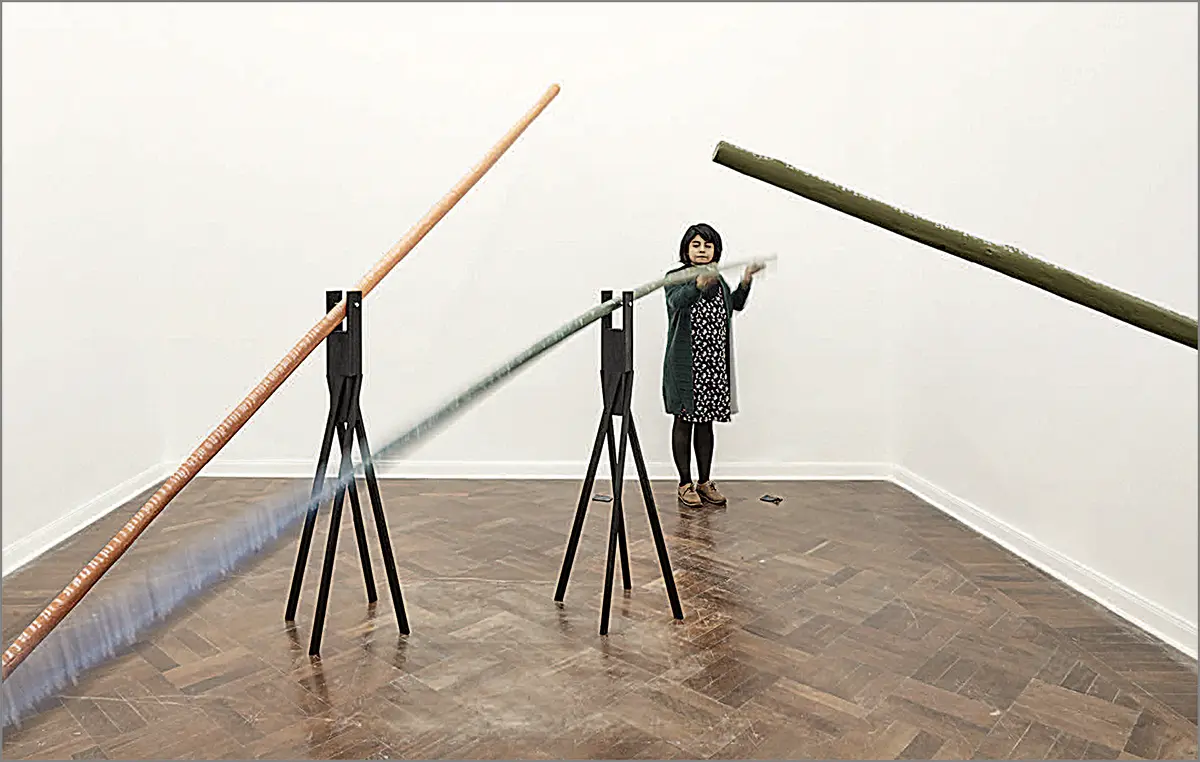
An installation comprising twenty-one wood sculptures and a series of charcoal and pencil on paper drawings articulate the idea of the portrait and the biographical narrative in Sin conocernos, sencillamente seguimos (Without Knowing Each Other, We Simple Continue), an exhibition by Rita Ponce de León. Those mobile sculptures are made using long rain sticks, painted in a gradation of colors, mounted on bases that make them pivot like a see-saw or a swing chair. The length of each stick is covered by hand-written text: words and lose phrases that, in isolation, are as common as they are enigmatic: friends, Brussels sprouts, falling in love, camp, sea, watermelon, novel, ugly school, etc.
These texts tell the stories, in highly condensed form, of twenty-one individuals from Ponce de León’s milieu, whom she asked to summarize their lives into a series of biographical landmarks to written on the wood. The artist’s strategy brings to mind Félix González-Torres’ word portraits, comprised of names, events, and dates (public and private) that were significant for his subjects, deployed with the purpose of evoking their life stories.
The open and non-narrative character of the micro-autobiographies that Ponce de León presents us within this project makes it possible for the radically private aspect of the experiences of others to resonate with a broader audience. By not referring to a set of anecdotes nor to a specific chronology, and by alluding to mostly shared experiences, these elliptical biographical narratives open themselves up to their narrative appropriation by the reader (in my case, reading the word kickflip fostered an identification with an anonymous someone).
Unlike a standard narrative written on paper, what gives testimony of these lives in Ponce de León’s work is not only the words but also the interstitial spaces, which evoke life’s rhythms and their variable intensities, moving to the time of those experiences that most deeply impact us. In these twenty-one narratives, we find shared references to existential landmarks including love, family, children, friends, travel, death, and so on.
Meanwhile, the use of branches as support (the branches used to manufacture the rain sticks) suggests the idea of a sequential process of growth and development (albeit, one devoid of dates). This idea is reinforced by the sticks’ different longitudes, which seem to allude to years lived and/or experiences had.
It is also worth noting an element that also plays with the notion of vital trajectories and the density of lived experiences: the sounds produced by the rain sticks. Each one generates a distinct sound that varies in intensity and duration, not only according to the length of the stick but also to the amount and type of elements within it, and the interior shape of the tube in which they flow. The sound is produced by the back-and-forth motion of the sticks, which evokes life cycles: from the oscillation emerge memories of childhood and a graphic representation of life’s ups and downs.
Walking around the installation, we are prompted to imagine random encounters and how different life stories come to intertwine, since, ultimately, what these biographies all share is their connection to the artist. Approaching each item and interacting with it (reading, manipulating) represents our involvement with the world and our dynamics with others, not only as individuals but also in terms of groups and, by extension, of communities. It is there that the connections we make between the various items—by their color, their placement, the texts they carry, their sound—acquire their full relevance. Not in vain do these individual narratives exist only from a collaboration with the artist; in other words, they are not entirely individual.
That is a crucial aspect of Ponce de León’s exhibition. What she depicts is, above all, life as a journey of discovery and possibility, expressed in our encounters with others and traversed by chance, by the randomness that for a time may bring two lives together: a possible resonance that is also the underlying harmony of sound contained within the rain sticks.
In this way, Rita Ponce de León reminds us of the transformative potential of an encounter with a stranger, which can always rewrite the narrative of our life.