In his first solo exhibition, El retorno del cometa Biela (The Return of Biela’s Comet), Rafael Mayu Nolte uses a complex narrative fiction as the starting point for his approach to issues of creativity and the role of the audience.
The literary plot that provides the show’s structure begins with a real historical event: the discovery of Biela’s Comet, first seen in 1792 by Jacques Leibax Montaigne and Charles Messier, recognized as a periodic comet by Wilhelm von Biela in 1826 (hence its name), and finally lost from view in 1859 (presumed disintegrated). Based on this story, Nolte creates the narrative of a parallel world, peaceful to the point of stasis, discovered in the documentary evidence left behind by the inventor Conrad B. Rallad (an allusion to the dystopian sci-fi writer J. G. Ballard). In Nolte’s story, Rallad is a visitor from that world, who comes to Earth in search of a way to refuel his world’s creative processes. According to Rallad’s theories, the absolute peace achieved in his world has produced stagnation. The vanishing of all violence is the end of creativity: absent the power of destructiveness and the motion it fosters, creation is impossible.
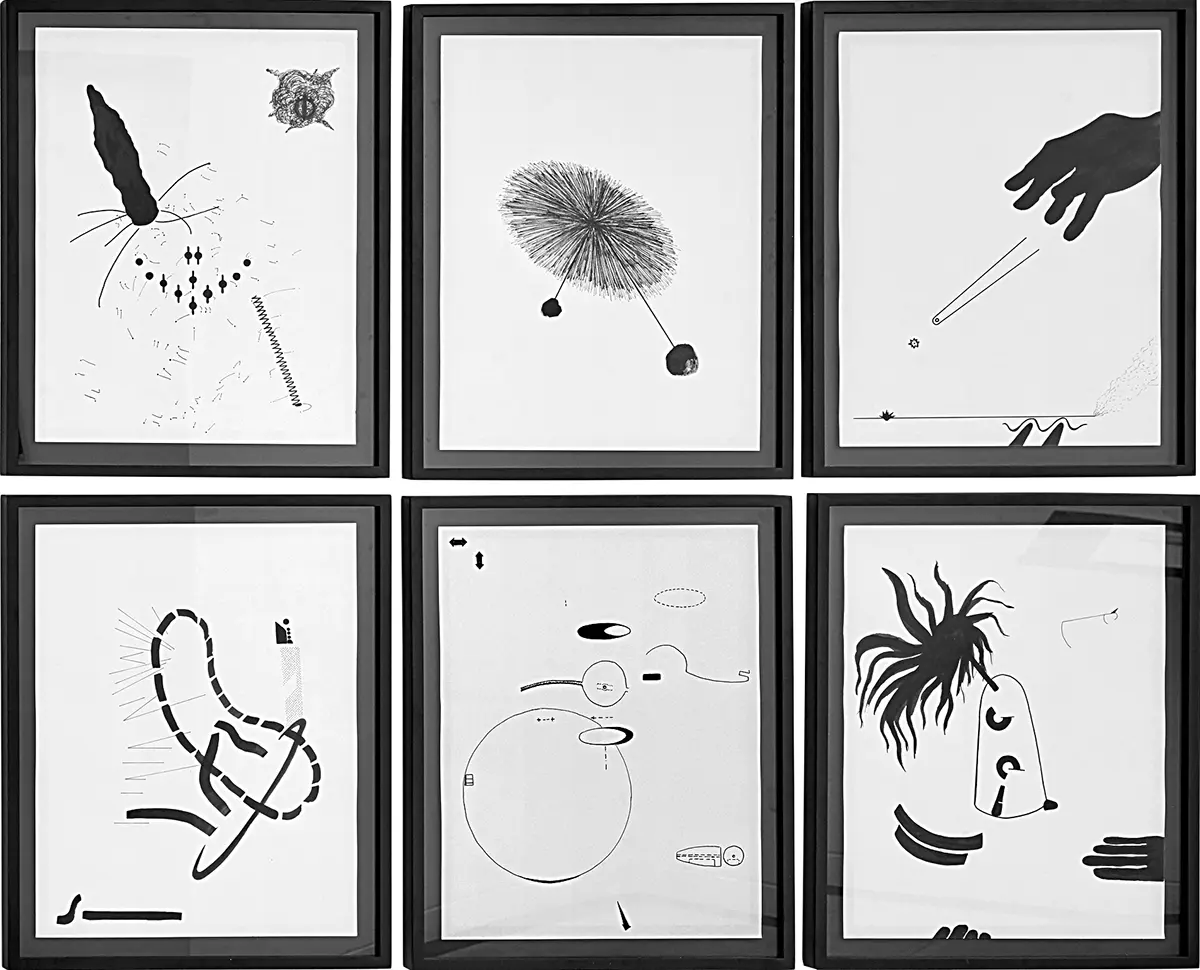
The different series of works on display in the exhibition trace various storylines connected to the main Rallad/comet plot, each signaling different aesthetic possibilities. Using these storylines and their associated works, Nolte engages the many ways that exist in producing art. For example, his series 5 partes (5 Parts), comprised of drawings of highly synthesized and flattened forms against mostly empty grounds (resembling some iconographic alphabet), was inspired by period cartoons illustrating the sighting of the comet in the Nineteenth Century. The series of drawings Poemas (Poems), purportedly based on Rallad’s research, features diagrams of weapons (real and fictional) gleaned from the Internet, with references to technical draftsmanship and to industrial design. Planos (Plans), a series of drawings of abstract shapes that evoke macroscopic and/or microscopic images (outer space, microorganisms) alludes to Rallad’s world but also brings to mind Man Ray’s rayographs (especially the drawings, where we see the outlines of hands) and early abstract art.
Nave (Ship), the exhibition’s central item (depicting the remains of Rallad’s vessel), is a structure of metal rods that combines a graphic, Pop-Art element (the plan view outlines the figure of an explosion) with references to constructivist explorations from the first half of the Twentieth Century. A variety of visual registers and art-historical references are thus set in motion, as are different modes of production, all organized around a literary plot line but also using a display narrative: modes of representation that refer back to the archive and the museum. An example of this is Diario de Conrad B. Rallad (The Journals of Conrad B. Rallad), containing the character’s musings and drawings, which operates both as a document to be examined and an object to be contemplated. Similarly, the metal box with sand and electronic circles in Sin título (Untitled) is presented as an aesthetic object and an artifact to be studied.
However, Nolte posits a broader framework, one that goes beyond the issue of the artistic and visual mode of production and touches on matters of artistic creation as such. These matters appear foremost in the narrative setup, through the suggested relationship between violence and creation. They are also present in Otro lenguaje es possible (Another Language is Possible), a series of works where sheets of paper with typed texts are grouped with postcards: drawings and watercolors of rainforest landscapes accompanied by texts extracted from the manifestos and releases of Latin American subversive and terrorist organizations, written in a poetic structure.
The artist links, thus, the idyllic images of the ferocious immensity of the forest and the embellished discourses of a social utopia to be brutally implanted by violence, whose aesthetic meeting point would be that experience of cognitive overflow that we call “the sublime.”
The question of creation brings as a correlate the question for the audience and how it relates to it. This task of the public is outlined from the same narrative starting point that organizes the entire exhibition: the discovery of Biela’s Comet and the enigma of its disappearance, and the story of Rallad as a labor of reconstruction based on documents and artifacts materialized in Nolte’s drawings, texts, sculptures, and objects. In that sense, what the artist seems to be ultimately suggesting, beyond a possible nexus between creation and destruction, is that creation and interpretation are not all that indifferent to one another.