When the exhibition “Inside Out: New Chinese Art” landed at P.S.1 in New York in 1998, many of us discovered for the first time the “exotic” art of the Asian nation, after decades of a real informational wall. A new market was being launched, as was an expanded interest in a forcefully critical and politicized scene that continues to grow to this day, fueled an unstoppable economic growth that has left several other nations in its wake. Despite the large-scale migrations that have taken place in this period of globalization, of expanding traffic, China’s economic openness and the convenience of manufacturing there at a low cost, information about what happens inside the country remains difficult to obtain, and the art that is produced in its overpopulated cities is no exception.
Two decades later, during my second visit to China, invited by the Hubei Institute of Art, I received the surprising news that for the first time, the Shanghai Biennial was to have a Latin American curator. In one of the Asian giant’s largest cities, with a population nearing 24 million, the 12th edition of the biennial opened on November 10, 2018, curated by Cuauhtémoc Medina (Mexico City, 1965) working with co-curators: María Belén Sáez de Ibarra (Bogota), Yukie Kamiya (New York), and Wang Weiwei (Shanghai), with Shi Hantao (Shanghai) as their General Coordinator. The selection of 67 artists from 26 countries included 19 Latin Americans, also an unprecedented number for this event (and perhaps for the country as a whole.) Perhaps most significant was the fact that the Latin American presence was a highlight at the enormous Power Station of Art (PSA), the biennial’s main venue.
It must be noted that there were other “firsts” for Shanghai in this event, along with the Mexican curator. Despite being a port city and one of China’s most “European” cities, not to mention the fact that it competes with Beijing for dominance in the arts, it was hosting China’s first solo exhibition by Cindy Sherman (Fosun Foundation) and Francis Alÿs (Rockbund Art Museum). Two large art fairs took place simultaneously with these large exhibitions (Shanghai 021 and West Bund), at the same time as the 12th Biennial opened its doors. Most symptomatic in this context of Western art displays and giant art fairs was the presentation of China International Import Expo, at the opening of which President Xi Jinping made significant economic news: China is poised to buy US$30 trillion in foreign goods over the next fifteen years, and to invest $10 trillion in foreign services. If we take into account that Latin America is a focal point of the commercial corridor in the “New Silk Road,” such an interest in the southern portion of the Western Hemisphere is not entirely inexplicable.
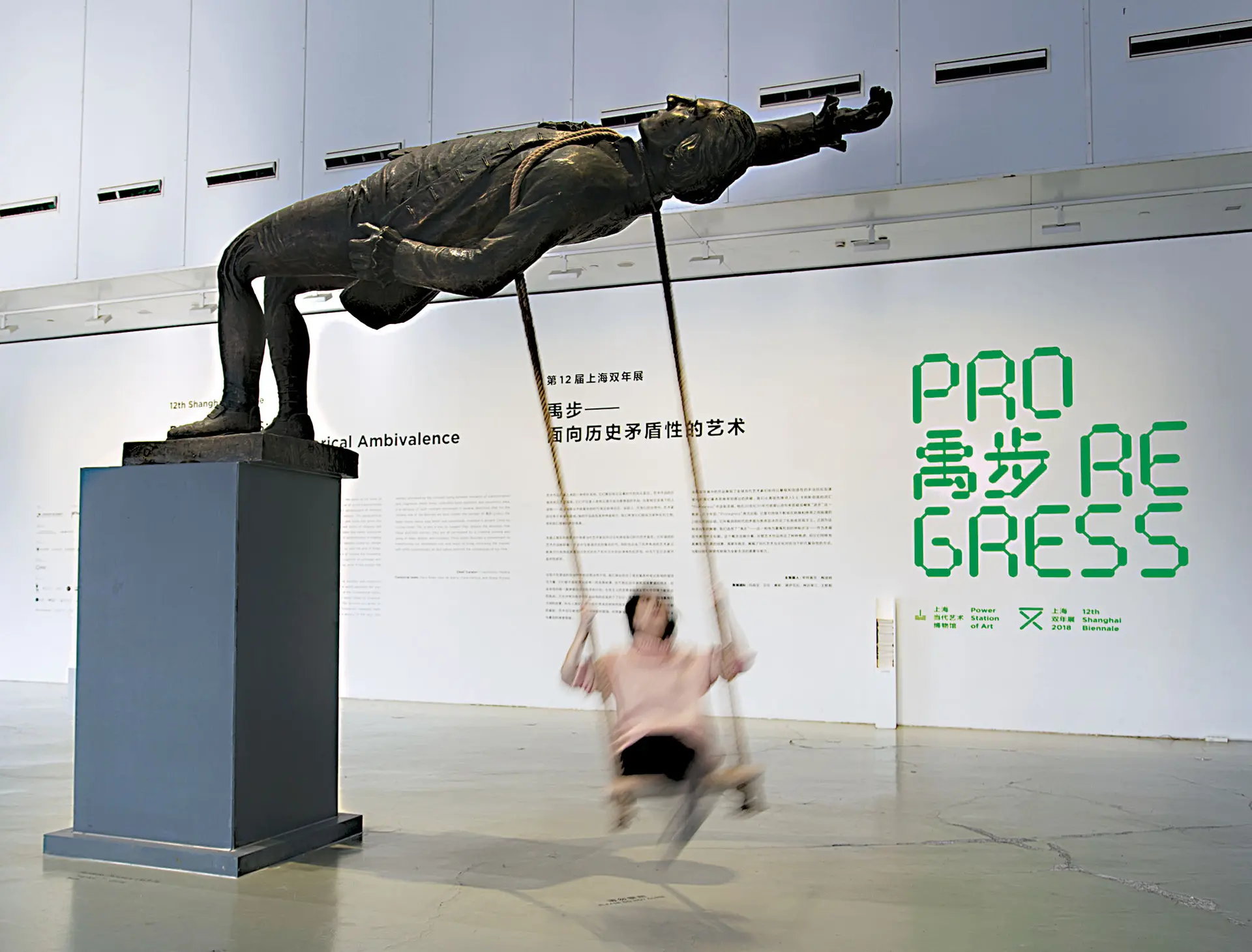
China’s reputed economic openness gave the theme proposed for the Biennial by Cuauhtémoc Medina, Proregress (a portmanteau word made up of progress and regression), a somewhat critical undertone. The subtitle, “Art in the Age of Historical Ambivalence,” reminded me of the title chosen for the upcoming Venice Biennale: “May You Live in Interesting Times,” in turn a reference to a famous Chinese proverb. Proregress, a word inspired on the poet e. e. cummings, can be translated into Mandarin using the poetic concept of Yubu, which refers to the basic steps in a mystical ritual Taoist dance from ancient China that combines forward and backward movements sequentially. Several works echoed the idea of Proregress from the very entrance to the PSA, sometimes subtly and sometimes very overtly in the curatorial narrative.
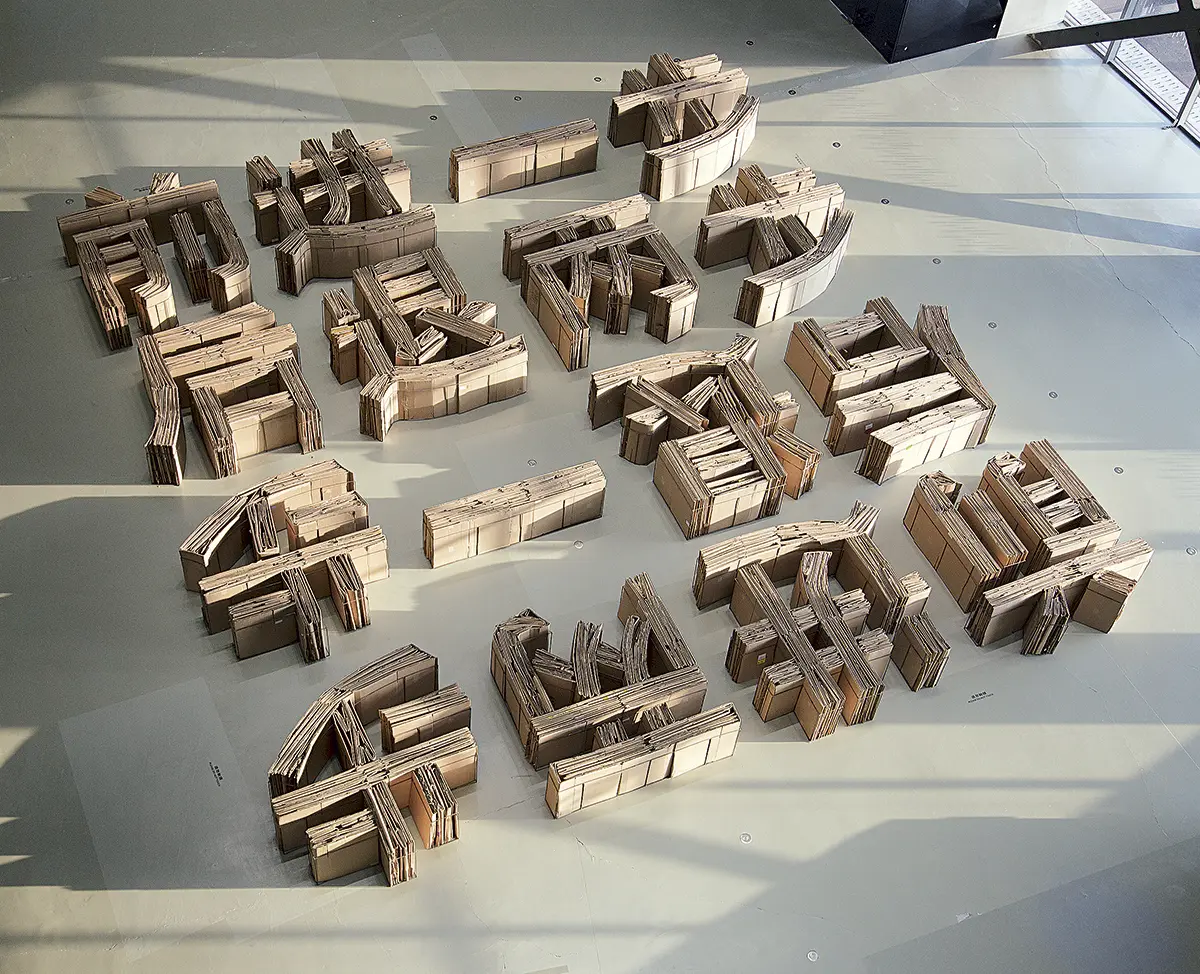
Swing, an enormous bronze sculpture (425 × 400 × 120 cm) commissioned by the Biennial to Spain’s Fernando Sánchez Castillo, greeted visitors as they passed through the turnstile at the main hall entrance. Its representation of an Enlightenment-era figure on a pedestal curved backward in precarious balance was in permanent danger of falling by the action of the swing from which it hung, accessible only to children. The presence of this Spanish artist, known for his critique of memorial monuments in public spaces, among them Franco’s effigy, was incongruous in Shanghai, given how all imperial vestiges have been eliminated in China, but not to Medina, in whose curatorial discourse and practice a critique of modernity is central. Located nearby and equally commissioned, In Hemmed-in Ground, by Mexico-based Argentine artist Enrique Ježik, seemed at first blush a tight accumulation of piece of cardboard, tied together by a metal structure organized in space. More than referring to recycling or the minimalistic or referential appropriation of materials referred to Arte Povera, it connected the work of cardboard collection in China with its equivalent in many Latin American countries. Seen from above, from the second floor, the installation made perfect sense: observers discovered the sculptured writing, in Mandarin characters, of a text by Vladimir Ilich Lenin, “One step forward, two steps back,” at the Second Congress of Russian Social Democratic Labor Party (1904). This phrase, which has become a sort of popular saying, also echoed Warhol’s “quote” about Pollock, as well as the dance steps on the floor allusive to the abstract-expressionist artist’s creative process.
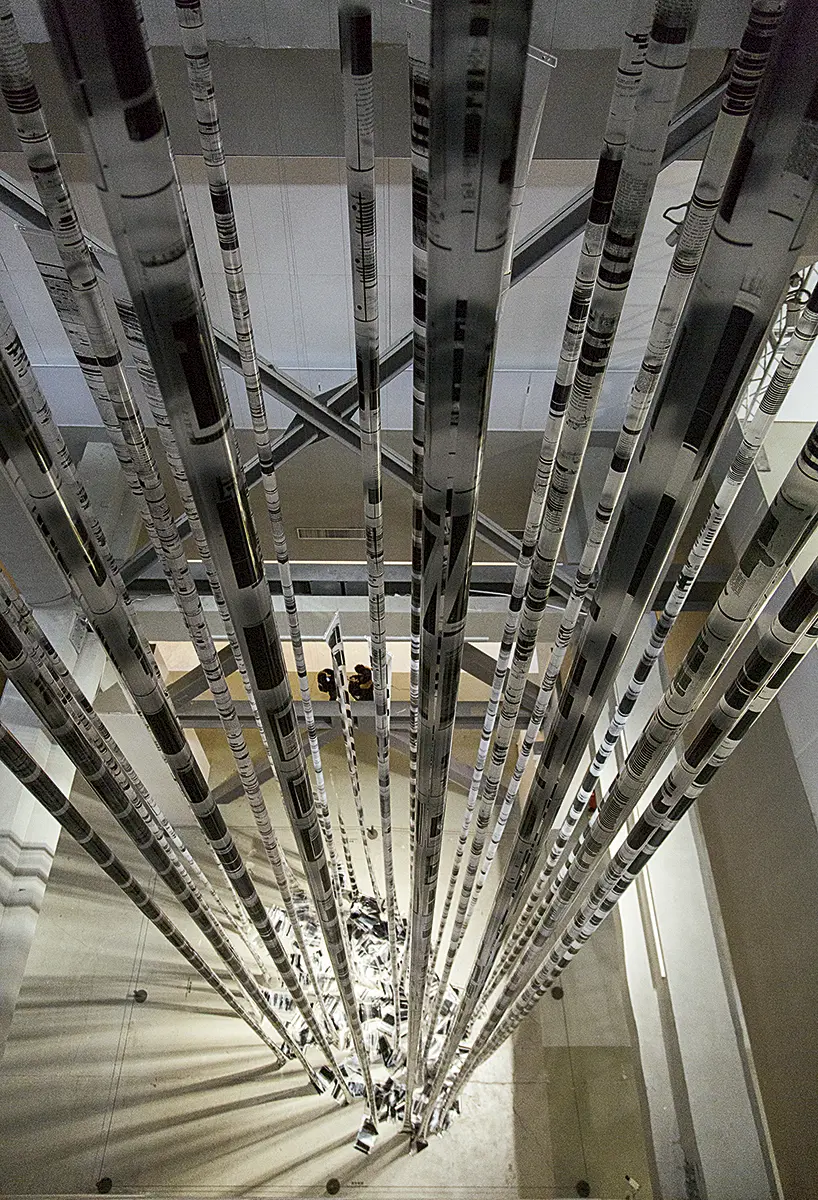
Another site-specific installation that connected empty spaces between floors was Monumenta (2018) by Chilean artist Voluspa Jarpa, who presented a new version of her redacted acetates of declassified CIA documents about its interventions in Latin America. The lightness of the material and its elegant fall from the second floor of the vestibule, like celluloid ribbons, along with the repetition of their minimalist shapes, highlighted the beauty of the form rather than the content of the work.
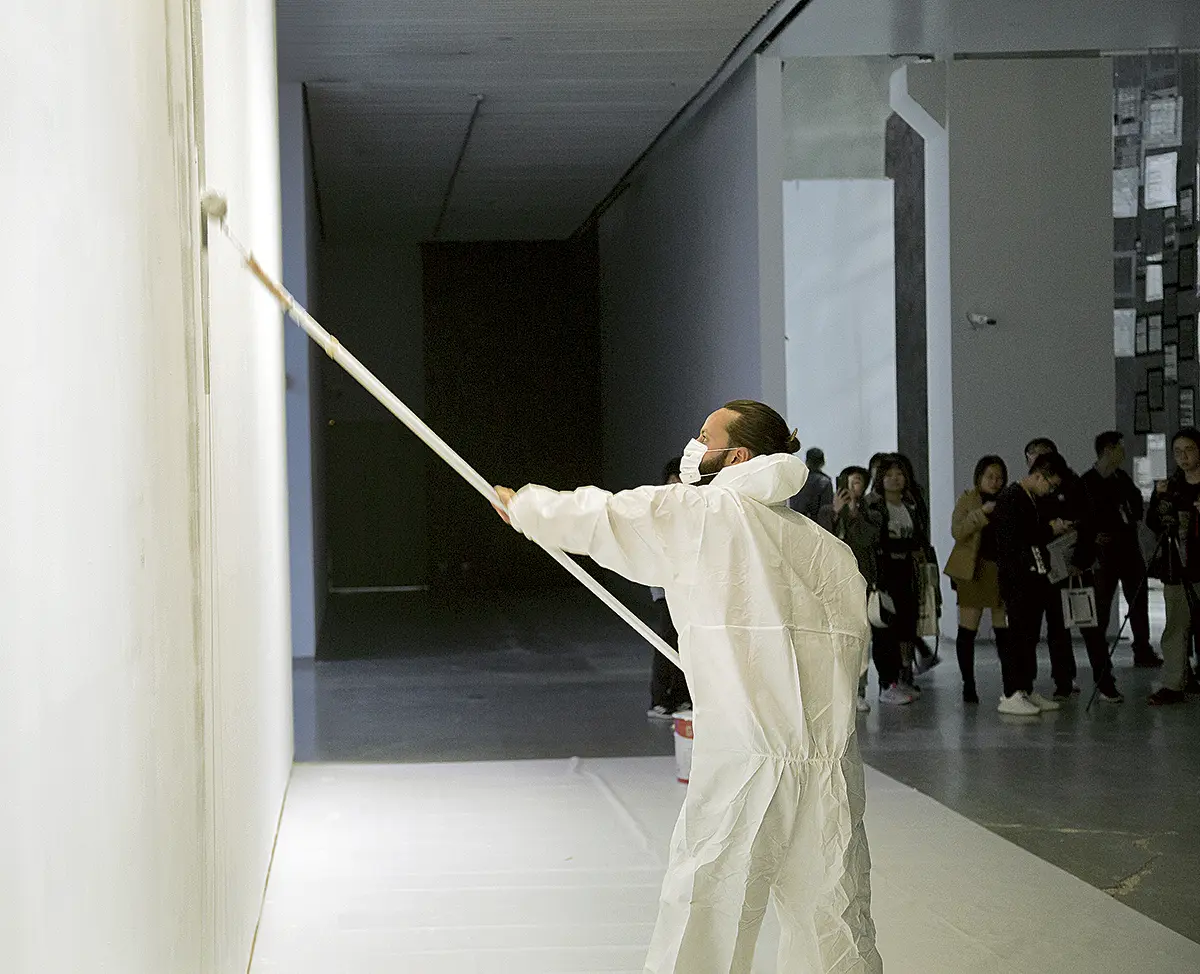
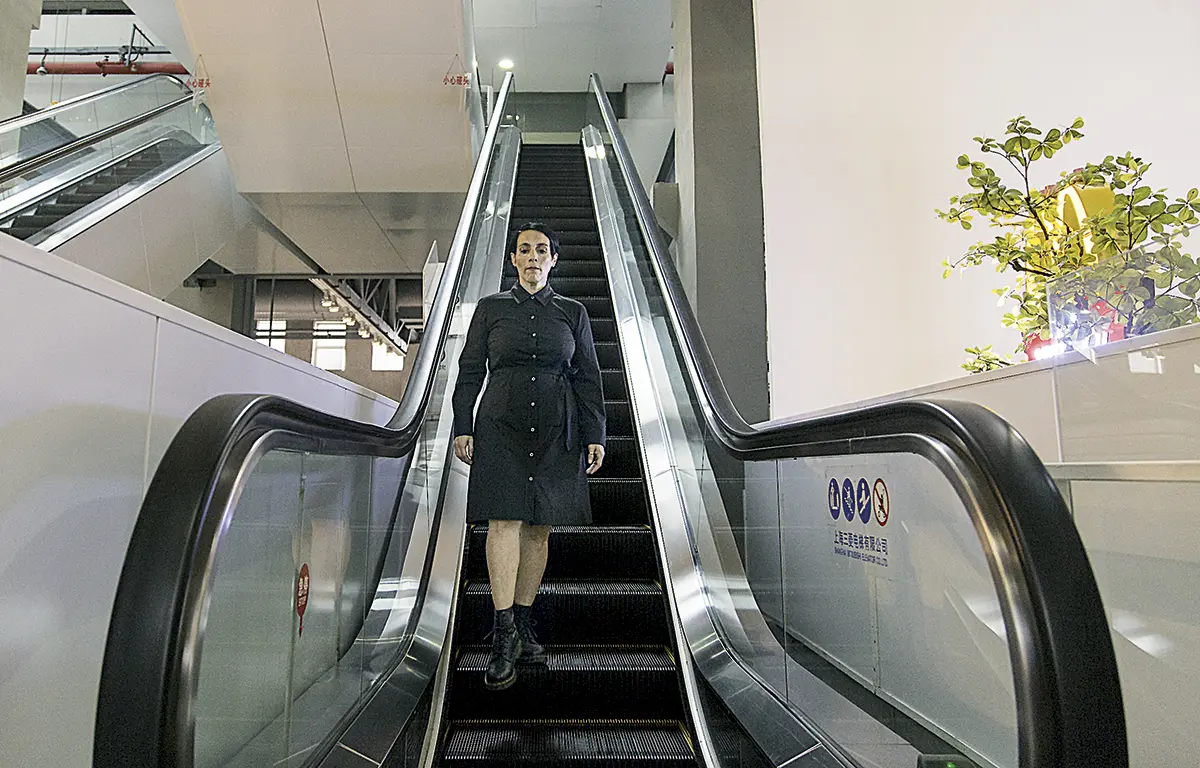
Two repetitive performances that asserted a critique of the models and narratives of late-modern political systems, as well as those of the avant-garde and the art system, were those by Cuba’s Reynier Leyva Novo, Nothing About Nothing (2018), with his action of painting the wall white time and time again, as visitors walked by wondering whether the biennial was still being set up. The gesture of repetition carried political as much as artistic implications, from the paradigm of the white cube, erasure, incompleteness, or simply the nothingness of nothingness in contemporary art discourse. Meanwhile, in her performance Deascent, Berlin-based Mexican artist Ilya Noé went up and down the escalators to the various levels of the PSA during several hours, moving against the motion of the device. While these actions could be connected indirectly to Francis Alÿs’ reiterative falls in his video-installation Choques (Clashes, 2005), the video Tornado (2000-2010), featured in his solo show at the Rockbund Art Museum, made much more sense to me. The important action of chasing a tornado and entering it insistently with a camera in hand, in order to become part of the experience and record images of confusion and invisibility, would have been more suggestive in the context of the biennial.
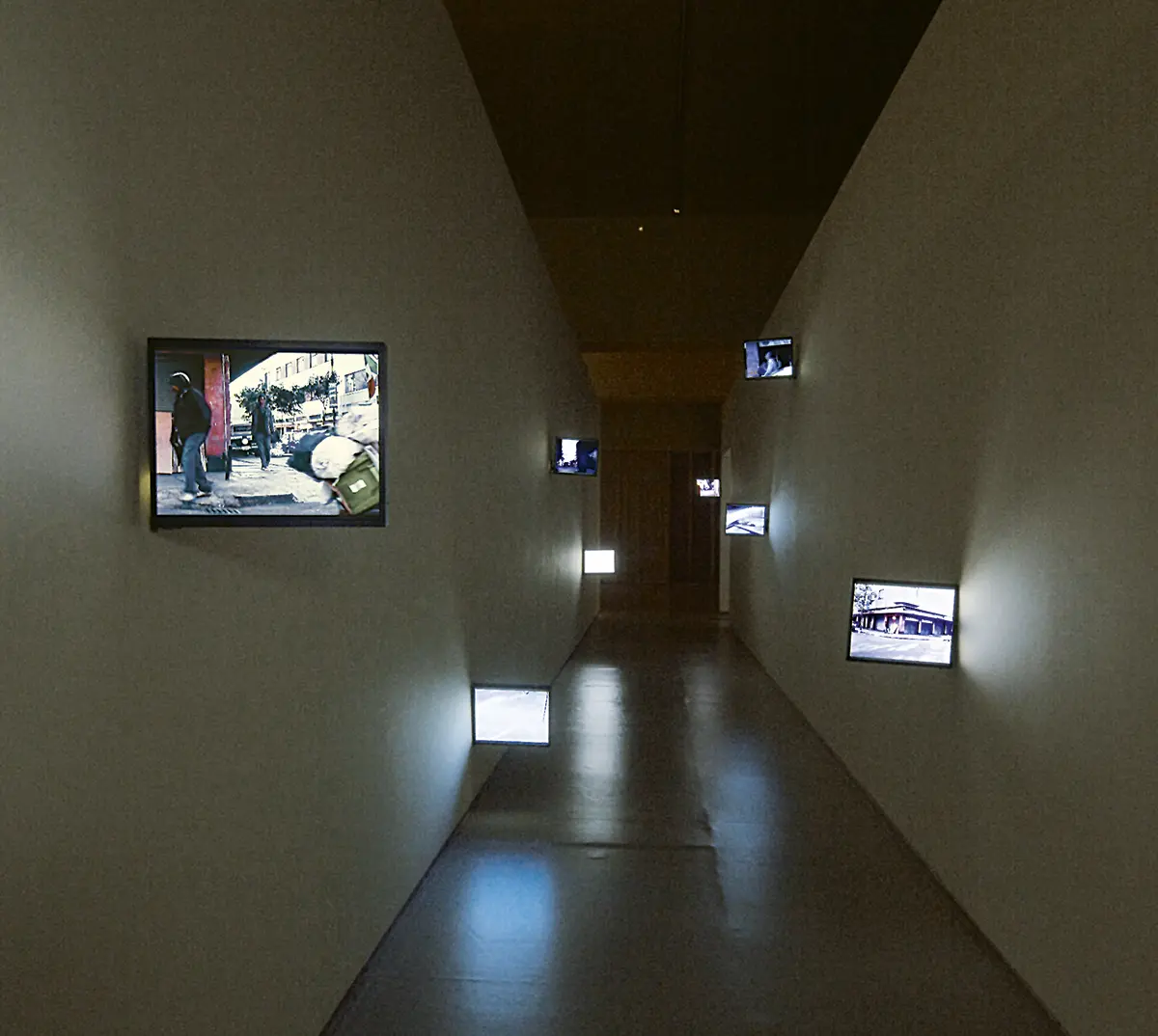
All of these absurd yet titanic actions could serve as a metaphor for the mega-exhibition presented at the PSA by the curatorial team, dominated by long projections and installations of videos with a certain redundancy in terms of their subject matter. Video projections and small solo exhibitions came in quick succession both in the ground floor, with a broad corridor giving access to enclosed spaces with videos and installations, and the second level, where visitors encountered subdivided, enclosed galleries resembling a contemporary shopping mall’s multiplex.
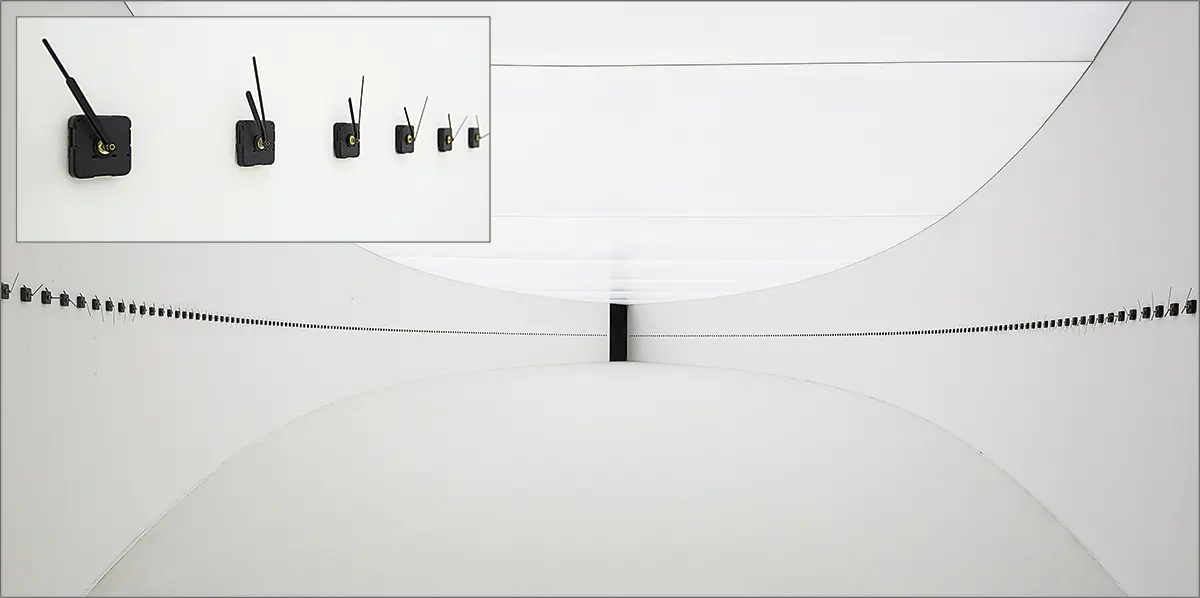
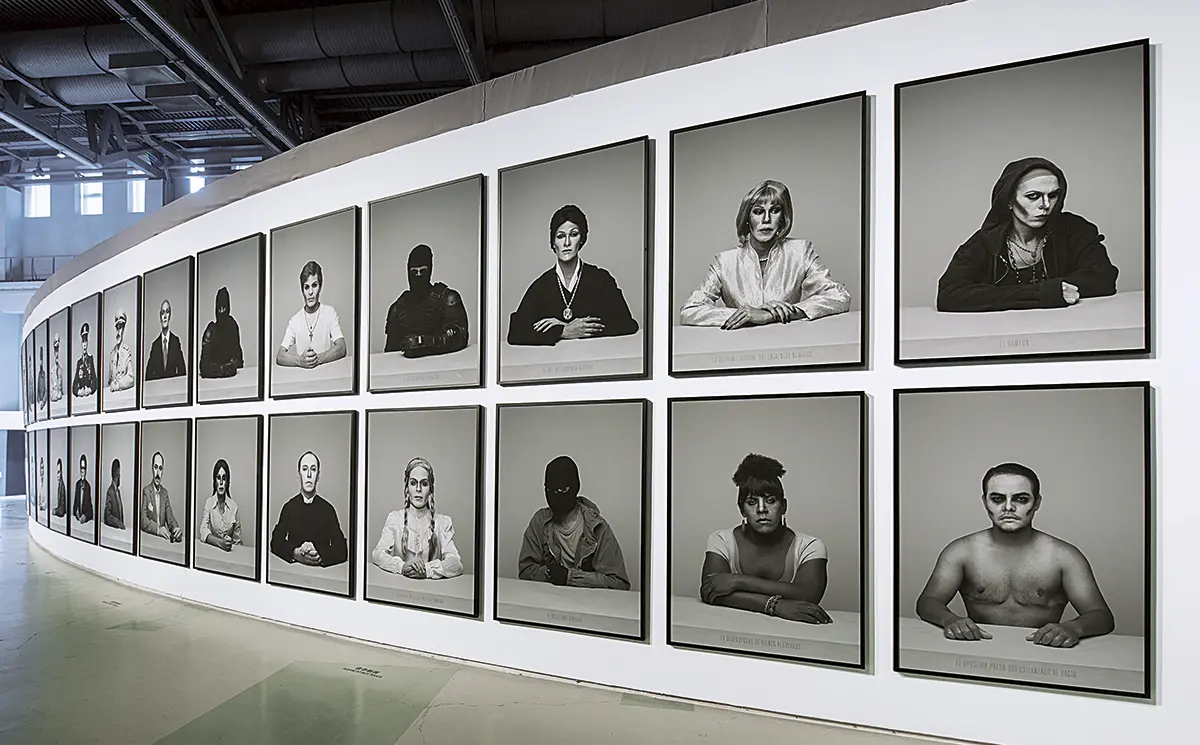
Right at the entrance to the second level, on a curved wall, a spectacular photographic installation by Venezuela’s Alexander Apóstol immediately grabbed visitor’s attention. Known for his videos and photos critiquing the failure of utopian ideals in modern Latin American architecture, in Dramatis Personae (2017-2018) Apóstol presented an entire walkway of portraits. Here he revisited a more directly political and gender-themed critique of the culture, politics, and economy of the last twenty years in Venezuela, transformed employing makeup in monstrous, distorted faces. The curved space allowed Clockwise, an installation by Spanish artist Cristina Lucas, to emulate the curvature of the Earth in an impeccable, minimalistic space that repeated 360 clocks 4 minutes apart from each other, to complete 24 hours.
Despite China’s strong pictorial tradition, examples were few. In fact, Latin America was better represented in the genre, albeit with a selection that pointed towards a more critical, deconstructive approach to materials and subjectivities. One name to mention is Yishai Jusidman, from Mexico, whose series Prussian Blue (2012-2014) was a set of monochrome paintings of great beauty and a powerful if subliminal political implication in the use of the pigment that gave them their name. The reference in the images was based on photographs from the Nazi regime’s concentration camps, where the acid solution used to wash the gas chambers’ walls stained them in that color.
Meanwhile, Savage Economy (2018), Colombian artist Miguel Ángel Rojas’ abstract-pictorial installation, set two murals about the devastation of nature by economic interest, in mixed media using silk-screening, clay, mineral pigments, cardboard, and silver and gold leaf, to confront one another. A separate mention must be made of Yerkish (2018), a pictorial-linguistic installation by Argentina’s Amelia Pica, with a mural comprised of square modules of equal size representing some language of signs and graphics or the communication between humans and other primates. Pica’s modular nodded with a degree of irony towards Joaquín Torres García’s universal language and his structured paintings, or to Lygia Pape and her Livro de Tempo (Book of Time, 1961), among other examples of neo-concrete art.
Curator Medina noted that video is the painting of the Twenty-Frist Century, and this was on overwhelming evidence at the Biennial. Egó Sympósion (2017) a video by Japanese artist Yasumasa Morimura, was a must-see, 74’00’’ and all. Known for his spectacular metamorphoses and characterizations of important historical figures from the worlds of politics, science, and art, Morimura deployed his histrionic abilities in memorable ways in the narrative and staging of twelve icons of Western art, with setups that ranged from the exquisite to the most obviously fake.
New and old names from the international circuit were there for the discovery, of course, but my attention was captured primarily by River by Assault (2018), by Colombia’s Clemencia Echeverri, on the subject of nature and human interference; Jennifer Allora & Guillermo Calzadilla with The Great Silence (2014); or the poetic yet disquieting installation Double (2018), by Mexican artist Rafael Lozano Hemmer, with the “portraits” of his own DNA resembling a virus’ in two high-definition screens.
Meanwhile, the complex gaze of an artist like Pakistan-born, Mumbai-based Nalini Malani, who combines video and photography with drawings and paintings in her video-installation In Search of Vanished Blood (2014), it had with the flow of images in the totality of the space and its subject matter connecting women’s issues, ecology, and maps showing war zones throughout history. Cinema Paradiso (2017-2018) by Yi Lian, referred to the nostalgia-filled Italian film of the same title and a similar, fast-moving situation in China as a result of new technologies. Finally, in Hong Kong artist Samson Young’s installation Muted Situation # 22- Muted Tchaikovsky fifth (2018) we heard only the noise made by the instrument’s friction while a screen showed the energetic movements of an entire orchestra, a collective struggle without the music’s usual harmonious sounds.
In China, everything seems possible, and our idea of the future is here a very palpable present; the overburdened megalopolis and technology-filled everyday life of science fiction film appear almost as an alarming confirmation of dystopia. That is, at least, what we found in Material World Knight a video installation by Shanghai artist Lu Yang, a sign of the presence of such hypertrophic realities in the futuristic context of this Asian nation. Contemplating these displays, I wondered whether the title of the biennial, Proregress, Art in the Age of Historical Ambivalence, was not just a question made by the West in the face of the bewildering reality that China presents to its foreign gaze. Medina and his all-female team posited an intellectual quandary that is most pertinent in Europe and the Americas (and particularly in Latin America), where modernity remains an inescapable point of reference.
In the residues of an avant-gardism rendered inoperative by today’s culture of the spectacle and of technology, Proregress, the word that inspired Medina’s curatorial proposal, sought a recurrence of the role of art on the basis of its subjective experience, a way of allowing us to “tolerate the contradictory forces of contemporary life.” The complexity of our life today surpasses many theories, unable as they ultimately are to explain the confusion and perplexity of our approach, as subjects in transit, to such, diverse, overwhelming, and fleeting reality.
* “Proregress: The 12th Shanghai Biennale” installation view at Power Station of Art. Courtesy: Power Station of Art. Photo: Jiang Wenyi.
DERMIS PÉREZ LEÓN