Pia Camil, born in Mexico in 1980, is a multimedia artist who performs her work and also prepares stages for the audiences to become the performers. Camil’s approach to the work of art is not the traditional one of the creator in her studio, but rather the opposite. The street, informal commerce, the exercise of raised consciousness that occurred among seamstresses after the 1985 earthquake, collaboration across disciplines, and a shifting of the traditional structures of the exhibition, are all imbued in her proposals and presentations.
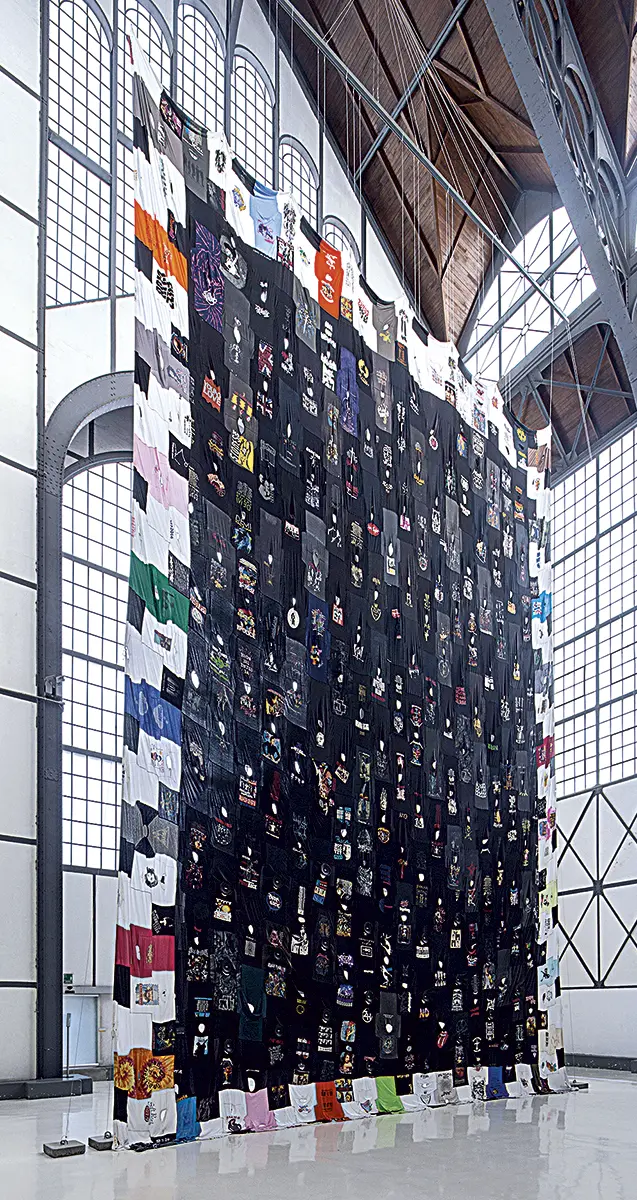
Telón de boca (Mouth Curtain), presented at Museo Universitario del Chopo, exercises the reference in the previous paragraph. Its title also applies to the above-cited approaches by the author. In a building of peculiar proportions in Colonia Santa María de la Rivera, now a museum, the young artist Pia Camil once again conceives the interaction between intellectual and urban-popular elements, between historical architecture and its remodeling, between families, bands, and musical groups, remembered or alluded to. She pays keen attention to the commercialization of t-shirts as a referent for changes in socio-economic relationships. The expansive establishment of informal markets for exchange and resale manifests itself in the t-shirt produced in Latin America for the United States’ market. Overstocks and discarded items create a new level of commerce, from vast quantities to single units peddled in the street. The presence of this kind of markets, known in Mexico as tianguis, was first visible in the Chopo area, thus the importance of presenting Telón de boca precisely in this museum.
Pia Camil’s has had a significant presence in international spaces, but this is her first institutional solo exhibition in Mexico. She has shown in different spaces, including Fade into Black (Savannah, Georgia, 2018) and “Bara, Bara, Bara” (Dallas, Texas, 2017). The t-shirt, commonly used in her actions, was replaced at Frieze, in New York (2018), by ponchos made from second-hand fabric materials, commissioned and manufactured by Frieze Art Inc. In Telón de boca, the preparatory coordination is as necessary as, if not more then, the final result, which is more static albeit sound-based. Perhaps we should say that pre-production and result are inseparably significant.
The roots of Camil’s work go back to the 1960s when the counterculture went on the march: an intense blast of youthful rebellion exploded against established behaviors, beliefs, and socially-sanctioned values. There are those who see that moment as the last utopia of social change. History and praxis prove that it was not, and it has repeatedly reappeared in different formats. There is no exhaustion with Pia Camil’s experiences; she moves fluidly among textiles, her best media.
She worked with designer Lorena Vega to created 150 second-hand T-shirts that she exchanged in the Chopo using barter, as a reference to the tianguis that originated there in the past and expanded the project to include the musical groups that have traditionally performed in the Chopo. Music has been an important constitutive element of the tianguis from the start, and it is central to the museum today. However, Telón de boca did not operate only from a will to memorialize, but as a ratification of the social and market situations that the artist signals. These situations are like pace-setters for communities in Latin America, which have expanded to smash all traditional parameters for buying and selling. Telón de boca includes twenty-four loudspeakers intertwined with the T-shirts, turning into a monumental sonorous textile for the audience and some of the activities taking place there.