Root/Route: A Personal Cartography is the title of the most recent solo exhibition of works by Pepe López (Caracas, 1966). Held at Dotfiftyone Gallery, in Little River, Root/Route…, as the title indicates, presents a kind of personal map of an artist’s intent to delay the fractured identity through a sustained migration process.
Curated by Tamara Chalabi and featuring two-dimensional collages, intervened maps, notebooks, and installations, the exhibition revisits the artist’s biography, taken as a starting point for an exploration of the conditions of uprootedness and transience embodied in the figure of the émigré.
Mapa Boom 07 (2005-2018) and Mapa Boom 06 (2004-2018) are comprised of intervened atlases and maps that belonged to the artist’s grandfather (who migrated to Venezuela, via France, fleeing the Spanish Civil War). Both works, laden with emotional content, generate a new private cartography, marked by personal explorations of emotional character.
As a counterpoint to these two works, flanking the central gallery’s main walls, are the series Plastic (2005-2015) and Root/Route (2018). From a formal standpoint, these series establish a dialogue with the tradition of Concrete Art, so closely connected to Venezuelan modernism and the oil boom. The selection of raw materials is essential in both pieces.
With kinetic-art resonances, Lopez’s elegant series Fantastic Plastic features collages made entirely with vinyl adhesive tape on cotton paper. The menacing black grid seems to muzzle the support in a kind of negation of the promised conquest of the physical space that animated kinetic artists. The superposition of grids, summarized here by a monochrome vibration, emerges as a critic of kinetic art as an avant-garde movement in a modern, prodigal Venezuela under the influence of the oil boom chimera.
Root/Route (2018) is an installation composed of fifty collages made from plastic bags of different origins the artist has collected throughout his travels. The starting point for the installation is the notions of Renaissance grid and purism, so dear to the Concrete movement. Then it moves away from self-referentiality in order to reconstruct personal spaces—the floorplans of homes López has inhabited—that are then sewn onto the paper to give each template a personal charge different from the purism of geometric abstraction. As a monkey wrench thrown at the notions of progress and modernity, the plastic bags—made essentially, again, from petroleum—rally against consumerist society and pollution, and at the same time become a symbol of the migrant’s unstable existence, always carrying their memories on their backs.
These two series are re-readings and negations of Venezuela’s abstract-concrete tradition, defined by its constructive sterility, and the construction of a new map and a new territory (a symbolic territory, since we are denied the physical one). In that sense, Pepe López’s proposal is connected to those from other Venezuelan artists, including Eugenio Espinoza and Jaime Gili.
At the center of the gallery, two displays feature a variety of objects. Never-ending Route and Spiral, both from 2013, are small-format sculptures. Nylon-thread skeins, steel wire, and discarded plastic pieces that, in their playful appearance, contain the drama of an émigré deprived of a secure project and viable goals.
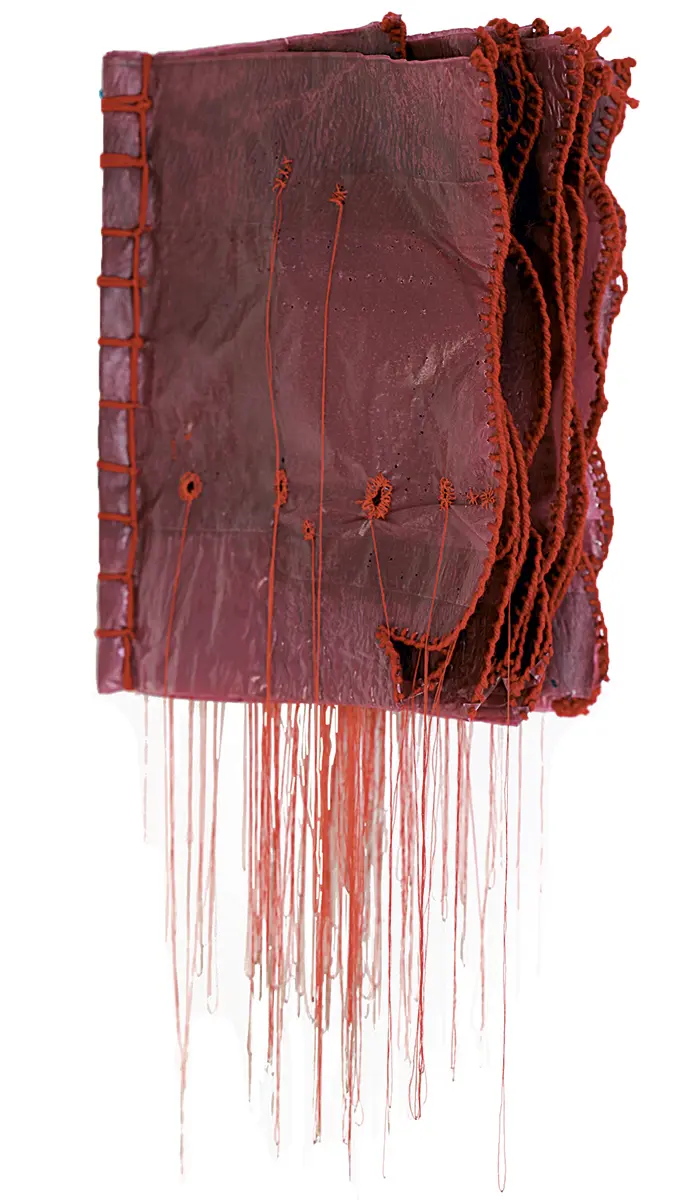
Without a doubt, one of the exhibitions most poetical and at the same time heart-rending works is The Original Story (2018). This small notebook made from hand-sewn red plastic bags, bleeding wool, and cotton threads, that end on pendulum-like needles, resembles a sacred heart image.
The exhibition closes with two important installations: Plastic Roots and Angel Cart, both from 2018.
Plastic Roots is a site-specific installation with plastic bags and adhesive tape. Situated at the center of the second gallery, it forces viewers to walk around it. A more intimate relationship develops with the totem-like vertical structure, which resembles a refugee tent, a wedding dress, or a trash bin.
Angel Cart, conveniently situated in the gallery storeroom, presents us with a replica of the Winged Victory of Samothrace. Substituting for the prow of the vessel is a shopping cart, and it is all wrapped in shiny packing paper. The victorious Athena, an icon of Classical Greece, herself a symbol of migration and plunder, belongs to the series Crisálida (Chrysalis), in which López recovers objects connected to his personal experience and mass displacements in the contemporary era. Amid Venezuela’s current situation, Angel cart acquires an additional, more hopeful layer of meaning. Like the Winged Victory of Samothrace that was taken from the Louvre at the start of WW II and returned in 1945 as a symbol of France’s liberation, a patient yet eager Angel Cart seems to wait, in the vaults of the gallery, the liberation of the Venezuelan people.