Our bodies are evidence of the fact that we are in the world. It is in the body that the processes that define a form of life take place: breathing, eating, reproducing, and many others situated in the interval between physiological needs and physiological constants. However, that is a purely biological explanation, one that excises the complexities of the body immersed in social reality, a time and a place. From a philosophical standpoint (to choose one among many that are possible), Gilles Deleuze’s idea of a “desiring machine” is perhaps most appropriate for an understanding of Paul Setúbal’s work. Because, in general, it situates desire not as the pain caused by the absence of something, but as a process; a drive born not from a distance between subject and object, but from a motion that goes from effect to effect, or from affection to affection.
Born in Goiás and living between Goiânia, Brasilia, and São Paulo, Setúbal explains that everything he creates is directly connected to a concrete situation he experienced. The circumstances of his nomadic life give the artist unique ways to bring lived life and created art closer to one another. The frenzy of life in São Paulo, for instance, reaches him as an exacerbation of the contact between body and society, while in Brasilia, matters of high politics are closer at hand, and what seeps through one’s pores in Goiás are the labors of the land. In all of these cases, the trigger is always a reaction to a specific experience, which Setúbal transforms into a print, a drawing, an object, or a performance, always mediated through the body, which works as a chamber for the development of responses. It is there that the most visceral of the artistic act takes place. It is through the body that an everyday occurrence, whether banal or brutal, transforms into a creative drive that gives the world an artistic event in return—not necessarily a redeeming one, but decidedly resilient. The artwork that emerges from this process is, in general, filled with potential, as if screaming its existence.
A member of EmpreZA, one of Brazil’s most active performance collectives, Setúbal has been developing his solo career on a parallel track for some time now. Corpo Fechado (Sealed Body) at C Galería, is his third solo exhibition and the first one in Rio. Curated by Daniela Name, it features a significant selection of the artist’s work, with the title as its connecting thread. Corpo Fechado is an expression used in Afro-Brazilian religions to describe a person protected against physical and spiritual ills. More than a mere defense, it implies the possibility of joy, the celebration of a force that has been liberated and can be exerted.
Many of Setúbal’s works contain references to the Afro-Brazilian deities known as orishas and their associated religious rituals. The series Armas para os deuses (Weapons for The Gods) features bronze swords with blades shaped like the leaves of the plants known as espada-de-são-jorge and espada-de-santa-bárbara (both variants of viper’s bowstring hemp, literally “sword of St. George” and “sword of St. Barbara” in their common Brazilian names), commonly attributed to the orishas Ogum and Lansã. Due to the repression of religious beliefs and practices under slavery, those deities were fused into the Catholic images of St. George and St. Barbara. In several projects, Setúbal deploys the ironic paradox of the placid-looking plant with a warrior-like symbolic content with great mastery.
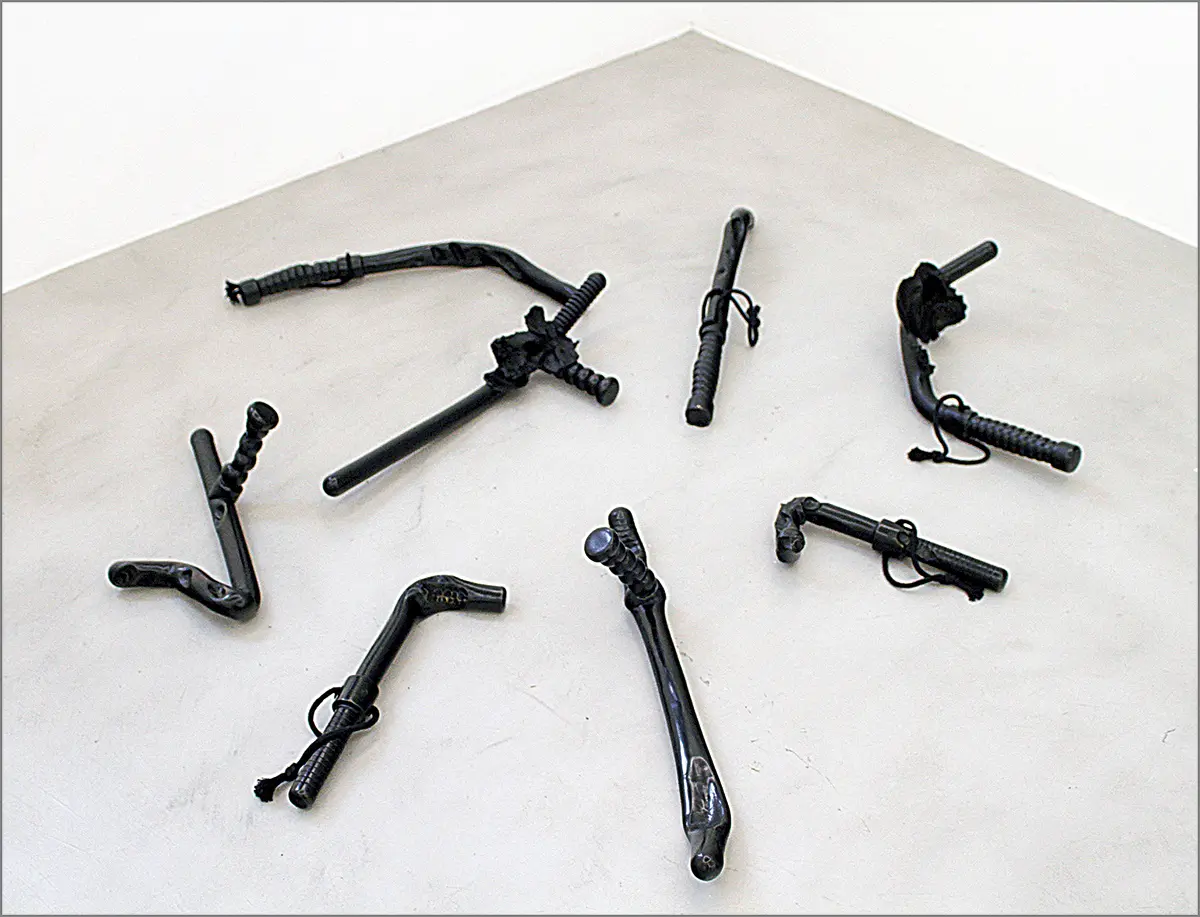
Compensação por excesso (Overcompensation) speaks of situations of conflict with political power. Here, the body appears as resistance to the police, an increasingly common sight in Brazil since 2013. Setúbal’s installation uses bronze batons, twisted or bent, imprinted with parts of the artist’s body as if molded in negative by a blow. The deformities of these instruments of repression bear witness to the clash and are proof of coercive attempts and the corresponding reaction; they show that the body was not intimidated and instead asserted its right to exist and to oppose the existing order. The video Por que os joelhos dobram (Why Do the Knees Bend) complements the installation. In it, Setúbal, dressed in uniform, guards an empty room, a typical white cube. He starts to tap on the empty walls with his baton insistently and creates an experience that reverberates inside the gallery with the familiar sound of hard bows. For Setúbal, this recognition reveals our dormant capacity, as social beings, to hurt others, those bodies that are not ours and, in consequence, perhaps mean danger. The violence against this invisible enemy continues until the artist is exhausted and his instrument of oppression is bent all out of shape by the silent resistance of the walls.
Paul Setúbal gives us the body as a shield, as a chrysalis, and as a harbinger. This body is not a single, individualized entity. It is collective, multiple, and integrative–a body that is legion.
SYLVIA WERNECK