MALBA’s Pablo Suárez retrospective brings together a well-organized selection of one hundred works by the artist (Buenos Aires, 1937-2006), chosen based on a research project by curators Jimena Ferreiro and Rafael Cippolini, along with the museum’s curatorial department. As soon as we cross the entrance to the exhibition, Suárez’s unique universe evolves over four fruitful decades that clearly express his commitment: a critical articulation that connects several generations in a specific prevalence of “the plebeian.” Some of the valuable traditions in Argentinean art that emphasize the grotesque as the metaphor of a degraded culture, defined by the critic Jorge López Anaya as “an authentic, iconic lunfardismo,” are folded into Suárez’s mythology.
Suárez’s forceful materiality, his use of planes and space, the human figure and its absence, unfold in three large galleries in the museum, with the goal of analyzing in depth both the artist’s legacy and the place he occupies in the history of Argentinean art. Two important essays about Suárez’s work have been collected in one volume, where Ferreiro and Cippolini shine a spotlight on the historical context that is woven into his production and his unique contribution of the male nude, which adds to the national canon “a nude for which there were no precedents.” In the first gallery, we encounter an emerging Suárez, associated to a kind of informalism that closely follows Alberto Greco, who accurately determined that these works possess an element of “drama” and attempt a kind of “hidden figuration, difficult to discern.”
Suárez’s works from the 1960s leap towards the characters in Muñecas bravas (Fierce Dolls), from 1964, inaugurating a combination of plane and volume with intensely grotesque female figures that are closely connected to Antonio Berni’s series, in a different social register. Those figures were anticipated in La menesunda, perpetrated by Marta Minujín and Rubén Santantonín, with Pablo Suárez’s collaboration. From that moment on, Suárez never abandoned figuration or his pleasure in detail, even as his work includes elements that escape a simple classification as caricatures, and every object or character in it provides a reservoir of meaning. His strident bottle-blonde figures coalesce into a character that will continue to be central, a figure he dubbed “the secretary,” capable of playing many roles, where desire, drama, absurdity, and humiliation are the clear signs of social critique. In 1968 Suárez sent Jorge Romero Brest, the Director of the Di Tella Institute, a letter renouncing to participate in Experiencias 68, with arguments like his “moral inability to continue with the rhetoric of an illusory confrontation with institutions, when in truth the phenomenon of art is taking place outside, in the streets, in life.”
After the ascent of the dictatorship, Suárez abandoned the Buenos Aires scene for San Luis province, seeking refuge in a type of painting that explores Argentinean pictorial traditions like those embodied by Fortunato Lacámera, Gramajo Gutiérrez, or Molina Campos. These works were presented in isolation to a more intimate circle, and one perceives in them the absence of human figures; with great technical mastery, they depict plants, tables, or chairs. A special element stands out: shadows that appear as if in the background, yet neatly outlined. Ferreiro recognizes here that “their edges are net, and the effect is ghostly. The surveillance and control system of the time seems to have been concentrated there, disturbingly, like stalking, and the shadows, have been transfigured into unknown subjects.”
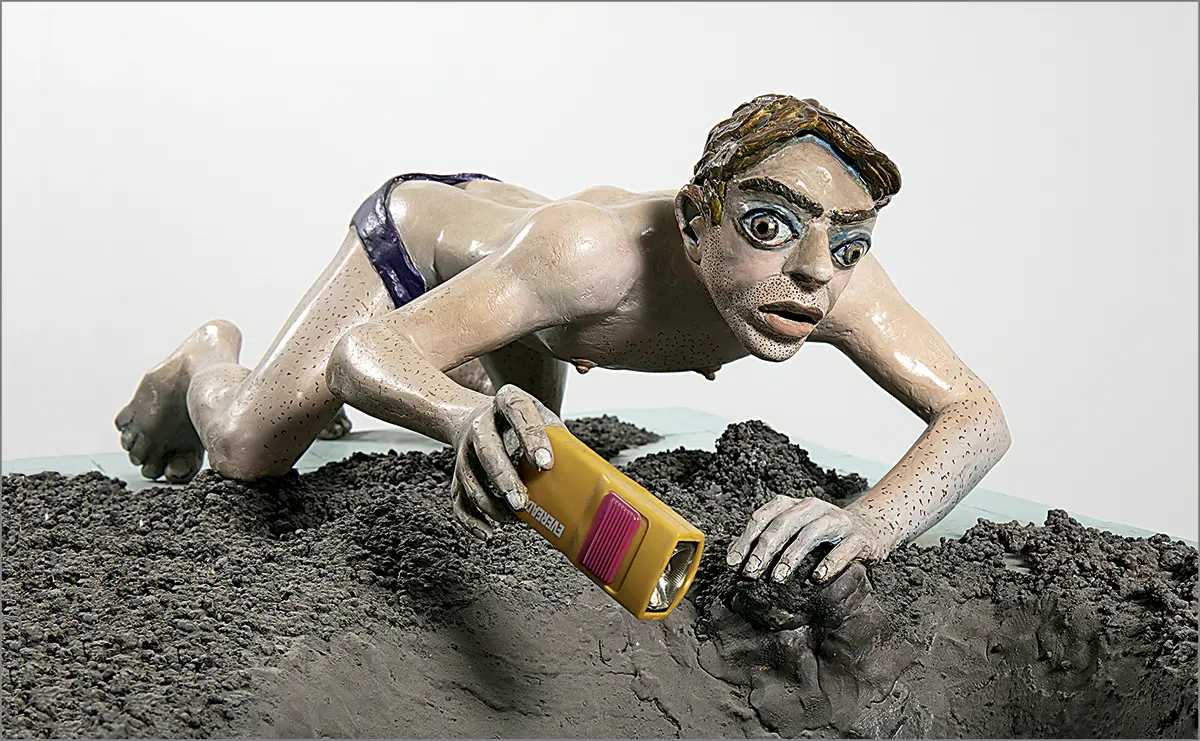
After the country’s return to democracy, Suárez moved back to Buenos Aires and settled in a rather un-European neighborhood, Mataderos, the city’s old abattoir sector. The largest room of the exhibition centers on Narciso de Mataderos (Narcissus From Mataderos), a sculpture that establishes the canonical form of the chongo, a lunfardo word that defines a “strong, virile, young, lower-class active homosexual.” Chongos gradually gain a more significant presence in Suárez’s work. They provide a disturbing window into a code—at once aesthetic, sociological, and anthropological—for the representation of a classless space that will include a variety of motifs, such as the toad-men, the climbers, and the diggers, all of which signal towards a cruel human tragedy and openly refer to folk expressions.
PILAR ALTILIO