This exceptional and beautiful exhibition by renowned Colombian artist Olga de Amaral features thirty works produced during the last fifteen years of her long and prolific career. Recognized for her textiles, Amaral has long gone beyond the craft of weaving to create unique combinations of fiber, paint, gesso, and precious metals that transform the material into the immaterial. A highly awarded and exhibited artist of international reputation, she founded and directed the textile department at the University of the Andes in Bogotá in 1964 and continues to be a major supporter of the arts in Colombia through her workshops that employ local women to assist with her projects, thus working with her to preserve their rich heritage. In the ancient Andes of Colombia, Peru, Ecuador, and Bolivia, gold, silver, and copper were the favored materials for materializing a belief system through body ornaments and ritual paraphernalia. Gold was the Sun and Silver was the Moon, and they were not revered for their monetary value (as they are today), but for their association with the nature gods and goddesses. The brilliant metals had eternal value; changeless and immortal, shiny, malleable, rare and costly. The colors paralleled that of the sun and the moon, and such precious materials became expressions of the divine. To look at an Amaral textile, shimmering with gold, is a transformative experience that is as modern as it is ancient. The metals are on cloth, the other most precious material of the ancient people, and like the high quality of their metallurgy, weaving displays a symbolic language on some of the most complex textiles ever produced.
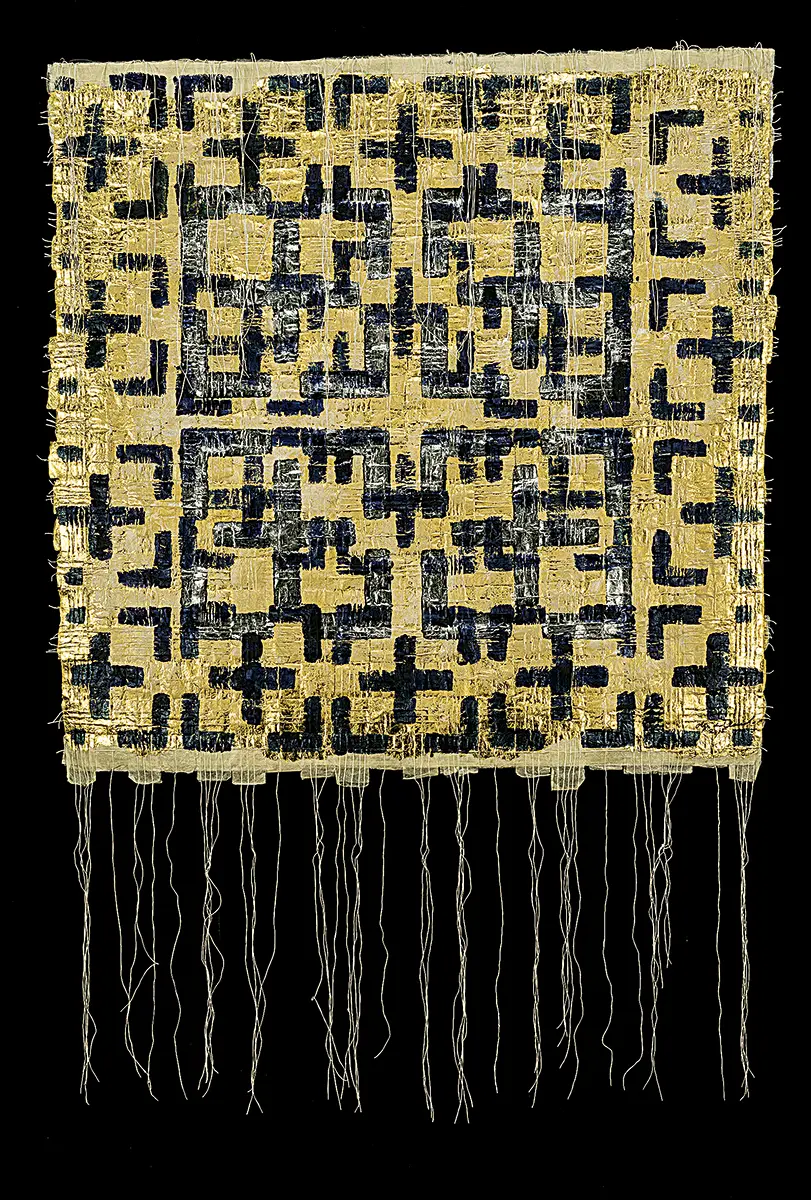
The art of Olga de Amaral combines extraordinary techniques to create a personal lexicon of symbolism inspired by the past. She begins with strips of fabric – linen and cotton – that become the warp and the weft of her weavings. The strips are coated in white gesso to stiffen each one and heighten their austerity while preserving the imprint of the cloth’s texture. Rice paper is the next layer, then the color, often gold leaf but in this exhibition, there are blacks, indigo blues, moss greens, and reds revealed either on the surface or beneath (like the ground for the gold on a Byzantine icon). Cobalto, 2014, is made of silver (Palladium lead) and indigo blue for an interesting diversion from the gold weavings. In Alquimia, 2007, one of the most impressive works in the exhibition, the weave is interrupted by loose green threads further complicating the surface texture, while never interfering with the gleam of the gold. Many of her weavings are manipulated to produce swirls and undulating patterns, like vast landscapes in time and space, or pulled to reveal threads or smaller strips in complex designs. In one series, she also inserts precise cuts of bamboo, and small round pegs fit into the weave. Each work delivers a visual message created in shimmering cloth. Corteza, 2007, reveals an imaginative landscape formed by complex weaving that lures the viewer into its very soul. Such transformative effects appear throughout the exhibition. Pueblo moves with a spiral rhythm that recalls Pre-Columbian designs in ceramics and metals, while Fossil with its dark blue threads and circular patterns is far more dramatic. The patterns In Nebula #7 and #1 are made like the gold filigree of a Pre-Columbian ornament, paying homage to the great craftsmen of her homeland. Throughout, the designs replicate textile patterns, ranging from the geometric forms to abstract swirls of symbolic meaning, and ceramic designs hundreds of years old.
The installation in the center of the exhibition has four hanging panels, titled Estela, 2007. Their weaving is heavily laden with gesso and thick paint to create the effect of a forest of ancient monuments with gold surfaces. The backs are raw paint, adding to the ethereal and sacred environment, like architectural remnants of a lost civilization. It is the beginning and the end of a mesmerizing experience infused with the memories of an ancient world.