Phenomenology has made us aware of the existence of an intimate relationship between our corporeity and the world. In one of the side notes in “Phenomenology of Perception,” Maurice Merleau-Ponty wrote: “There is no distance between the world and the body because the world is also flesh.” Personally, I like this phrase because it completely erases the dividing line between the world and the body. More mental than real, this notion of a gap between the two does succeed in establishing a distance between them. More often than not, it is a misconception that leads to wrong ideas about being in the world, equivalent to a thing merely taking up space in a given place. However, being in the world is much more meaningful than that, as Martin Heidegger had already explained masterfully.
The German philosopher’s existential thinking is what inspired Luis Aristizábal to exhibit the work by Nicolás Cárdenas titled “Being There” at LA Galería Arte Contemporáneo, in Bogota. About this, Aristizábal said: “Dasein, which in German means ‘being there’ or ‘presence,’ was the condition found by Martin Heidegger—for many, the most important philosopher of the 20th century—to rethink the meaning of human beings and their essence. He further addresses the purpose of an existence that, pro(ject)ed to the world, to there, commits to the pursuit of our ability to be—to find and understand the state of being; a state that ultimately cannot be sustained because of the transient nature of existence. The inhospitable future of being and the anguish generated by its condition has distanced us from its essence. The history of the Western world is the story of forgetting to be, of the inappropriate existence in which the world, the surrounding environment, time, even us, everything, has been turned into a resource for production, for the accelerated transformation of a ‘there’ that only answers to the laws of capitalism, consumer society, and technology.”1
From this perspective, the work by Nicolás Cárdenas points to a series of tensions between the body and the world in which equilibrium is fragile. Such tensions seek to find a balance precisely through an ecological perspective offered by the landscape. However, Cárdenas unusually approaches the landscape: the bucolic idea that had inspired a good part of his art no longer shows the domesticated natural scenes that seemed as if they could be serenely contemplated through a window. Instead, contemplation gives way to a true state of being there that emphasizes existence. It is as if the window had been ripped from the wall and replaced by a platform or territory-image for viewers to experience. One of the theses that Cárdenas has been advocating for some time now proposes that the usually passive viewer takes on taken on a new role: that of the activator. Today, contemporary art makes this once a passive figure visible, more active. Therefore, a mutation takes place during the transition from spectator to an activator, and a proposal like “Being There” by Cárdenas succeeds in showcasing this new contemporary art protagonist.
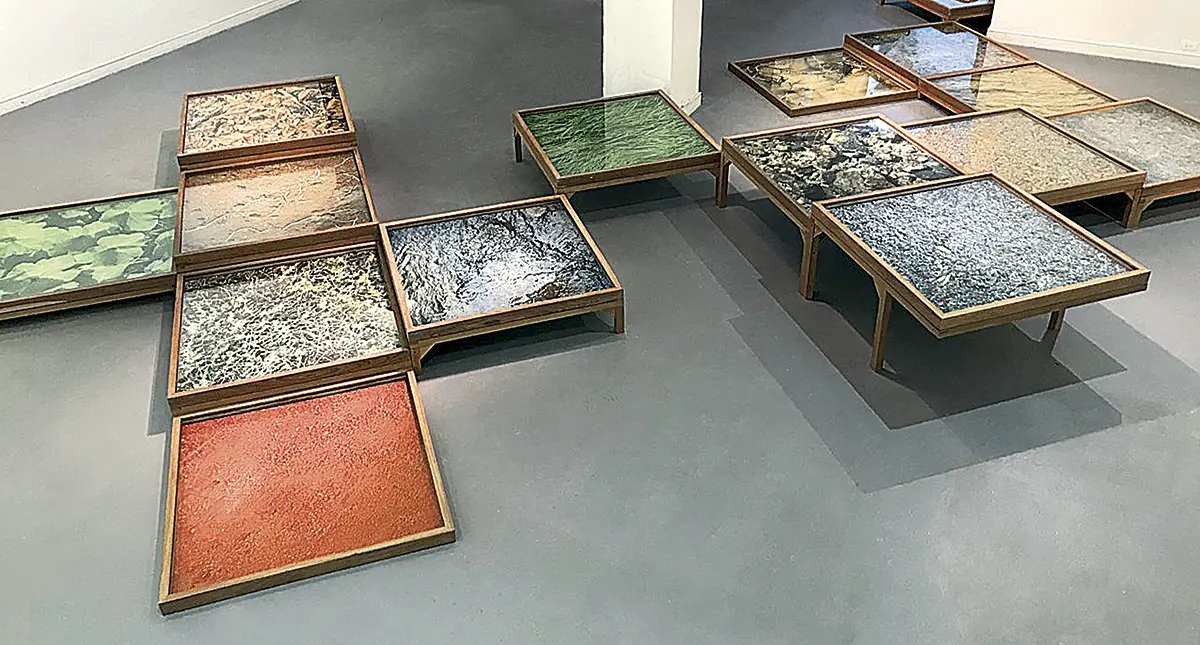
So the windows—works were replaced by a structure formed by several square meters of photographic images with wood frames protected with security glass so the activator can walk on them—have been installed on the floor. The images captured by Cárdenas are fragments from different types of landscapes. The quality of the images is so high that they seem like fragments of real territories. On the other hand, the one square meter idea establishes a close connection with the commercial value of the land which, in the real estate market, is speculative. Here is where the work opens a necessary debate centered on the effect of capitalism and the markets on the fragile ecological equilibrium. In our context, for example, real estate speculation is common practice in those areas highly coveted because of their natural value. This work by Cárdenas succeeds in opening an aesthetic debate on the matter. Additionally, stepping on that square meter of landscape-turned-into-an-image also focuses our sensibility and awareness on that which we are standing. If there is an aesthetic and ethic contribution in Nicolás Cárdenas’s work, it is precisely shedding light on the meaning of treading on a territory.
By observing the activators walk through the installation, we are also able to witness how awareness eventually leads to pure, unadulterated playfulness. We are surprised by the idea of stepping on artwork and by the realization of being, existing at that moment. Here, there is an extraordinary coincidence with the anti-work Fragmentos (Fragments) by Doris Salcedo, which allows the activator to step on what originally constituted the work. It is an action that desacralizes the notion of the immaculate work of art, given that the piece in question has been created to be stepped on, but not trampled. The awareness of being there, existing there, is accompanied by being careful when stepping on the work. “Could one break it?” or “can I stand on it?” were questions that I heard from the activators who could not contain smiles of satisfaction.
Another exhibition room showed a video that featured (if watched patiently) a cloud passing over a mountain. Here, contemplation once again strengthens the aesthetic experience by insisting on pausing to observe, something that has practically become a real privilege.
A work placed in the same gallery was practically unnoticed. It featured a white on white drawing subtly drawn across the entire gallery wall with words that formed a landscape: the names of fruits, including pineapple, star fruit, melon, pineapple, and guava; names of trees and plants, birds, insects, and other animals; as well as the names of rivers and different types of terrains. The words on the drawing generated a horizon line. Only a few activators saw this work. This fact seems great because it illustrated a particularity in this proposal by Nicolás Cárdenas: an ability to make something visible that we would otherwise step on without noticing, while also making something that would ordinarily be easy to disappear by directing our attention to this square meter on the floor. I consider this piece especially wonderful.
One square meter of dirt embedded in the floor by the gallery entrance becomes the entrance mat. Here the image turns sculptural as a square meter of soil is recreated with all the natural elements that can be found in it. This generates a tension between representation and presentation, on the one hand, and in the fascination, we experience by not being able to ascertain reality from fiction, on the other.
Indeed, Cárdenas’ work proposes a rigorous inquiry into the restricted idea of being-in-the-world. “Being There” corroborates that we are the world. Moreover, by recognizing the importance of that existential dimension, territories suddenly become body and flesh, leading up to the idea (essentially of ecological and poetic nature) that whatever you do to the world-body, you do to your territory-body. This is tied to a certain anachronism well-known by the so-called primitives. At play is a poetic idea (in the strict sense of the world) of habitation that is very dear to Heidegger and Gadamer. I explored this concept in an essay written a while ago titled Poésie: l´habitation de l’inhabitable [Poetry: the Habitation of the Uninhabitable]. As I indicated: “In this manner, and for our purposes, the being in the—poetic—habitation must be understood not only as construction but also as to how we assume the open space, as overcoming the limits and as the very essence of inhabiting. The habitation of the uninhabitable is performed for poetic purposes and in poetry by thinking and pronouncing openness, which is the same thing as a call for freedom.”2
This body of work by Nicolás Cárdenas confronts art, nature, and science in a clear manner, without pretension, but with conceptual depth and technical mastery. When one steps onto his work, when one stands there, it becomes possible to observe what is happening in that square meter and to assess its symbolic and existential value independently from any commercial worth that the pieces may have.
NOTES
1. Presentation text of the exhibition written by Luis Aristizábal.
2. Ricardo Arcos-Palma, “Poésie: l´habitation de l’inhabitable.” Cahier de Poétique No. 9. Université de Paris VIII, 2003, p. 65.
RICARDO ARCOS-PALMA