Activism can be expressed in several formats and usually occurs out on the streets. Performances involving nudes and fake blood. Banners with skulls and bullseyes. Mass sit-in protests with chains and handcuffs. Denunciation can also take the form of resin on paper and be carried out at an art gallery. While the action may not be as explosive, it is also possible that the actual reason behind the protest takes a backseat.
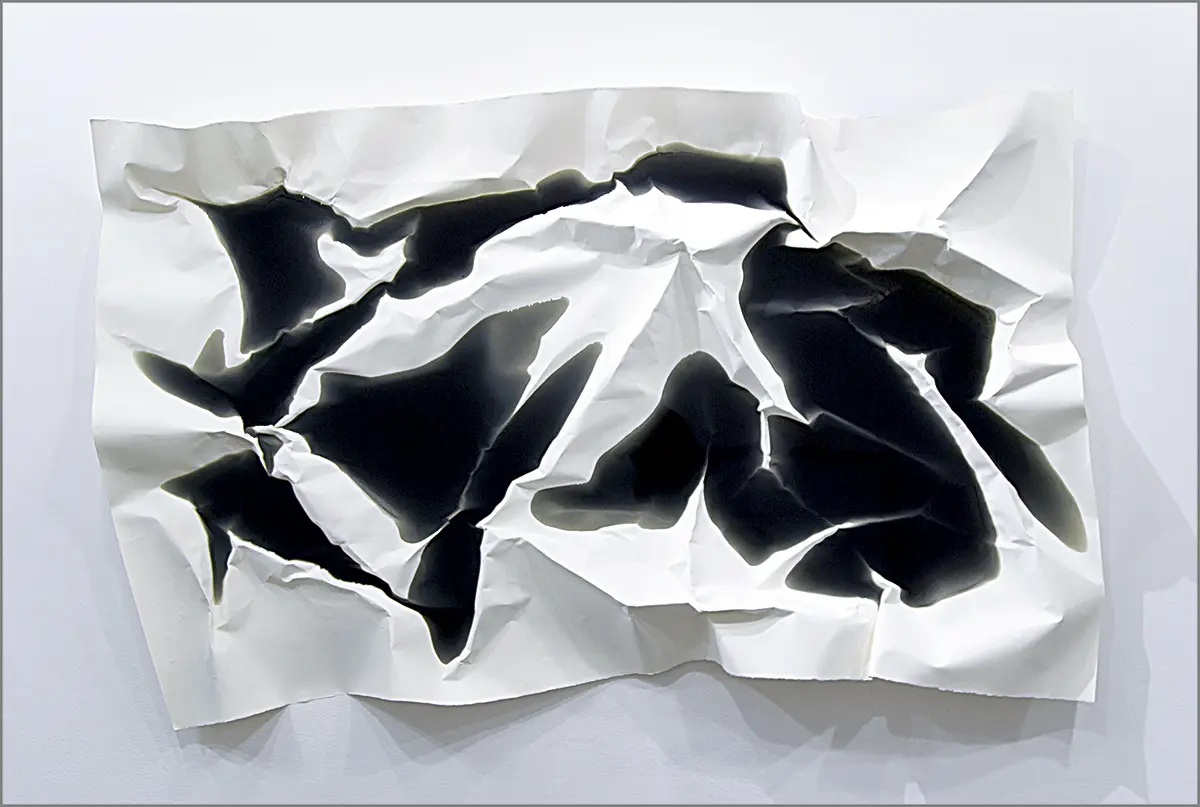
In his first solo show at the gallery, Miler Lagos (Bogota, 1973) experiments with form and its connection with content. The series featured in the exhibition, comically titled “Lakes,” consists of several works, half-way between sculpture and painting, created with epoxy resin and heavyweight watercolor paper. Miler Lagos tenses the materials in order to relax the message. He “crumples” paper and fills its cavities with red or black resin, forming with the resulting high reliefs the schematized and aestheticized miniatures of an invented topography. Surrounded by small white mountains, the artificial lakes hang vertically on the walls. The materialization of that impossibility provokes an uncomfortable reaction, the feeling that the lake’s content will spill on the gallery floor. It is an uneasiness associated with the meaning viewers can grasp even without knowing the context. The domestication of nature in “Lakes” connects with the exploitation of natural resources.
While the paper industry and the usufruct of minerals are the backdrops for these works, Colombia is the actual terrain on which this creation settles. Colombia is a country with nearly two thousand lakes, many of which have become sites for the exploitation of minerals and have suffered from the pollution from the sewage generated by the irresponsible management of adjoining factories. Black waters. The cartography outlined by the works resembles the Andean mountain range and, therefore, the veiled criticism also addresses the deforestation caused by logging companies. The conflict can be stained with blood, just like some of his red resins on paper. However, as pointed out at the beginning, denunciation is not the priority in Lagos’s proposal. In that case, the humor disconnected from the object of repair would have had not taken place - see the title of the exhibition, or some of the works’ such as Lago ballena con papada (Lake Whale with Dewlap), suggested by the artificial lake’s shape-. Ethical aspects would have been approached more carefully: it would not have been possible, for instance, to denounce indiscriminate logging to sale paper with works created on watercolor paper to sell art. What we observe and experience at the Galería Max Estrella is a contemplative and reflective occurrence, and the most significant stimulus comes from the brilliant technical mastery of an artist who had already worked the raw material in question—in proposals like Anillos del Tiempo (Time Rings) or Cimientos (Foundations). The series “Lakes” is presented atop a wooden structure, but this time in a natural environment surrounded by vegetation. Wrinkles and aquatic evocations—muddled but reflective nonetheless—are also present once again. Paper—and trees before—suffer.
Miler Lagos is an artist interested in involving viewers, but also in the possibility of bringing awareness through his creations. In the last edition of the International Art Fair of Bogota (ArtBO), he received the Kubik Award for his masterfully rendered monumental interactive installation Rainmakers. It consisted of a giant wooden wheel that could be used by the public to activate a watermill. The work served as background for selfies and attracted the attention of visitors who, by activating the watermill, became the animals that power it, its brainless machinery. Subtly, like in “Lagos,” the artist questioned the consequences of speculative capitalism, the destructive actions of insatiable humanity.