Throckmorton Fine Arts gallery presents an elaborate retrospective of versatile and prolific artist Miguel Covarrubias. Viewers who came to see it had a chance to cover everything at a glance. One perceived softness, drawing, elegance, diversity, subtleties in black and white as well as in watercolor and graphite. The gallery is recognized for exhibiting strong and harmonious works, mainly Latin American photography, and for being a foremost specialist on the subject. At the same time, pre-Columbian and Asian categories coexist in the space, in an alternating sequence. With a museographic design of both groups and individual items, this “Retrospective…” includes paintings, drawings, and caricatures by the Mexican illustrator, anthropologist, archeologist, and ethnographer Miguel Covarrubias (1904-1957).
The name of Miguel Covarrubias and his body of work are known to specialists and connoisseurs of the art of his era. He has been included in group exhibitions of Mexican art from the first half of the Twentieth Century, but he certainly merits solo shows. Mexico City’s Pablo Goebel Gallery organized a similar show in 2017-2018, titled Recorriendo el mundo del chamaco Covarrubias (A Journey Through the World of the Covarrubias Kid). Since his stay in New York, Covarrubias’ name became familiar and treasured not only in the city but also in the international scene of the era, for the intensity and expansiveness of his work, exhibiting in Mexico and expanding the circle of renowned artists of the Twentieth Century. Something similar happened with regards to Mexico’s indigenous cultures and with interest in cartography and dance, added to the significance of repeated visits to Bali and Covarrubias’ promotion of that place. Two things are often mentioned when presenting him, and they must be considered. First, Covarrubias married at a young age, and his wife was a dancer, which gave him entry and interest to that world, its backstage, and its photography. Second, among his many activities, one must not forget his work as a teacher and an institutional manager. Among other things, Covarrubias taught Art History and Anthropology at Mexico’s Escuela Nacional de Antropología e Historia. Everything he did seemed natural, like the flow of lines in his drawings.
Capturing the various cultures among which he was raised, the ones he experienced, and the ones he visited in his travels was a natural motivation for Miguel Covarrubias.
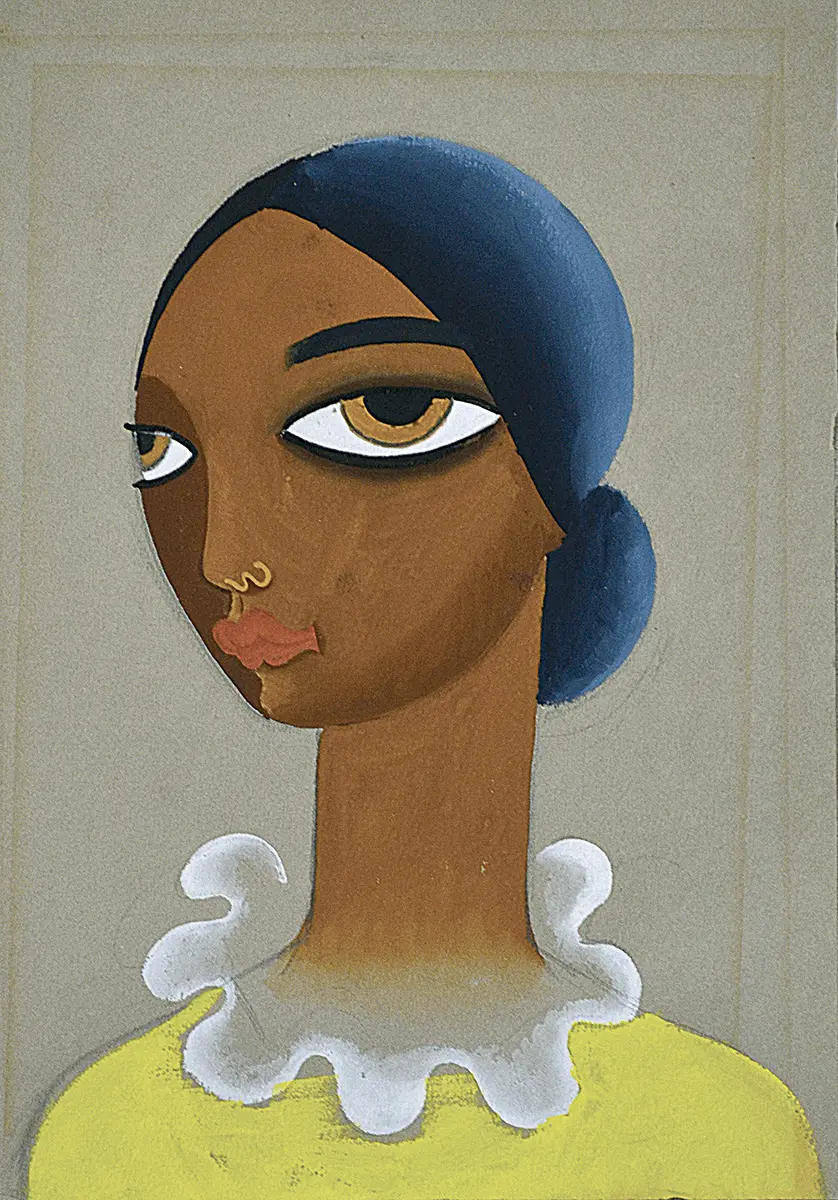
His works attest to his observation of people, their proportions, movements, and interests. Plants and animals also attracted his gaze, and his drawings were at both ends of the spectrum in terms of size and technique: from small formats—20 x 12 cm and similar sizes—to gouaches and lithographs—on average 60 x 90 cm—to a commission of six murals with international significance. In 1930 Covarrubias married dancer Rosa Rolanda. She learned photography from friends Edward Weston and Tina Modotti. The couple took a long trip to Southern Asia, with Bali as a particularly appealing place. They would return there to finalize their book La isla de Bali (The Island of Bali), with texts by Covarrubias and Rosa’s photographs, which gained international recognition. In New York’s exhibition, alongside Miguel Covarrubias’ written observations and his delicately exotic drawings and watercolors of the period, there were works like Sin título-Desnudo balinés (Untitled–Bali Nude); Bali Maiden; Retrato de una mujer filipina (Portrait of a Filipino Woman), and even Perfil de mujer con cuello (Profile of Woman with Neck), made in China. His interest in indigenous Mexican peoples and the Series de Harlem (Harlem Series) are yet two more aspects of Miguel Covarrubias’ anthropological motivations during those years. Less common in his oeuvre but not less notable are his works depicting birds and fish, as can be seen in Langosta (Lobster), in graphite, ink, and watercolor on paper.
Listing Covarrubias’ themes, materials, and applications is a simple solution that nevertheless does not show his powerful creativity in its proper dimension. It is fairer to focus on analyzing his creative ability to compose each subject without repeating himself, as illustrated in a simple and pleasurable way by pointing to the many angles from which he drew frontal images of his wife, Rosa Rolanda, as well as many other portraits. The secret is not to say “portrait,” “figure,” “nude,” “dancer,” or “caricature,” but to observe the repertoire of bodily tilts, the contours of the dancers like elongated vertical “S” figures, diagonal, isolated, in pairs or groups. The full-figure illustrations of women, be it three-quarters to the left or the right, lightly posed on some steps or surrounded by stairways, accessories, pillars, and—logically—wearing hats. Everything that the Covarrubias “kid” did he did in total immersion in his environment. His gaze came from an analytical vision filled with a soft-edged sense of humor. There was no grotesquerie in his intentions or his results. Depending on the subject matter and destination of a given work, Covarrubias found varying degrees of elegance. One word describes him: multifaceted. He is the author of stylized compositions, themes, techniques, and materials of high variability, simultaneously defined and undefined in space.