In the exhibition spaces of SN maCarena in Bogota, Mariana Varela showed two projects concurrently: “Cross-stitch” and “Inextricable.” The former alluded to the female condition and the latter to the landscape; both approached from the point of view that subtly established connections between the violence perpetrated against women and nature.
“Cross-stitch” consisted of three small oil paintings on canvas, two videos, two embroidered images, and three charcoal drawings. The title stated the project’s intentions: to transform embroidery, the cross-stitch technique specifically, into a “metaphor for life and death, courage, reminiscence, and presence,” as it relates to the female condition in a world that is hostile to women.
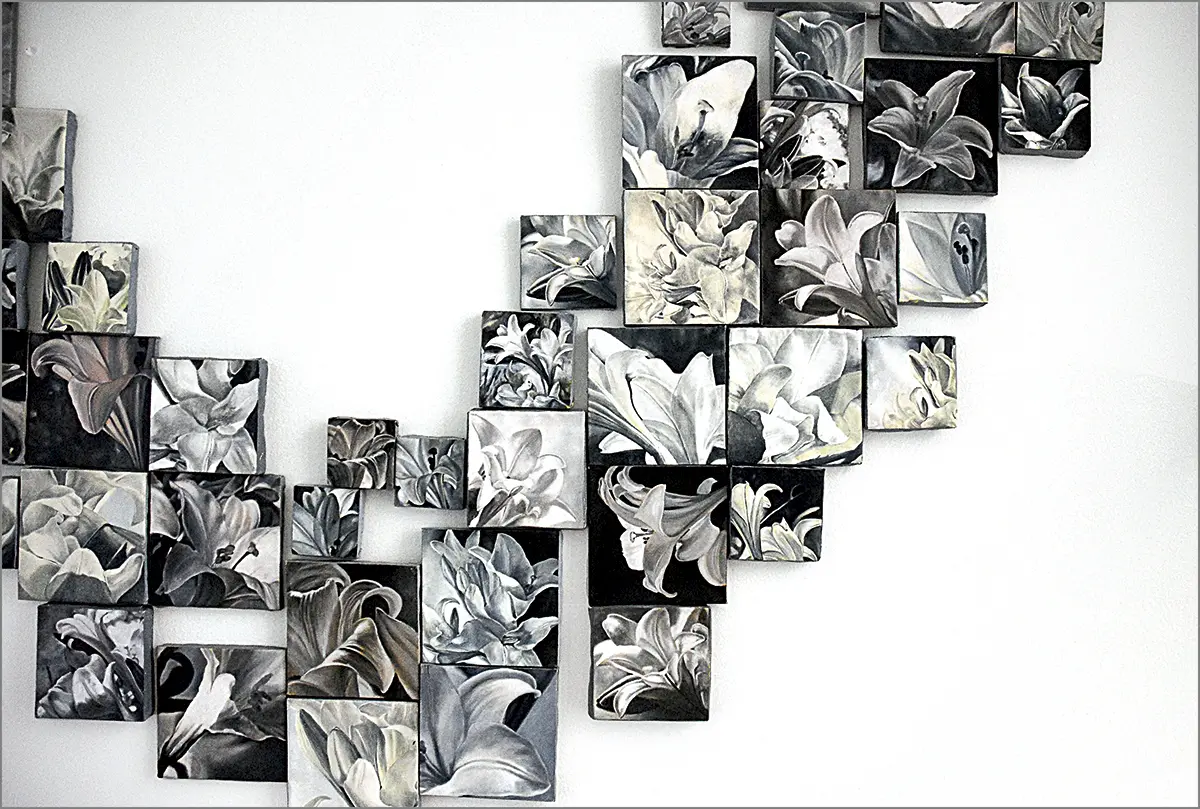
Throughout history, embroidery has been associated with a female practice of delicate handwork that also entails meditation, patience, and the embellishment of daily life. With the same dedication of an embroiderer, Mariana Varela adopted, as she often does in her work, a realistic language that, in the case of the oil paintings, justified “a clear attempt to achieve female inclusion through the individuality represented in every flower fragment.” She achieved this objective through the meticulous work that patiently rendered several tonalities and rich forms of lilies and roses on 217 small lightly tempered canvases. The lilies and the range of whites, which at times bordered on violet or showed light hints of yellow, served to offer a tribute to women, to their persistence and delicacy. Roses, on the other hand, often referenced in literature and poetry, alluded to “women’s sexual anatomy, an important and fragile point in terms of being a target for aggression, both during times of war and in everyday life.”
Cross-stitching was, for a long time, exclusively a handmade practice. Today, technology allows machines to be programmed to weave and embroider all kinds of motifs. Mariana Varela entrusted an experienced female embroiderer with the accurate reproduction of Girl Crying by Roy Lichtenstein, and a fragment from Rogier van der Weyden’s Descent of Christ from the Cross depicting the crying eye of Saint John. On the other hand, with an impeccable mastery of charcoal drawing, Varela recreated fragments from Albert-Ernst Carrier-Belleuse’s Leda and the Swan, Artemisia Gentileschi’s Susanna and the Elders, and Anne-Louis Girodet’s The Entombment of Atala. In all instances, Varela renders with a high degree of realism works that “attest to some of life’s conditions experienced by women throughout history.”
The detailed depiction of the elements represented in this project and the painstaking work involved in their rendering were achieved through the temporality evoked by embroidery to address intimate time spent by women. According to Mariana Varela, women “wander through life light as a breeze, like fleeting clouds,” bearers of life who are at the same time often “subjected to attacks and aggression.”
“Inextricable” consisted of an installation formed by 475 small oil paintings on silk. Each painting was attached to the wall with invisible pins from its upper border in such a way that a light breeze or any slight movement in the exhibition space made the fabric flutter gently. The motifs on each painting consisted of landscape details: close-ups of foliage, leaves, water, and fish. Like a breath of life flooding across the four walls of the exhibition room, the delicate presence of the installation had a surprising effect on the viewers. The breath of this unique landscape relates to something experienced by Marina Varela at the end of the 1990s, when she visited the Gulf of Urabá’s banana plantations, in Colombia. While flying over this region, she marveled at the beautiful and ordered shape of the landscape down below. However, once she landed and traveled through the territory, she became aware of the chaos that dominated the place. The fallen and trampled leaves that paved the ground also peppered with the plastic bags used to collect the fruit, along with the infiniteness of a field entirely dedicated to single-crop farming, attested to humankind’s abuses against nature. At the same time, she remembered the bitter history of the region, especially one of the worst massacres in the history of Colombia which took place in the town of La Chinita, in 1994. In response to this display of brutality and violence, Mariana Varela offered a breath of life of undeniable and overwhelming beauty.
MARTA RODRÍGUEZ