A powerful creative pulse traverses Luis Zerbini’s work. His poetics, framed by an imagistic voraciousness, were on display in a recent solo exhibition at Carpintaria, in Rio de Janeiro. Seven large-format paintings, alongside three monotypes and a sculptural table, reasserted the markings of Zerbini’s complex visual vocabulary, developed throughout more than three decades of activity. The confluence of figuration, abstraction, and geometry appeared once again as the epicenter of canvases the artist considers “an expanded field of possibilities, here framing the viewer’s gaze, there building immersive windows that reveal subtle figurative vestiges.”
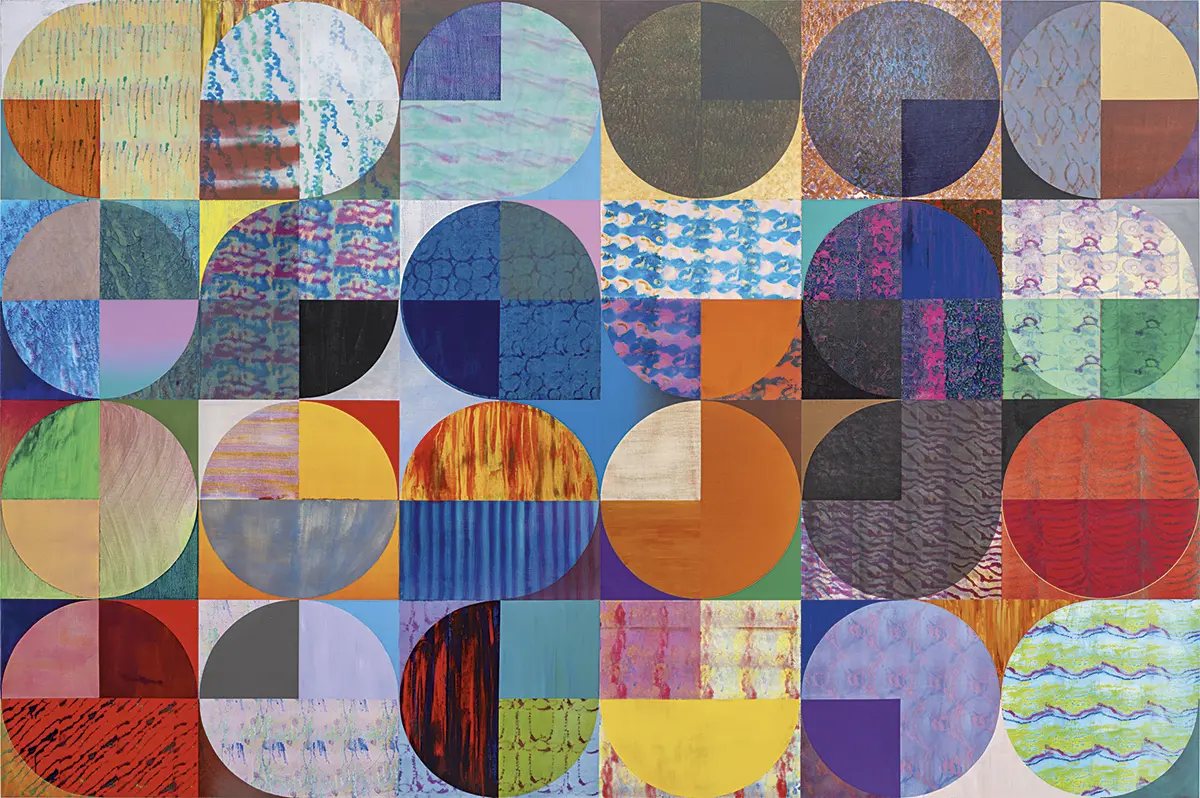
In the paintings included in this exhibition, Zerbini moved even more in the direction of the geometric abstraction field with grid structures that explored relationships between color, light, and object. Gemini (2018) and Vento Voa (Wind Flies, 2018), for example, revealed a malleable approach to geometric systems, favoring a joyful contemplation in contrast with the rigors that are usually associated with geometric abstraction. Despite the seeming absence of the recurring images from the artist’s repertoire—sea waves, vegetation, noise—these works allude them by playing with transparency and opacity, processing chromatic experiences that appear as key elements for the creation of a vibrational field, as in Espiral (Spiral, 2018).
With images that speak of people, places, architecture, nature, and time, Zerbini has been building a journey that is expressively marked by a collision with the formal consequences of painting, its meanings, challenges, and limitations. Even when detouring from painting as such and exploring the creation of objects, installation, video, and collage, the artist remains firm in his purpose of investigating in the utmost depth the contemporary possibilities of the image.
Born in São Paulo but resettled in Rio many years ago, Zerbini was included in the landmark 1984 exhibition Como Vai Você, Geração 80? (How Are You Doing, 1980s Generation?), which featured works by Leda Catunda, Jorge Guinle Filho (1947-1987), Beatriz Milhazes, Cristina Canale, Daniel Senise, and Leonilson (1957-1993). That exhibition, held at Rio de Janeiro’s Parque Lage Visual Arts School, helped define the return to painting in 1980s Brazil. Since then, Zerbini has continued to carry forward an experimental practice that transcends trends and fashions and has produced a significant body of work.
Early on in his career, Zerbini produced figurative canvases that depicted surrealist-tinged scenes and also used photography in collages conceived as studies for large-format paintings. In that way, he created a repertoire connected to Pop Art. A dreamlike feeling and the use of intensely vibrant, luminous colors distinguished Zerbini’s work back then, for instance, the many self-portraits that presented the artist enveloped by a profusion of colors and images. In the 1990s, along with Barrão and Sergio Mekler, Zerbini launched the multimedia group Chelpa Ferro, which for over twenty years has worked with objects, motion, and sound. The group explores electronic and industrial sounds, creates new uses and meanings for old electronic equipment, and uses noises from everyday objects like printers, registers, ping-pong balls, and even the steps of visitors, to their exhibitions.
Zerbini’s works of the early 2000s demonstrate the intention behind his pictorial practice, his compositional strategies, and his relationship with time: dense combinations of flora and fauna, geometry, detritus, personal objects, and mentions of past experiences collapsed into a hybrid present. Several elements appeared in his exhibition at Carpintaria as traces of this repertoire. In Logo Love III, the precision of the forms dissolves into sinuous curves that evoke the representations of tropical vegetation so often found in Zerbini’s work. In other works, like Dito popular (Folk Saying, 2017), the artist uses a technique similar to printing on fabric, creating textures from his manipulation of the printing roller.
Zerbini’s monotypes give continuity to the printing experiments he began in 2016 when the first exemplars were produced using for their matrix various plant species collected at the Inhotim Institute Botanical Gardens, in Minas Gerais. In his most recent incursion into the format, Zerbini opted for expanding the range of colors in his experiments, allowing for pink, blue, and black hues to contaminate the paper and the plants. Towards the front of the exhibition space, Mesa Rio (Rio Table, 2017) rendered the contours of Garrafas ao Mar (Bottles to the Sea, 2018) three-dimensional, transforming them into waves that softly scratched the glass and gained space in the shape of shadows on the sand at the base of the work.
Sensibility and reason walk hand in hand in Zerbini’s work. His large-format canvases reveal a pure joy in the creative endeavor, in the possibilities of figuration, in the power of art. The abundance of classical aesthetic themes like landscapes, portraits, and matter, allied to an intense experimental drive that encompasses the use of music, performance, and installation, is proof that technique and passion move in unison in this artist’s great poetic invention.
ALESSANDRA SIMÕES