Near the end of last year, at Rubbers International Gallery, Luis Felipe Noé (Buenos Aires, 1933) presented a somewhat unexpected exhibition of recent works, all dated 2018. Nobody expected this new show, Por ahora (For Now), because in 2017 the Museo Nacional de Bellas Artes organized Noé: Mirada prospectiva (Noé: Prospective Gaze), featuring 120 works produced by the artist between 1957 and 2017, and encompassing painting, drawing, and installation. A book titled El caos que constituimos (The Chaos We Form, MNBA, 2017) accompanied this “retrospective gaze” and complimented the permanent dialog in which Noé’s works—works that make a virtue out of excess—engage one another. At the launch event for this book, the fifth of his career, Noé summarized its core concept: “after creation, chaos comes. There has always been a kind of chaos that forges order, and vice versa. We need to assume chaos, which is to say, we need to realize that chaos has always been life. A general theory of Chaos is yet to be articulated, and that is why this is a book of approximations.”
Early last year, Noé also presented En terapia (In Therapy, Rubbers International Gallery, 2018), a selection of more than 140 drawings, made between Paris and Buenos Aires during psychoanalysis sessions that consisted on talking and drawing at the same time. Noé had decided to stop painting in 1966, after achieving great visibility alongside the New Figuration group:
Ernesto Deira, Rómulo Macció, Jorge de la Vega. The ground-breaking gesture of that “other figuration”—between figuration and abstraction—during the intense first half of the 1960s, entered the history of art in Argentina as the emergence of a freer, disruptive kind of painting. Noé’s therapy began mainly in an attempt to return to painting, which he finally did nine years later, in 1975. This beautiful book is dedicated to his analyst, the Brazilian physician Gilberto Simoes.
Tireless and full of vitality as he nears the age of 86, Noé is not contemplating retirement in any way; he continues to work “as if directing an orchestra of my pasts: this is my present, which is to say, my future.”
In Por ahora, he presented sixteen paintings, drawings. Eager for new experiences, he showed ceramic works (Somos y Panorámica [We Are and Panoramic]) in collaboration with Natalia Revale; expanded polystyrene sculpture (Tiempo congelado [Frozen Time]) with Andrea Allen; and glass (the stained-glass window Siempre buscando la luz [Always In Search of Light] that could be seen from outside and inside the gallery) with Marifé Perales.
The works exhibited mostly reflect the energy of chaos—not the same thing as disorder—or its aesthetic. The inclusion of new materials is connected to Noé’s notion of “living creatively” and to his relentless quest for renewal. He does not want to feel “like the widow of an artist who existed in the 1960s.”
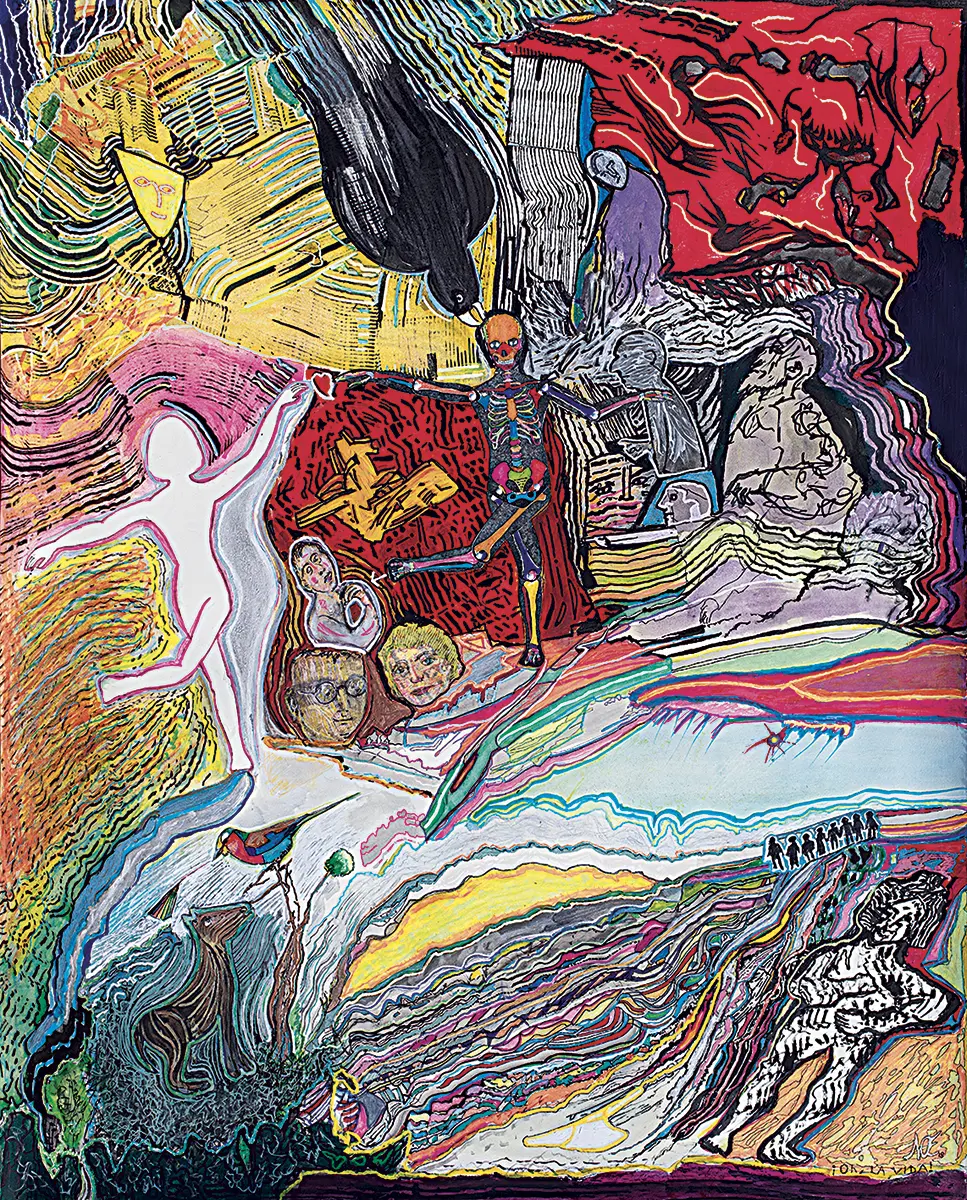
Even though Noé’s works deal with the issue of man and his circumstance, along with a critical stance towards the political and social context, they mostly do not have a stable, secure meaning; they communicate a certain irony and uncertainty about the complexities of the contemporary world. His paintings, on large canvases or with irregular frames (in collaboration with Fabián Lopardo), are often populated by labyrinthine lines and tracings, indiscernible characters with one or two visible protagonists (those in the ceramic Somos are also evident). Some of the works turn out to be a meditation on history, like Testigos y testimonios (Witnesses and Testimonies). Other paintings come close to depicting a tangled South American landscape, as in Por encima (Superficially), or one that is about to be surveyed from above (Panorámica [Panoramic]). They can also allude to gender violence like Cálmate (Calm Down). Some of the works on ink engage existential despair, as expressed in their titles: Ser hoy (Being Today), Confusión (Confusion), or Cambio generacional (Generational Shift), all posing questions about the individual in the face of change. ¡Oh, la vida! (Oh, Life!) one of them exclaims, presenting the artist in a state of freedom and, as Lorena Alfonso’s catalog essay puts it, “committed to the incessant satisfaction of sharing his artistic work with others.”
Conformity and resignation are not in Noé’s vocabulary, yet the very titles of some of his works tell us that “we are what we can” (Somos lo que podemos) and pose the question of “Now what?” (¿Y ahora qué?) The answer could be in Lorena Alfonso’s words: Day after day, week after week, year after year, Noé works tirelessly to conceptualize essays, to hurry along unfinished projects, to imagine heterogeneous formats and materials, embarking on new adventures towards ports that are, more often than not, unknown at the outset.” Indeed, one of those projects did arrive safely on port: 2015 saw the publication of two large autobiographical volumes, Mi viaje (My Journey) and Cuaderno de bitácora (Logbook). However, the journey has not reached its end: Noé continues on his creative march, and in Por ahora he surprised us again with his skeptical optimism (the artist describes himself exactly in those terms, a “skeptical optimist.)