SESC 24 de Maio is a recently inaugurated space located in the downtown area of the city of São Paulo. Sponsored by the city’s Commerce Federation, SESC is a non-profit private institution whose primary objective is the well-being of workers from the trade of goods, services and tourism sectors, but also offers activities to the general public. Present in all the states of Brazil, SESC promotes initiatives in the areas of education, health, culture, and entertainment, aimed at strengthening the citizenry. In the state of São Paulo alone, the institution has 42 centers. In the cultural area, in addition to music, film, and theater, the visual arts occupy a privileged place.
The space located on Calle 24 de Mayo offers an entire floor with excellent infrastructure for the presentation of art exhibitions, which allows the space to host shows of historical importance. The most recent exhibition presented to the public Brazilian modernist painter Lasar Segall’s production. The show opened on October 25, 2018 and will remain open to the public until March 5 of this year.
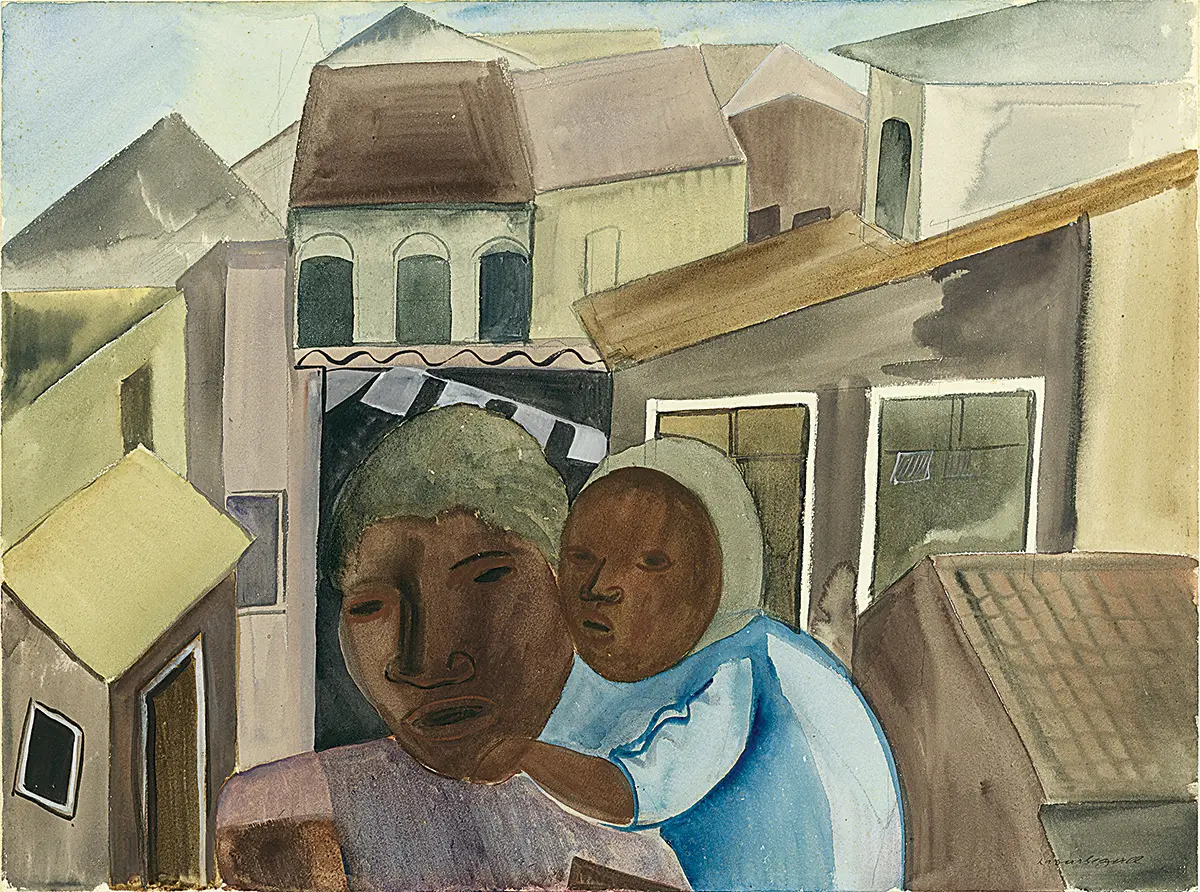
Titled “Lasar Segal: Essay on Color,” the show was curated by Maria Alice Millet. It consists of a group of eighty-seven works, including paintings, sculptures, gouaches, and drawings, in addition to photographs and documents used to historically reconstruct the career of the Lithuanian-born artist based in São Paulo since the 1920s.
The curator interprets Segall’s artistic journey, considering his use of color as the central element. In this manner, color becomes key for establishing the thematic core of the exhibition. Maria Alice Millet indicated: “the conquest of chromatic freedom is of great importance for Segall in all facets of his painting. For this reason, the different chromatic schemes adopted by this painter determine the layout of the works in the exhibition.”
The exhibition is divided into four blocks that surround a central area. The layout was conceived to allude to the quadrants of a city with a square that contains the sculpture titled Três Jovens (Three Youths), from the collection of the Pinacoteca do Estado de São Paulo. The sculpture is part of the group of works installed in the Jardim da Luz (Garden of Light) adjacent to the institution. The bronze version of the sculpture, created in 2001, was based on the original 1931 sculpture created with Ipanema stone.
In each of the four nuclei of the exhibition, the curator offers an interpretation based on chromatic dimensions. In the first nucleus, titled “Anguish: the Emotion Color,” which focuses on the 1910-1923 period, the curator underscores “vermilions, deep blues, macerated pinks and yellows featured like anguished screams in society.” The second nucleus, titled “Under the sign of the Tropics: the National Palette” (1924-1935), showcases some of the canvases produced in Brazil, in which the reds, ochres, and greens of the vegetation stand out. In “Compassion: the Non-Color (from the 1930s and 1940s), the curator attempts to convey the impact the horrors of war had on Segall, commenting on their somber themes and colors. In “Introspection: the “Segall Color” (created between the mid-1940s and 1957, the year of the artist’s death), blues, greens, and yellows stand out for their gradations, interpreted as a personalized chromatic synthesis that contemporary art critic, Paulo Mendes de Almeida, called “Segall’s color,” a nomenclature evidenced by the curator.
The works exhibited come from private collections and institutions including the Pinacoteca do Estado de São Paulo, the Museu de Arte de São Paulo, the Museu de Arte Contemporânea da Universidade de São Paulo and the Instituto de Estudos Brasileiros (USP), the Fundação Edson Queiroz, the Fundação José e Paulina Nemirovsky, and the Museu Lasar Segall. An excellent film about the life and work of Segall runs continuously as part of the exhibition.
Of Jewish origin, Lasar Segall portrayed in his work the drama of the Jewish people and the violence that framed the two World Wars of the 20th century. He was born in Vilna, the current capital of Lithuania, during a time when the Russian Empire ruled. In 1906, Segall traveled to Berlin, where he frequented the School of Applied Arts and the Imperial Academy of Fine Arts. Unhappy about traditional education taught in those institutions, he left for Dresden, in 1910, where he continued his studies. In 1913, he visited Brazil, where two of his brothers lived and presented an exhibition of his work there.
Upon returning to Germany, with the arrival of World War I, the artist was confined to the city of Meissen because he was Jewish. By the time he was able to return to Dresden, the political situation had worsened. His hometown was taken over by the Russians, and Segall feared for his family. He traveled to Vilna and began to express the political violence of the period in his work. He presented some of those works in Dresden and received accolades from the critics.
He decided to migrate to Brazil, settling in São Paulo in 1924, where he was enthusiastically welcomed by artists and writers associated with the modernist movement. Lasar Segall died in that city in 1957, widely recognized for his artistic relevance.
LISBETH REBOLLO GONÇALVES