Juan Toro Díez (1969) is a Caracas-based artist who, since 2009, has been exploring the subject of violence and its relationship with power and politics. On this occasion, Toro Díez presents the exhibition “Tropus,” at the Galería D’Museo, in Caracas. There, he proposes a narrative centered on the street actions by detractors of the Venezuelan government that occurred in 2017, proposing several approaches based on visual material created by him about the events in question.
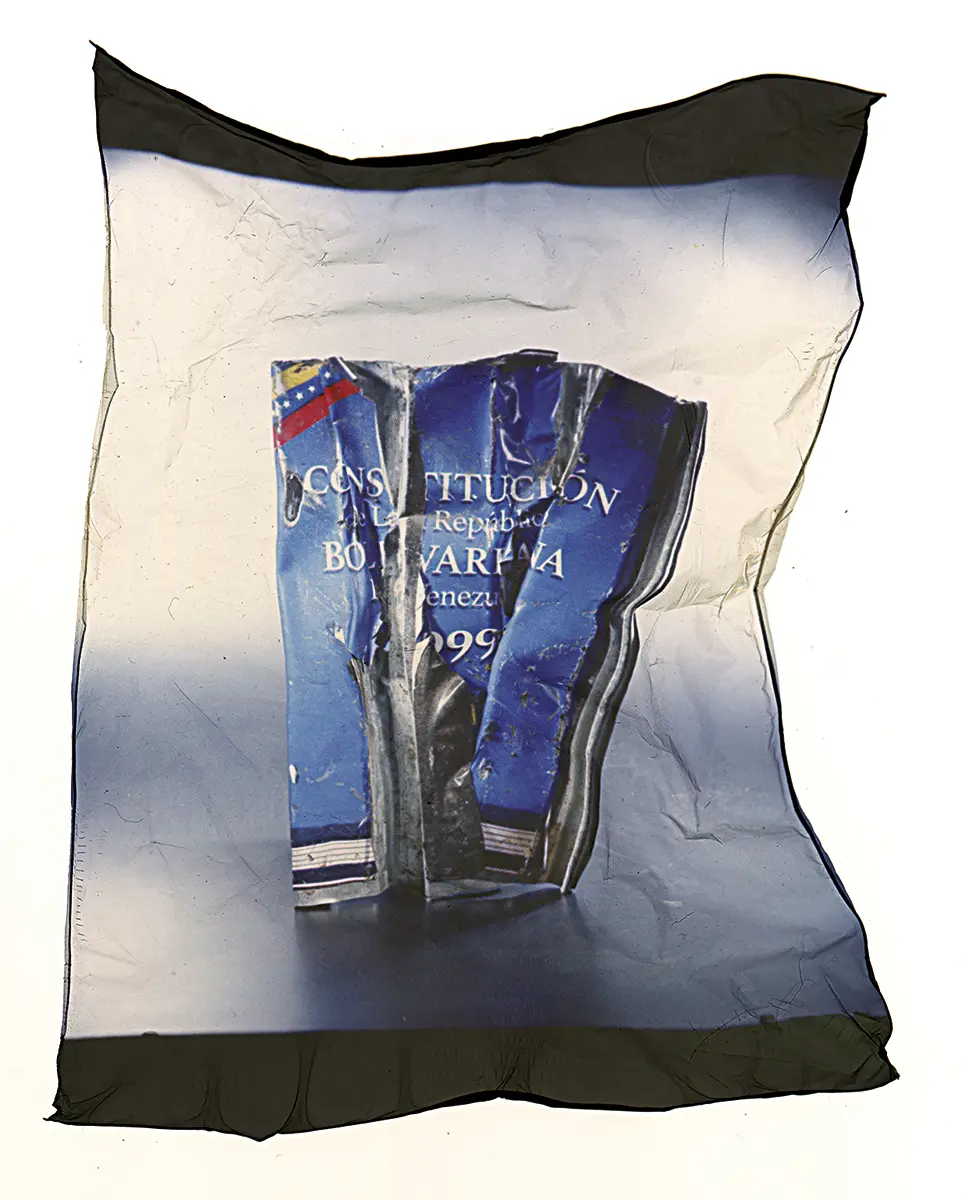
“Tropus” is an installation created in 2018 that consists of fifty images of shields photographed from the front and the back, developed in intervened Polaroid and supported by small light boxes of variable dimensions.
The curatorship by Yuri Liscano and the accompanying text by María Luz Cárdenas underscore the purpose that guides the installation through the museography. Several light boxes have been placed on the wall of the semi-dark exhibition room. Among these, there is one, wrinkled and torn, containing the emblem of the 1999 Constitution of the Bolivarian Republic of Venezuela. This emblem is central to the show and begins a dialog with the other pieces. Another group of works displayed on the floor refers to the fallen demonstrators. Its small size encourages visitors to stop, as a closer look is required to find in the details, in the minimized reproductions it contains, documents that grabbed the attention of Venezuelan society and international organizations during a good part of 2017: a large-scale conflict discretely resolved through silenced screams that live on in memory. Concerning the museography, the text by Cárdenas reinforces the proposal by being presented in a monitor that, like a teleprompter, underscores the newsworthy nature of the event.
Toro Díez relies on tropus, on changing the original meaning of ideas. He proposes a second look, an approximation through layers. In this manner, the perspectives that unleash the images and the material employed are many. To Cárdenas, metaphors and shifts in meaning are resources with which to articulate the narrative of the shields, shown from both sides, as referents for a struggle. The shields were elevated as weapons for the defense and protection of a resistance group. On the other hand, they limited the possibility of a complete vision and kept those behind them anonymous.
In a country without answers, without form, it generates an association with the amorphous Polaroid supports. Once the Polaroid membranes are detached from their supports, they cannot go back to their original form. It is precisely this irregularity what figuratively conveys the weak state and lack of solidity of the events that unfolded. Images become unattainable on membranes that turn transparent, raising the theme of memory and disturbing symbols that link the fragility of the material with the fragility of the events: sterile libertarian aspirations, vanishing on small supports that reconstruct fragments of pain experienced by those who hid behind them, and also by a country. The films also allude to the torn and cracked flesh.
The broken, fractured, incomplete shields are exposed like anthropological remnants of fallen actors. Their backs show the makeshift and precarious nature of their construction with planks, barrels, plastics. In sum, the desperate act of going into combat without any guarantees. Both sides of the shields show war cry emblems, slogans, and illustrations of patriotic symbols, the image of Simón Bolívar, colors, protests, hope: “Cheer up, new Venezuela,” “Liberators of Venezuela. Resistance,” “Heroes,” “SOS,” “Dammed the soldiers who turn their guns against their people,” “Water, food, medicines, cloth…,” “Shoot pills at me and kill me of old age,” “It could have been me… Not one more,” “… We can give water to our neighborhoods.”
A dated and unbind reproduction of the cover of the Venezuelan Constitution foretells the lack of institutionalism and inapplicability of the laws that sparked the need to create shields to protest. Through a contemporary proposal with sharp content, Juan Toro Díez unveils the moral results that society drags as result of the absence of any responsibility taken for events whose consequences have been relegated, without being clearly assumed by the groups implicated. This situation motivated the grand call for the installation Tropus.
The human losses with hidden faces, without identity, are expressed with force in the penetrating simile of the images on the floor that do not admit to being unknown.
ANNY BELLO