In the photo series Piedra y polvo (Rock and Dust) and the video Cronologías envolventes (Enveloping Chronologies), on display at Nueveochenta, and as is habitual in his projects, Juan Fernando Herrán (Bogotá, 1963) carries out a rigorous investigation of the particularities of the chosen space. He does not start from invented locations or realities, and his inquiry, even if based on glimpsed elements, is not limited to recording them: Herrán is deeply interested in having his explorations be the cornerstone for the articulation of new thoughts about what is being observed.
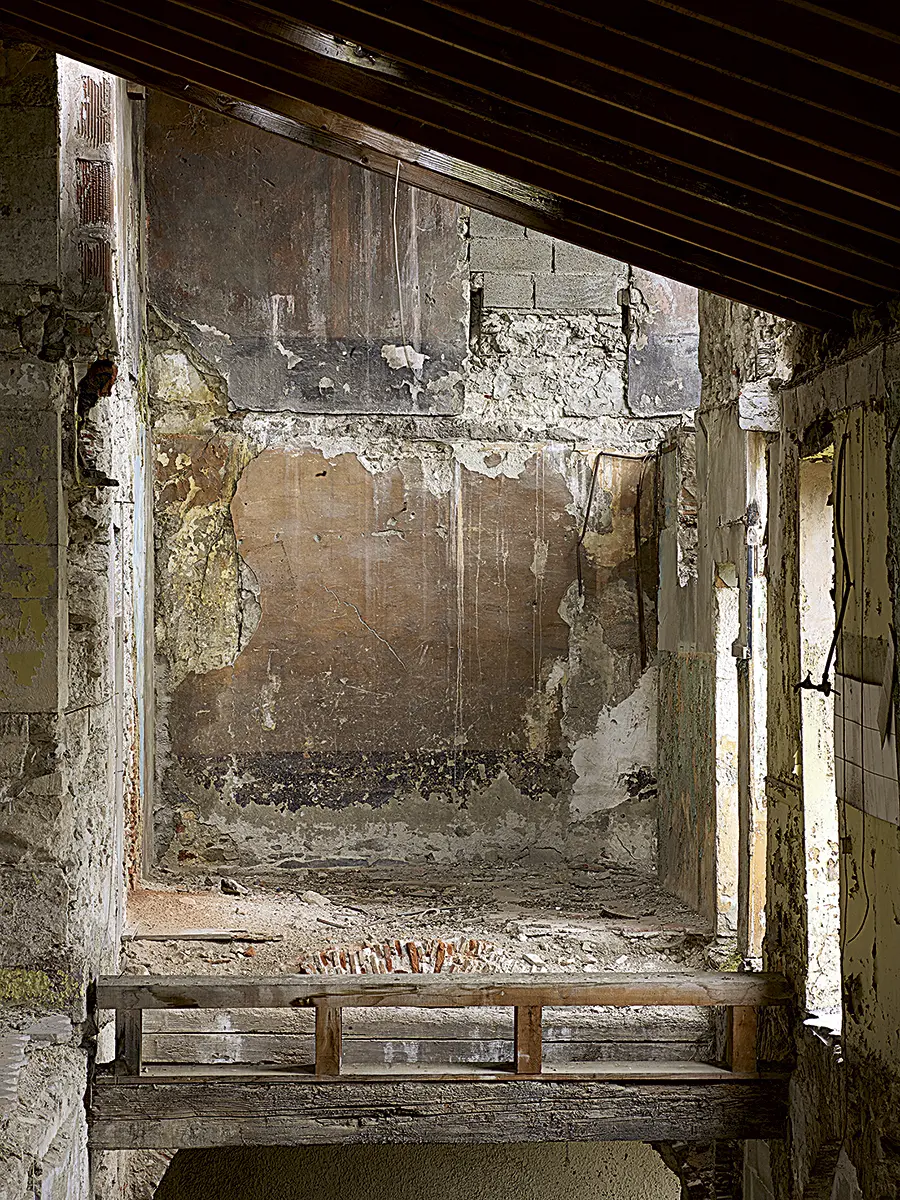
The project began as part of an event titled Colombia France, in 2017, when Herrán set out to examine a specific location in the French commune of Vienne: The Abbey of Saint-André-Le-Haut. Not fully documented in written sources, it is among the “noble lady” constructions, as early female abbeys were known.
Archeological studies that began in the last century and still ongoing have established that the earliest building dates from the Sixth or Seventh Century; the church, from the Eleventh and Fourteenth Centuries, and the cloisters, from the Seventeenth Century. 1 Since Roman times, the site has been the subject of many periods of occupation and use: Roman temple, Abbey, cemetery, hospital. Confiscated during the French Revolution and later sold; its western section was repurposed for housing units while the eastern section became a textile plant. Walls partitioned the building, new doors and windows were carved, and vaults were destroyed, in order to add floors and create adequate spaces for families to live. This situation continued until 1992.
Juan Fernando Herrán’s work brings out several elements: the possibility of tracing the different historical periods that can be found overlapping in the building, and an opportunity to visualize the very passage of time as, given the building’s peculiar occupation history, the sacred and the profane merge. Observing the behavior of the various types of wood used in the different eras, one discovers the Greco-Roman period, the passage to the Middle Ages, and the thick boards used today. The relationship of those historical processes with their present evidence makes it possible for Herrán to propose observations that sidestep the archaeological plane in order to focus on how cultural elements, not always evident, come to be braided and combined. The archeological precedents are there, but what Herrán’s photographs track and trace go beyond them so that the historical cycles reveal hidden memories, ideological and social shifts.
The complex, controversial relationship between history and memory reappears once again, bringing to the fore the gap between the meaning of those two terms. When are certain memories celebrated? Does memory’s time appear in the present in connection to strategies of power? What interests us from the historical past? In Herrán’s photographs, Pierre Nora’s reiterated concern—”memory must not be confused with history”—is in clear evidence, since the Colombian artist’s exploration in the register of images transcends the study of found materials and referents. He seeks to shed light on how such remains are bearing witness and at the same time molding, in the present, any reading of their history.
There is a hidden memory that shows how a good number of ancient buildings are the result of an appropriation of older materials taken from other buildings, destroyed in order to erect the new, thus revealing the limited patrimonial value given to such objects and how the notion of heritage is essentially modern.
It is precisely those hidden memories, so subtly revealed by Herrán in his outstanding photographic registers, that restitute a unique relationship between the historical past that is salvaged in its materiality by archeological study, and the small-scale personal histories of those who occupied a given space for some time.
Again, what we encounter is evidence of the fact that the present has the history as its foundation, and how, despite the architectural isolation of the register, it is possible to discover traces of absent bodies, of disappearances, of the fleetingness of life, of death as an inescapable reality.
The video Cronologías envolventes was exhibited alongside the photographs. Using a drone to explore the archeological remains of the old abbey, Herrán approaches the different textured surfaces, architectural vestiges that reveal historical processes and the reutilization of materials from the past. Once again, hidden memories and social and cultural processes are brought to light by the trajectory of the camera’s lens.
The text that accompanies the image voices singular experiences like that of Jacqueline, the last occupant of the improvised apartments, who explains how her husband retouched the chin of one of the sculpted characters located in the space inhabited by their daughter, using plaster to repair the damage done to a face that was created in the Middle Ages. Household repair becomes a tangible reality in a sacred space.
NOTE
1. Information from the Bulletin du centre d´études mediéváles. Hors-série No.10, 2016, Auxerre.
IVONNE PINI