Artist Juan Caloca is enduringly seduced by the paradox that underlies official images and their derivatives, be it national emblems or corporate logos. What fascinates him is not only their impact but also the instrumentalities, implementations, and interpretations these images carry and imply. Caloca appropriates these signs that speak or exist in the stead of that which they represent. These abstractions that speak to us of a vast array of extras, disguised or inferred, that comprise or are impacted by them—in order to illuminate the use (and misuse) of official representation (the mark, in the most literal sense) and in that way reflect in each new mise-en-scène about the meaning of its processes and shortfalls. A modern-day iconoclast, he is aware of the cult of the image.
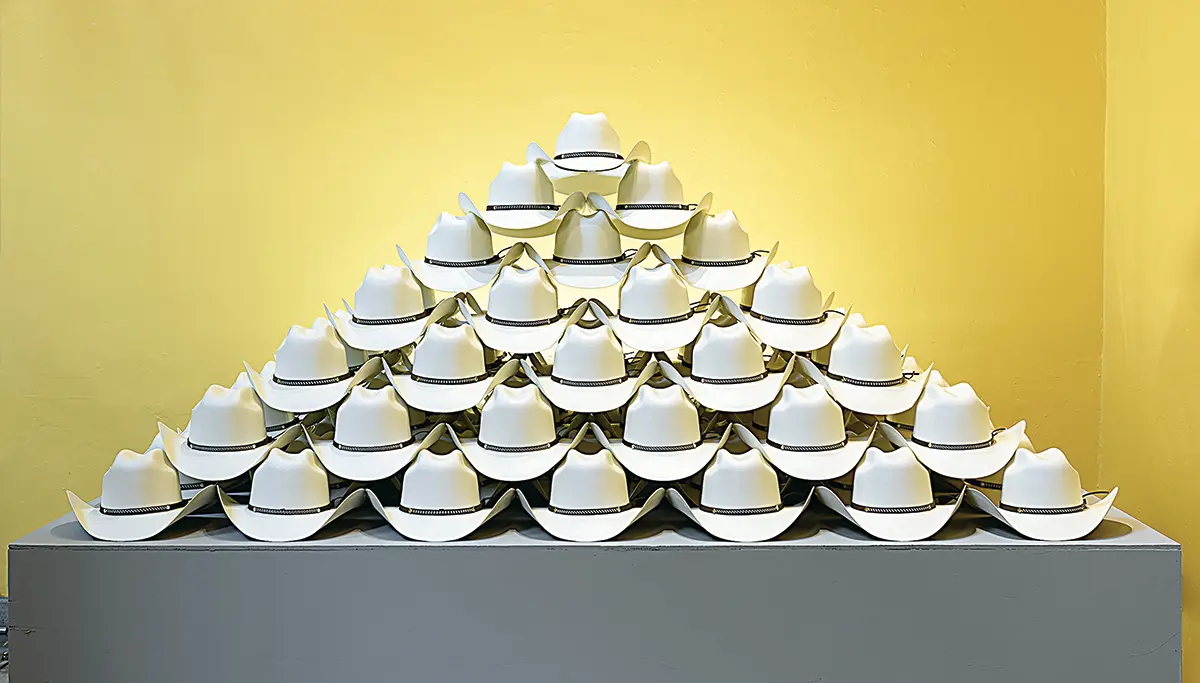
He decided to capture—halfway between the tableaux and the palimpsest—the stories or better yet, the statement of facts of places and events, as well as images and icons, that have defined Mexico’s social and cultural process with regards to the world or with regards to itself, opening up the particulars of the national to the global. He does this by developing, in collaboration with programmer Emilio Peláez, the videogame Alta traición (High Treason, 2017), and through the correspondences and contrasts between objects and signs in his most recent Petlalcingo (2018). The installation, built around a series of acrylic paintings on petates (a traditional Mexican bedroll and rug, made from the palm of the same name), lays on the floor of the exhibition space (in this case, a hallway). It illustrates the relationships and complicities among moral actors (ranging from political parties and public institutions and initiatives to corporations and cultural spaces) that have defined the country’s current political and social realities. More than a map—including rumors and gossip—Juan Caloca creates palimpsests by imposing the logos of the involved entities on the petates, a material he has taken as the basis for these incidental representations because of the multiplicity of meanings and cultural implications it possesses as an object, but also because of the formal possibilities it allows. In Caloca’s own words: “I use the petate as support because its lattice design denotes the complexity of Mexican history, the contradictions weaved into it from pre-Columbian cultures, the colonial era, and the country’s modern history. Layers and layers of events that today are braided into various versions, resulting in a jumbled plot that is difficult to read and above all make it impossible to adopt an ideological posture.” The weaving of a petate produces a shifting sheen that emulates the intricate pathways of political relationships in Mexico, which provoke a constant flux of simultaneities and confusions that illustrate the links between those public and private entities, evoking the country’s recent past for the audience as it discerns the figures. Among the logos emphasized (or revealed) on the painted petates that Caloca unfurls at the University of Guanajuato’s Tomás Chávez Morado hallway, viewers will encounter, to give an example of the narratives contained therein, Mexico City’s new airport. The project has been the focus of great social and political controversy from the moment the project was approved, to its recent cancellation (which implies multi-million payments and compensations). The logo overlaps with the ICA’s, the Mexican construction firm behind Azteca Stadium and the new Basilica of Guadalupe, which rose from a deep, years-long crisis. He also combines the electoral paraphernalia of the Green Party, a PEMEX plaque, a ceramic bald eagle, earthen vases, a mandala-like circle, kiosks from the PRI campaign to the Mexico City government. He plays with contrasts by combining a traditional straw hat with a top hat, and a pair of huarache sandals with a pair of black shoes (the latter lined with palm on the inside). A mannequin, representing a caricature of President Andrés Manuel López Obrador, used during his campaign, occupied the center of the public’s hallway that connects a pile of Texas-style hats and a petate displayed on a wall. The latter depicts a gross caricature about the power and influence of the United States on the state of things represented on the floor. Caloca places his painted petates on the floor with the intention of having the audience step on them; they are meant to get dirty in the process, used and erased. “These works are conceived to be exhibited on the floor and used as rugs, negating the pristine condition of the pictorial tradition and returning the object to its original use,” the artist says. Petlalcingo is also the name of a town in the Mexican state of Puebla, where the artist’s father was born.