The exhibition entitled “Material/Dark” by Jonathan Lara, curated by Alberto Asprino was presented between the end of 2018 and the beginning of 2019 at Spaziozero Galería, in Caracas. Winner of the Unique Award granted by the “19th Youths’ Salon FIA,” Lara reaffirms his willingness to combine, in a single compendium, painting as reason and purpose; graphic methods as resources and guidelines; and small, low-density, canvases as aids and simulators. Every result conveys interconnected summaries boasting a high aesthetic sensibility and an intense mastery of technical secrets. From the first to the last, all proposals promote the mysteries associated with a desire to decipher the resolutive and symbolic secrets condensed in every piece. Additionally, there are the sensory effects and sensual impacts of surfaces that, without dissimulating their depths and backgrounds, also encourage particular delights. However, it is interesting that none of his paintings take any gimmicky risks or relent their rigorous and substantial problem-solving temperament.
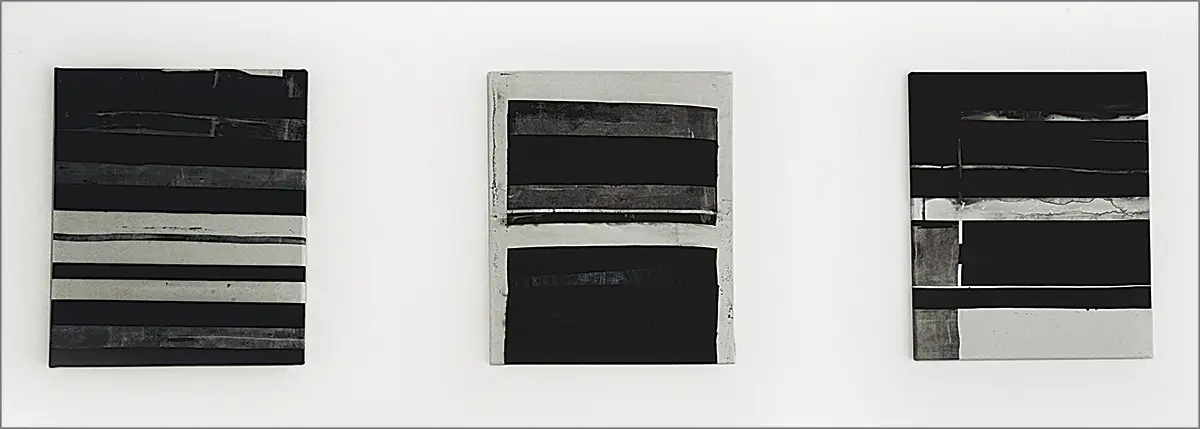
The pieces are resolved through a set of formal fragmentations that offer surprising topological spaces, insofar as they exchange atmospheric thresholds intersected by darkened and intricate stripes that underline perceptive intrigues. It could be said that in the same manner that words become lighter in verse but heavier in prose, in Jonathan Lara’s case the lightness of the atmosphere is trapped in the various densities of stripes and screens that are adapted to these suggestive visual realms. This results in explicit tracks and traces that sometimes suggest geometric records which ultimately dissolve into reassessed scopes. In addition to this data, there are also the transparencies supported by subtle screens, as well as the humid effects detached from the ink employed as a pictorial resource. The different densities of these impacts expand through depths that appear to be inspired by Hugo von Hofmannsthal’s idea: “Depth must be hidden. Where? On the surface.” Of course, here one could also paraphrase Antonio Porchia’s aphorism to remember that “The deep, seen with depth, is surface.”
In most instances, the visual bursts come from bright and dynamic contrasts that open paths between the tangible and the intangible, the outlined and the boundless, the forged and the liquefied, the sedimented and the volatile. This game of ambivalences suggests that neither darkness nor light can reach an absolute and inscrutable value, thus demonstrating that integration and coexistence prevail over any segregating or radical biases. Here Lara seems to want to remind us that the interaction between any gained materiality and lost spirituality forces certain mysticism presented like inviting and defiant thresholds. In this sense, it should also be pointed out that, at times, we feel as if we were before oversized warps seen from outside whose oversized state successfully disguises any of their original realities. It is a reminder that things change according to the types of approaches adopted and depending on the screens used to intervene in the visual records. This allows for a dimension of the inscrutable and remote sheltered amid images that transcend the sensation of transparency, but that have also distanced themselves from the darkness. We are structural ambivalences energized by analogous interactions like those underscored by Lara in this exhibition. As in life, his works emphasize that tensions promote life as long as the risks of overflowing are not heard. In these intersections dissonances grow and, like echoes, seem to move away only to return and reassess their origin.
In sum, the works by Jonathan Lara persuade us because they immerse us in environments that simultaneously offer structures and excesses, tensions and distensions, while also evoking the sense of a consubstantial human dialog between what one is and what one wants to be, or between what is shown and what is hidden. With exceptions that are typical of subjectivity, we interpret that these interesting works synthesize the encounter between the tonalities of white and the darkness of black, in order to warn us that exaggerated light can blind us and total darkness erases everything. In the line of this development, semidarkness crystalizes a connection between the internal life of human beings and the vastness of their environment. From this perspective, we celebrate the moderation and balance and harmony and rigor of these impeccable works.
VICTOR GUÉDEZ