The work by emerging artist John Nomesqui begins to become visible at the national level, and will undoubtedly gain international projection because it manages to put into dialogue something rare in contemporary art: a technical virtuosity of craftsmanship and a conceptual depth propitiating what form and idea configure a complex work and rich in signifiers. His most recent exhibition was open to the public at Galería Aurora, in Bogotá. It was framed within that ecological current of contemporary art that highlights a critical stance against the predatory process of human beings against nature, and the response, in a kind of symbolic resistance, that the artist manages to materialize in an aesthetic and political response to consumption, the nerve center of this issue.
Today, talking about art and nature has become a common practice—and, to be honest, a banal one. Pseudo-ecological works are everywhere: bushes here and there, nostalgic reminiscences of an idyllic past lost, and so on. Few artists have succeeded in exploring the theme seriously. In our field, José Roca has for many years committed to shedding light on such inquiries, showcasing works by artists like Alberto Baraya and María Elvira Escallón, among others, that tackle the relationship between art and nature is a serious manner. Currently, the project Flora ars+natura, an initiative resulting from this process, has established a solid curatorial and conceptual line. John Nomesqui continues in this vein as part of a new generation of artists wondering about the equilibrium between nature and humankind beyond the destructive exploitation of the natural world intrinsic to modern progress. He approaches the question through a combination of sculptural installation and performance that produces evolving work that is worth following.
Nomesqui’s work initially became visible some years back at the Galería Santafé (so sorely missed today) with a sculptural piece created mostly with paper that consisted of a series of weaves fashioned with the discarded pages of magazines and newspapers. The threads were made with long strips of paper previously rolled by the artist. The strips were then placed in a loom were the weaving process began to develop.
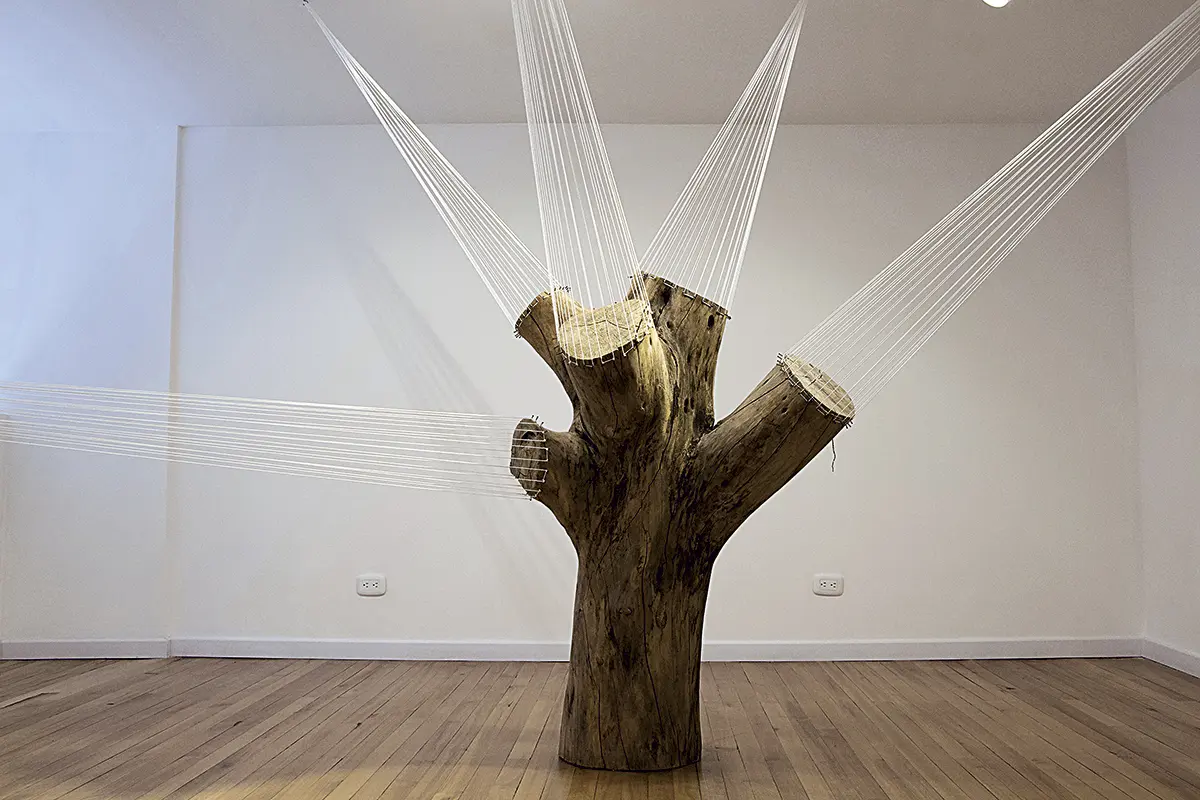
This action leads to a series of works that begin to have a certain organicity and materialize in the form of almost natural forms. In one of them, presented in the group exhibition “Other natures” at Poliedro Artsforms in 2017, the shapes looked like mushrooms that grew in the vertices of the showroom. More recently, his sculptural work uses cut discarded tree trunks collected in the city. Nomesqui “completes” these trunks by giving them “phantom limbs,” weaves of paper that bring back the material to its origins: wood. In this manner, he establishes a contrast between artificial and natural elements. The trunks are part of the piece titled Consumo cuidado presented in the group exhibition “Around the Shadow” curated by Mario Opazo for the Chamber of Commerce of Bogota. The show gathered a group of artists around the work of Ramón Uribe, one of the first young Colombian artists to participate in the Havana Biennale during the 1990s and whose work is very much deserving of consideration. Nomesqui’s previous exhibition was “Textus Resistentiam” at LA Galería, where he was able to begin the initial stage of the project that now resumes with this show at Aurora.
Another project by Nomesqui that stands out is the meticulous gathering of guava seeds that he has been working on for some time now. Installed on the floor, simulating a tapestry, the piece has been shown at several educational centers such as the Jardín Infantil Semillas—the kindergarten that his children attend—the college where he teaches, and the Universidad Pedagógica, where he works alongside philosopher Germán Vargas-Guillén. This educational component is significant because it illustrates a recurrent and compelling aspect in Nomesqui’s work: a social structure in which education plays a central role. Students and participants may intervene in the installation by drawing with it, stepping barefoot on the seeds, grabbing them, or even taking home a handful of them. El olor de la guayaba (the fragrance of the guava) is reminiscent of the conversation between Plinio Apuleyo Mendoza and Gabriel García Márquez in which the latter talked about the meaning of narrative in Colombia’s cultural territory.
The compelling power of Nomesqui’s ongoing work not only resides in literary or poetic references. His work also powerfully addresses the fragile balance of nature as a result, for instance, of the undeniable impact that the production of genetically modified foods has on the natural equilibrium and ecosystems. A good part of the world today is regulated by this neoliberal approach, and Colombia has not been immune to this type of economic pressure. In this context, Nomesqui’s work is compelling because it insists on the accumulation of native seeds—something forbidden today by the way—as a form to invest in the future. This work was also shown in one of the exhibition areas of the Chamber of Commerce of Bogota, during the group exhibition “Cultivation.” While the installation has not always been identical, in most cases sound and viewer participation have been essential, particularly the use of hands, which are vital for understanding Nomesqui’s entire body of work, which combines manufacture and craftwork with contemporary art in a powerful way.
Shown at Aurora, “Consumo cuidado” recreated a forest with the trunks built from cut down trees gathered in Bogota. Nomesqui attempts, in a personal way, to reassemble the missing part of trees that have ceased to exist. Weaves come to the rescue, threaded, as we already mentioned, with recycled discarded paper cut into strips. The material is restored to its origin, at least symbolically. It is a proposal that evokes the work of Italian artist Giuseppe Penone and Colombian artist Miler Lagos. John Nomesqui said the following about this work: “I specifically analyzed the phenomenon of biological regeneration, described as the ability of certain living organisms to restore lost or damaged tissue or to regrow a certain part of the body lost by accident or due to physiological reasons. Such process of regeneration translates into the act of weaving: continuing the body of a cut-down tree with thread from paper.”1 In this manner, art and science are combined, at least metaphorically, to convey that the central point is the recovery of at least some of the natural equilibrium that we have lost.
NOTE
1. Purposes of the artist entrusted to the author of this text.
RICARDO ARCOS-PALMA