Testigo (Witness), Jesús Abad Colorado’s exhibition, gains relevance every day. It is a visual document that leaves no room for doubt, presented at a time when the country is undergoing a complicated process, and the murder of social leaders and activists has become a common occurrence. This ambitious exhibition organized by the National University proves that, in many ways, Colombia has been a blood-stained territory.
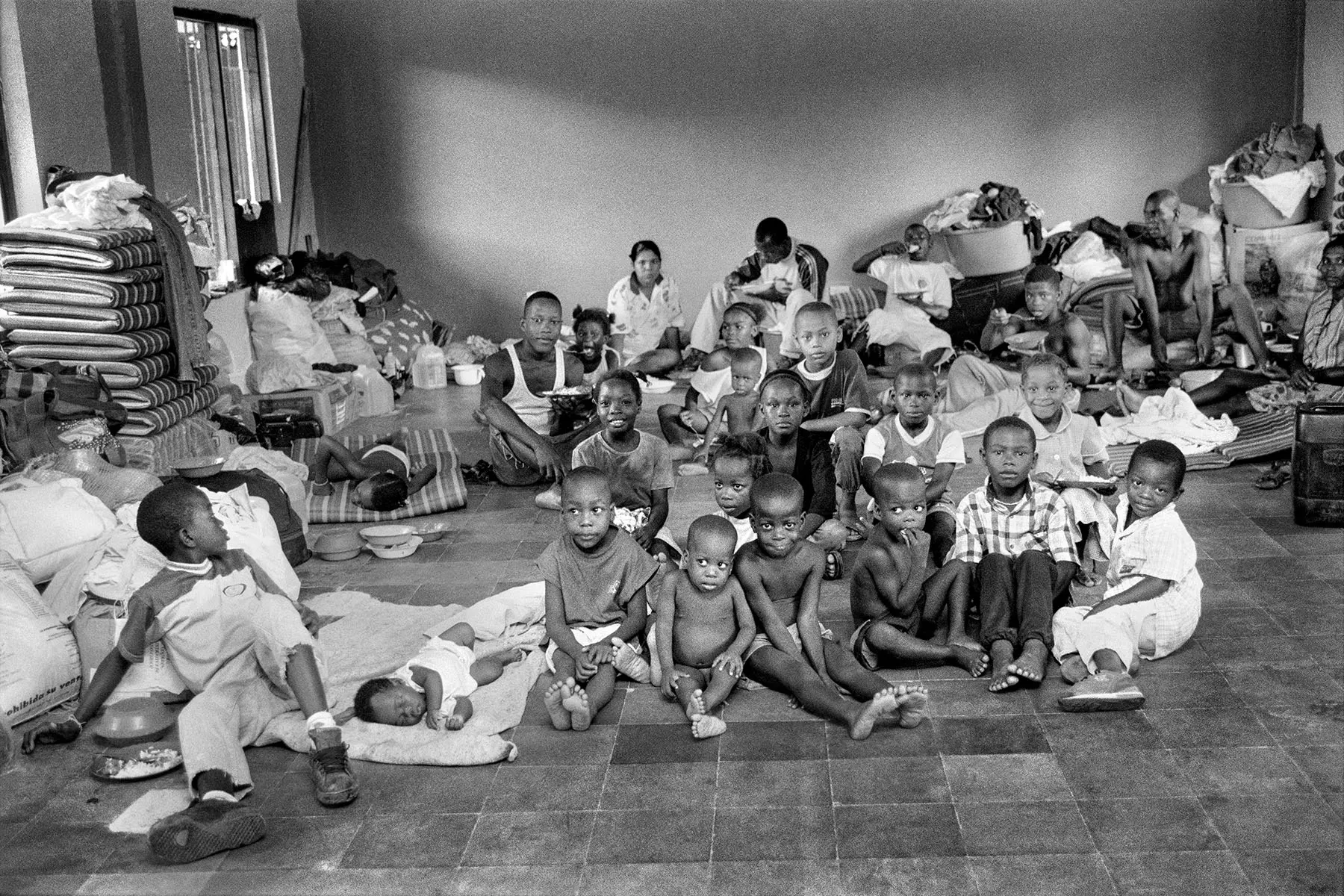
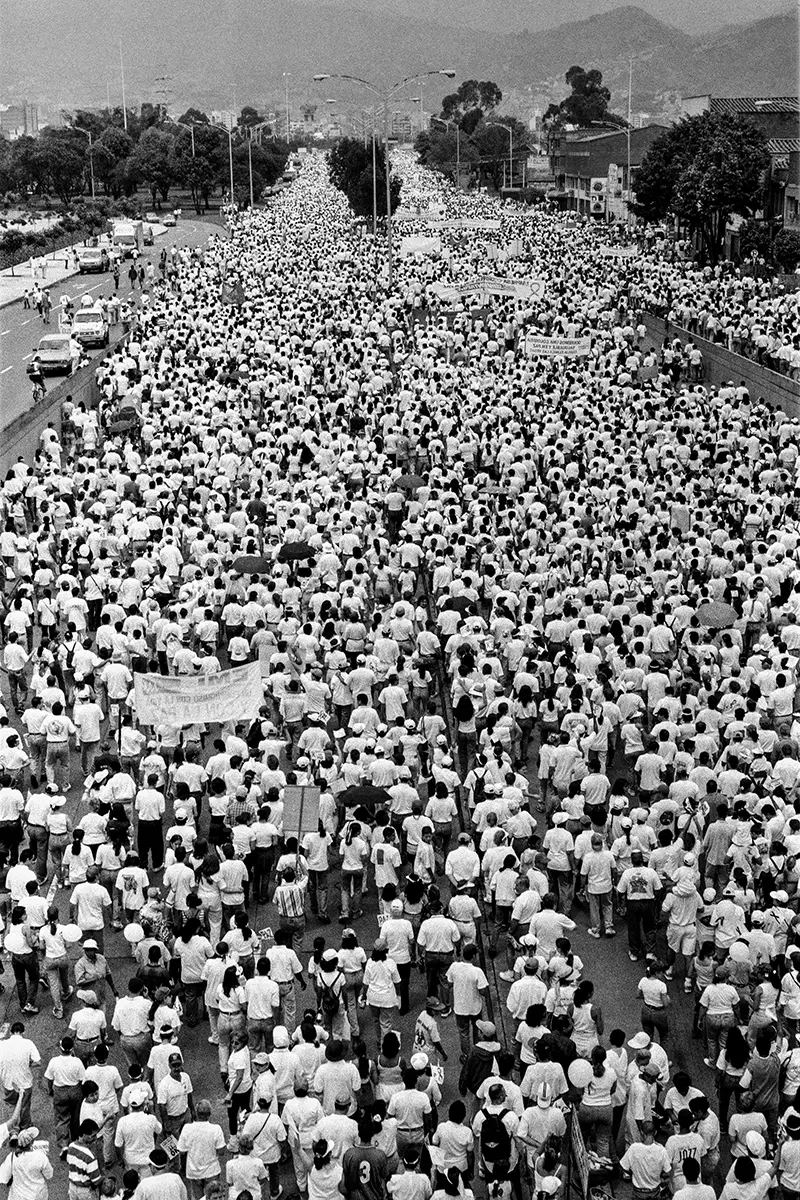
Curator María Belén Sáez de Ibarra has structured the exhibit in four chapters. The first one, Pongo mis manos en las tuyas (I Place My Hands on Yours), depicts marches and rallies, talks and negotiations, and civil resistance. The second one, Y aun así me levantaré (And Yet, I Will Rise), illustrates the power and resilience of the Colombian people. Tierra callada (Silent Land), shows nature darkened and destroyed by war. Finally, No hay tinieblas que la luz no venza (There Are No Shadows That Light Cannot Defeat) presents the hope and persistence of victims in the search for their disappeared, the exhumations, and the certainty about the identity of the killers who will one day come out of the dark. These constellations guide us through the “disasters of war” and the flimsy certitudes of the cease-fire. These photographs bring to the fore the subjects’ pain and despair, their terror, the absurd and irrational violence, the land dispossessions, the rape of women and girls, but also the superhuman strength and the resilience that allows moving forward despite the suffering.
In this way, Colorado positioned himself as a trusted source on the disasters of war in Colombia. Since 1992 to the present, he has walked with the people, listening to the stories of anonymous individuals and recording the facts with his camera. He is the man who traverses the most difficult paths through swamps and mountains, accompanying the war victims, the displaced with their children in their arms and their animals in tow. Who knows where he goes with them, since they have no place, they have lost everything and are searching for a new home in the world. His job, as he puts it, is to document what happens to the forgotten in a context where the politicians, the paramilitary forces, and the guerillas have a voice, but not so the civilian population suffering the effects of the war.
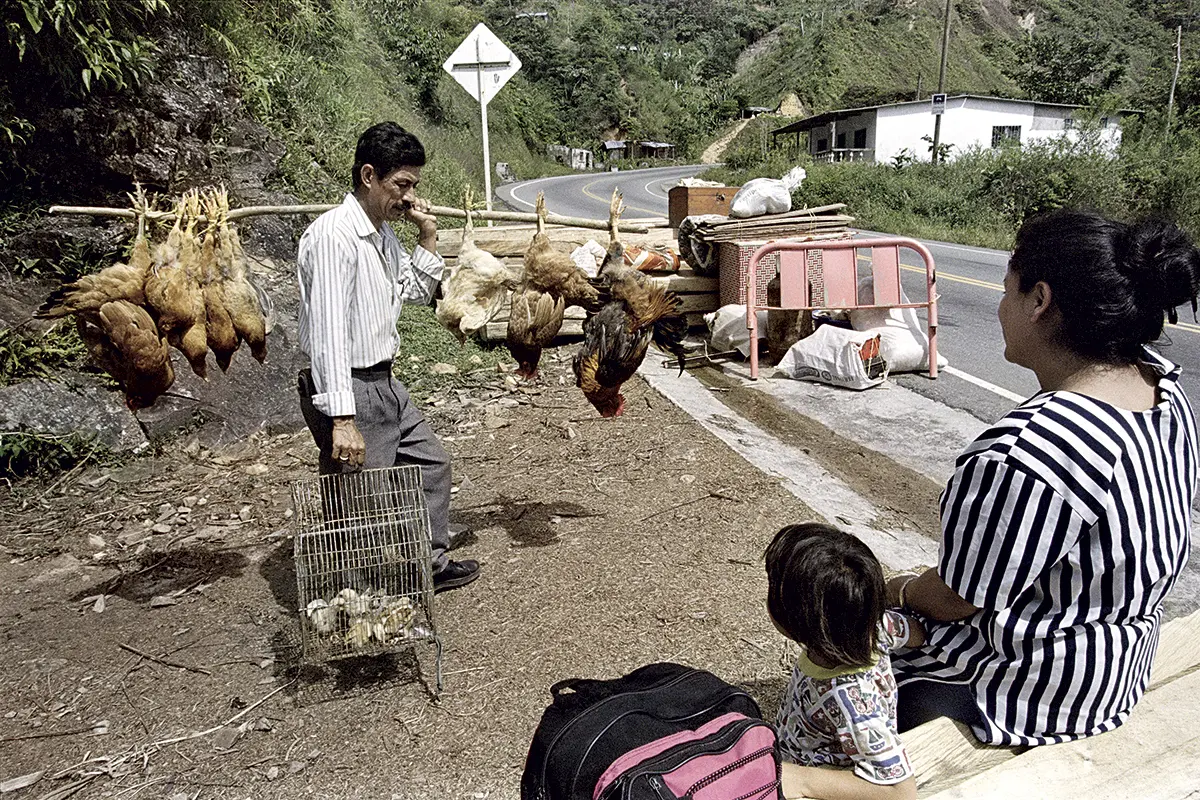
Colorado’s work confronts us with that very war, helps preserve its memory, and records a series of tragic events occurred in places like Bojayá, in Chocó; San José de Apartadó and Granada, in Antioquia; Mapiripán, in Meta, to name some of the sites. The images capture fragments of what took place, preventing these facts from being doubted, and using them to pose questions such as: If these are not the remains of a war, what are they?
This exhibition, straddling the boundaries between documentary photography and photojournalism, proposes some answers. Testigo takes us to the domain of contemporary aesthetics, which, according to Jacques Rancière, is determined from a political, social, and ethical standpoint. There is in Colorado’s posture a pacifist discourse, against the grain of indiscriminate, predatory violence. “What I am after is the humanity of our people, often reduced by war to mere numbers and statistics in government charts,” he says. The exhibition speaks of human beings with names and identities (Camila, Juana, Lucas) and captures the emotional state, the feelings and ways of life of a population confronted with war, and those moments of anguish remain in Colorado’s images.
Colorado has faced kidnapping, an experience he does not like to discuss. He has had family members killed, including his grandfather, shot in his bed during the two-party violence of the 1960s, and others subjected to torture and kidnapping. His parents were displaced due to the war from San Carlos to Medellin. Later, when he was a student at the University of Antioquia, he witnessed the assassination of Dr. Héctor Abad Gómez, whom he admired deeply, and political candidates Bernardo Jaramillo and Carlos Pizarro. These are some of the events that drove Colorado to grab his camera and walk the country, confident that his work could speak to our memory and reconciliation.
Colorado’s photographs are a genuine narrative of the tragedy, of the unsayable, and of the events that bleed Colombia. His work emphasizes the individual: “I witnessed it; I was there; I am giving a testimony.” That “I-ism” translates into a pressing need to narrate. Colorado’s intention is for the story to be known and for us not to forget it, and, of course, for the desire to move Colombia away from a fate of death and violence once and for all to be what weighs most heavily on making decisions.
At the same time, Testigo reveals the level of destruction inflicted on the natural environment by repeated shelling, which has left behind a cratered and destroyed terrain and has filled the rivers with corpses. Colorado’s images are also a warning that, if the war continues, our fields will soon dry up, the water will be exhausted by mining operations, and Colombia’s peasants will be unable to work the land. In that sense, the exhibition is a heart-wrenching document of the transformation of the Colombian territory by violent conflagration and the oil spills caused by the guerillas’ pipelines’ sabotage. It is a memory of the country made ethically and respectfully; in that way, the photographs on display reveal that Colorado’s overriding concern is to show how people live amid tragedy.
We see stray bullets, extra-judicial executions, massacres, immunization campaigns, torture, forced displacements, orphaned children, raped girls, one of them branded on the arm with a “tattoo” reading AUC (the initials of a Colombian paramilitary group)—the same brand seen on a tree used to tie up hostages and on a dog. This marking is part of a series of grammars deployed during the war in order to identify the various actors, and to signal how to kill or how to use biblical symbols and names that have fused with violence: “We are the children of the army of God, the AUC,” as we read in one of Colorado’s images. The exhibition also denounces how such codes become the paradigms of war and designate who are the “owners” and have authority, who commands the territory, and who has the right to kill.
Yes, Colombia hurts in this exhibition, and Jesús Abad Colorado has come to bear witness as someone who risks his own life in order to tell the story. “I was there. Believe me.”
MARÍA ELVIRA ARDILA