During November, in the centrally located Santiago neighborhood of Lastarria, one side of an emblematic building, the Villavicencio Tower, looked very different than its usually sober concrete and dark glass’ structure. Hanging on twenty-two of the twenty-three floors of the building’s west face were many everyday personal objects and household items: dresses, chairs, helmets, tables, books, chest drawers, suitcases, ladders, hats, trousers, watches, lamps, shoes, etc. Objects that contain in themselves, like the architecture that displays them, everything that is unequivocally human. The first thing that such a sight triggers in the passer-by is precisely the realization that architecture—like everything that exists, everything we have created and use—exists because we are here. Against the background of the building, inert objects become human and acquiring a new life.
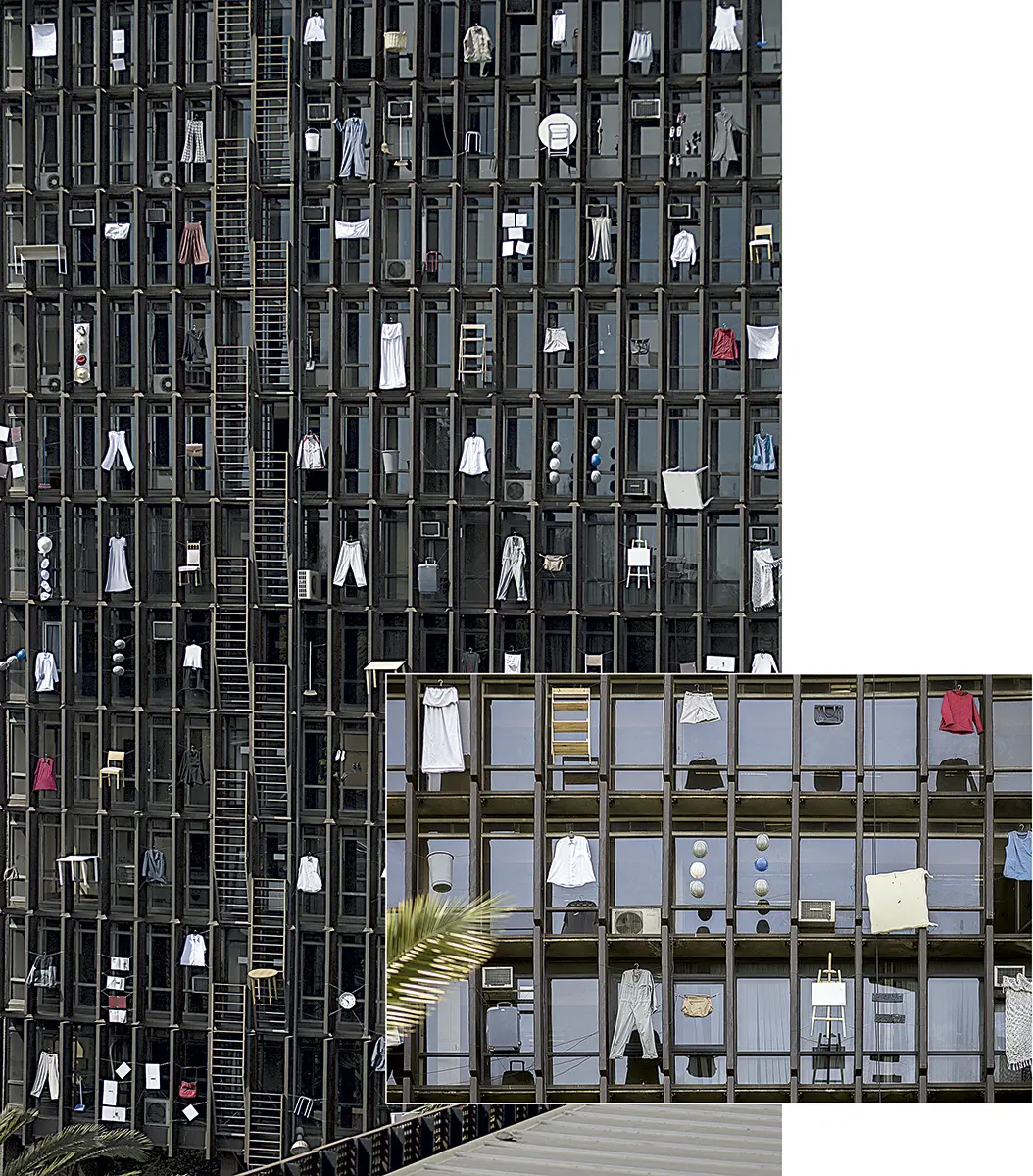
Janet Toro (Osorno, Chile, 1963), a Santiago-based multi-disciplinary artist, created La torre vive (The Tower Lives), the first of several self-produced, self-financed installations designed for the Chilean capital as part of her series Intersubjetividad urbana (Urban Intersubjectivity). In her inaugural speech Toro said: “Beyond this emblematic building’s concrete, its steel structures, its retaining walls, I was interested in probing the spirit that animated and prodded its construction.” La torre vive is a poem in the shape of an urban-space installation that reflects what we are the places we build and inhabit. Toro’s intention, with this series of massive installations displayed around the city, is to generate, in relevant historical sites, experiences and visual connections with the public, to stir and explode the collective memory, and to view the urban space as a reusable canvas. At the same time, the artist seeks to generate urban tensions, to connect axes of patrimony with more private household realms, to produce virtual blueprints and designs in areas of different social and economic strata, and, finally, to surprise passers-by with a mirror of their own lives, rendered as metaphors.
The Tower Lives allows several readings of the action of taking pieces of our lives to the public realm. Not only it speaks of the individuals who inhabited the currently unoccupied tower, but it also suggests the existence of untold stories from its closed windows. These may be the stories of the disappeared (under the Pinochet dictatorship), of the workers who built the tower, of the office personnel that worked there at one point in time, or the stories of the passers-by who connect with their memories. Ultimately, the public connects with the idea of granting the empty building-canvas, already freighted with history, a new life.
In this way, each of the pieces hanging from the building, like a hyperlink, tells new stories and points toward other lives, as if in the act of naming them, of reassessing their existence and that of the building, reclaiming our materiality and our memory.
Toro was prompted to intervene in the tower by its shifting history. Hastily designed and erected in order to host a United Nations Conference on Third-World commerce and development, it was quickly given new uses and placed under different jurisdictions. After the military coup on September 11, 1973, it became the headquarters of the Military Junta, after the Air Force destroyed La Moneda Palace. After Chile’s return to democracy, the building was used as a conference center and as headquarters for the Ministry of Defense, until a fire partially destroyed it. Renamed Villavicencio, the tower is now part of the Gabriela Mistral Metropolitan Cultural Center, although it remains unused, its renovation plans are questioned, and a possible demolition may occur. It is currently under the jurisdiction of the Ministry of State Assets, awaiting a resolution.
Before this architectural intervention, Toro produced Memoria viva (Living Memory) (1973-2016) at the Centex building in Valparaiso, in 2016. On that building’s façade she placed some inverted chairs that evoked the emptiness and horror of the bodies thrown to the sea from helicopters, and the torture of prisoners in Navy ships, in Valparaiso, during the Pinochet dictatorship. Meanwhile, in Este es mi cuerpo (This Is My Body), an architectural intervention/performance presented at the Museo de Arte Contemporáneo, in 2017, the artist hung herself semi-nude against one of the columns of the front of the museum next to a canvas that read “este es mi cuerpo.” The piece was an absolute declaration of femaleness as a force against the dominant status quo.
In this action, Toro directs her critique to the State institutions and their patriarchal nature, as well as to their connection with other structures of (male) power and their historical linkage to architecture.
In 2013, Toro presented Dibujar el límite (Drawing the Limit) at the Museo de Arte Contemporáneo (MAC), featuring over 700 drawings, videos of her performances, and drawings from her 13-year stay in Germany. “I want to articulate a visual and corporeal interrogation of every aspect of human existence, including the existential, the personal, the social, and the political. I am interested in creating a space of resistance and poetry,” the artist said at the time.
With La torre vive, Janet Toro has pushed many buttons, as she often does. She reoccupies the tower, rendering it more human; honors and transcends its history and the history of its inhabitants; fills it with memories as she tells her own life story, and shrouds the building with the most human aspect of all: impermanence.
AMALIA CAPUTO