The title chosen by Camnitzer for this large-scale retrospective at the Museo Reina Sofía in Madrid comes from one of the works in it, a piece that, albeit recent, clearly connects with those from the earliest stages of the artist’s career. It is a demonstration of the consistency that has allowed Camnitzer to engage a wide variety of artistic registers without losing his bearings. Camnitzer came of age as an artist in 1960s New York, a time when conceptualism—conceived at the outset as a reduction of the image to its concept—was inspiring radical artistic practices associated to the era’s characteristic social and political activism. Camnitzer was among the earliest promoters of that displacement, deploying conceptual art in the service of a critique of power at a time when the latter was showing its most sinister face in Latin America. Those were the years of military coups in Brazil, Argentina, and Chile, as well as in Camnitzer’s native Uruguay. Under President Bordaberry, Uruguay brutally jettisoned its peaceful democratic traditions and fell into a period of State terror: torture, forced disappearances, and clandestine prisons. Camnitzer must have felt doubly touched by these horrors, as they resembled those that had forced his parents to flee Germany. His response was the creation of many memorable artworks, a significant selection of which is featured in this exhibition. Among those on exhibit, the most forcefully striking is perhaps The Uruguayan Torture Series (1983-84), a sequence of graphic-art works that avoid the direct representation of torture victims and perpetrators, offering instead an elliptical approach of such inhuman practices based on fragmentary details and commentary about them, to much more eloquent results that is often the case with more brutal images. Camnitzer adopted a similar strategy in his Documenta Project, a proposal originally presented at Documenta, in 2002. It consists of a complex installation sprawling over two rooms, with two specific objects standing out from among the many included: a metal bed frame under two weak lightbulbs and a wall niche sealed by books glued together with cement, like bricks. Both evoke the clandestine prisons set up by the military regimes mentioned above, without aestheticizing their horror.
Camnitzer has been as flexible as he has been consistent. From the start of his career to this very day, political engagement has alternated in his production with works that either fall within the parameters of orthodox conceptualism or explore with a humorous wink the paradoxes and paralogisms that result from the contrast between words and images. A standout among the former is Living-Room, an empty room with labels on the walls to name the missing furniture: chair, lamp, bed, rug, etc. Among the latter is ABSENT LINE, a box with the title printed on its bottom and all the letters cut horizontally; and Una (…) que cubre la palabra que la cubre (One [that covers the word it covers]), which also consists of a small wooden box in which instead of the word spot there is a double drip of paint.
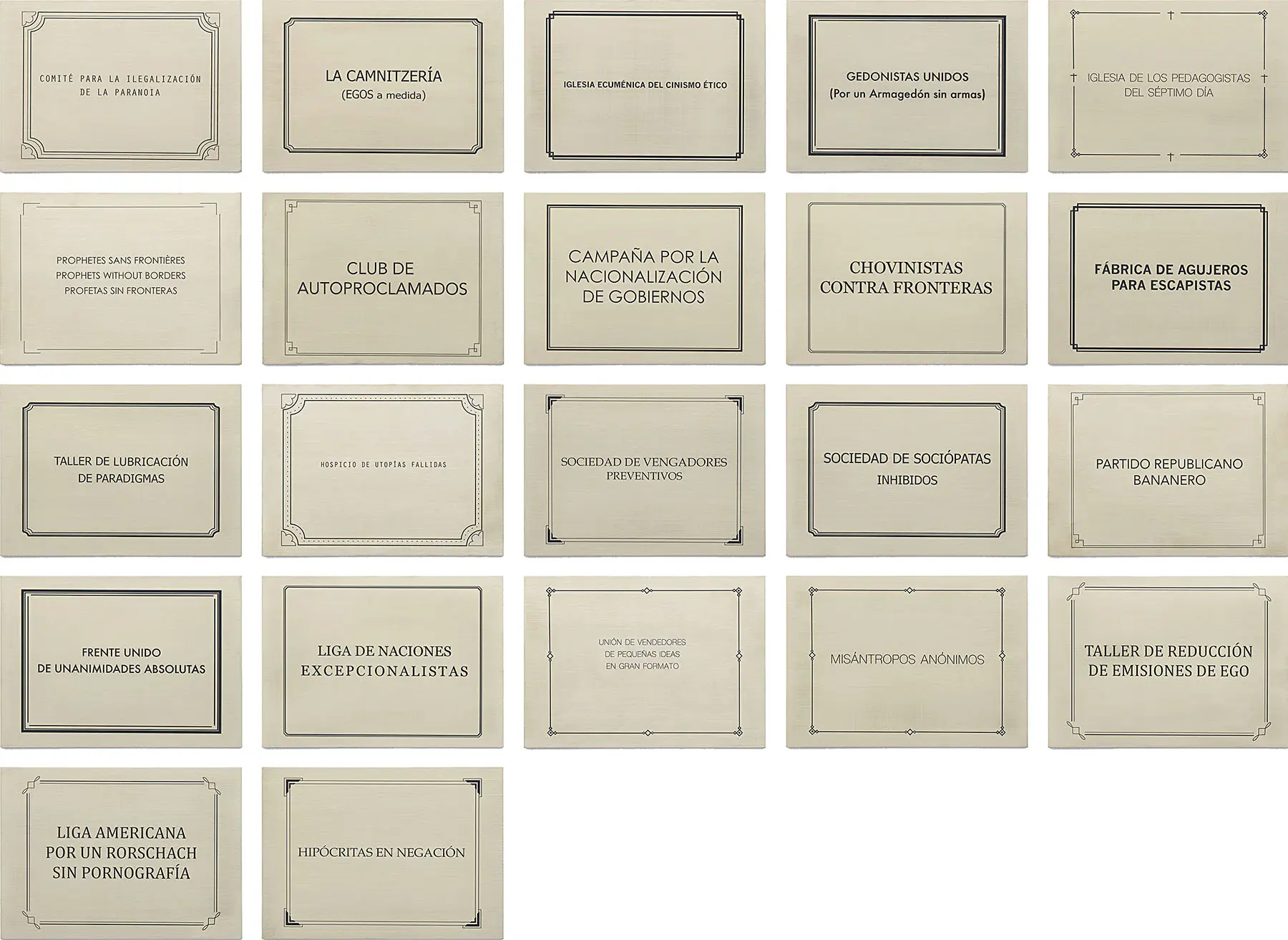
Camnitzer’s work mentioned at the beginning, Utopías fallidas (Failed Utopias, 2010-2018), in which he includes the sentence “Hospicio de utopías fallidas” (Hospice of Failed Utopias) connects with Sentences, from 1966. The difference is that the latter were minimalistic statements like “a surrounded space that expands in the direction of you,” which invited readers to experience everyday realities in unexpected ways, in the tradition of the surrealist’s and situationist’s “promenades.” In Utopías fallidas (Failed Utopias), meanwhile, what we find is a sharp-cut sense of irony in the service of an implacable critique of dominant culture. For example, “Liga de naciones excepcionalistas” (League of Exceptionalist Nations), “Liga americana por un Rorschach sin pornografía” (American League for a Pornography-Free Rorschach), “Frente unido de unanimidades absolutas” (United Front of Absolute Unanimities), and “Taller de reducción de emisiones de ego” (Workshop for the Reduction of Ego Emissions).
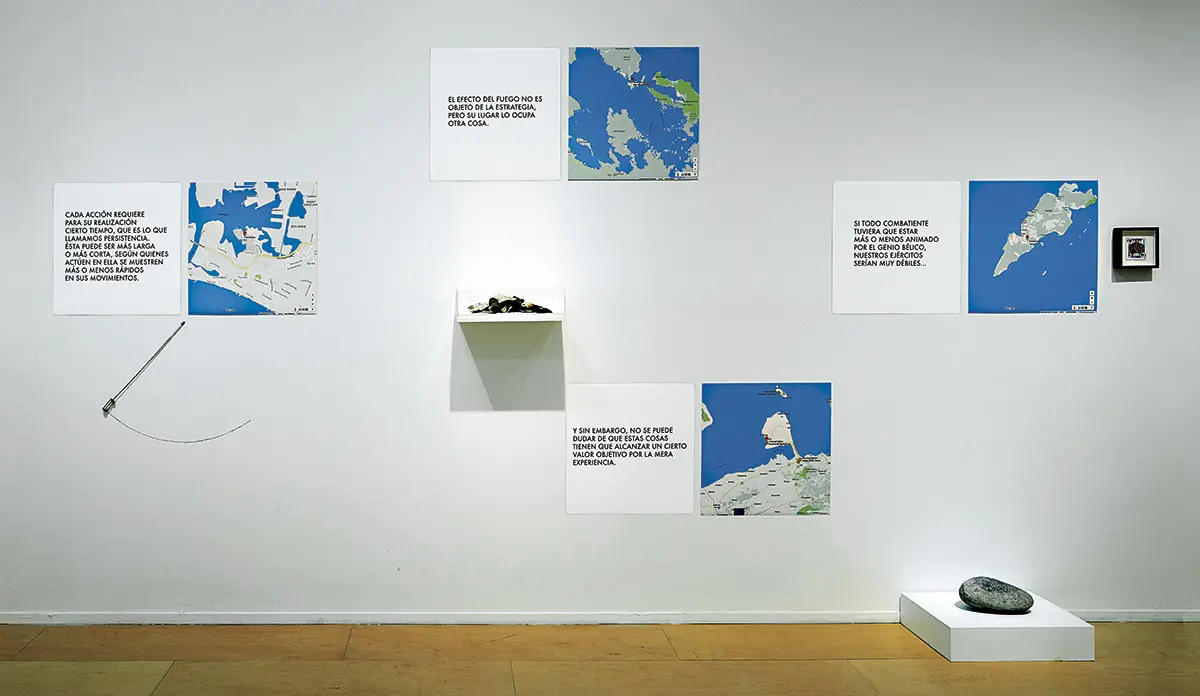
Among the recent works, notably the room dedicated to Von Clausewitz’s On War, titled De la Guerra, which revisits the continent’s political (and, thus, military) geography. Along with it, visitors found two highly representative examples of the artist’s longstanding pedagogical vocation. One is Radios infinitos (Infinite Radios, from the series Cuaderno de ejercicios [Workbook], 2011-2017), consisting of a text printed on a metal sheet, a pencil attached to it, and an invitation for viewers to write or draw on the wall their interpretation of or their response to the text’s instructions. The second is El aula (The Classroom), a space with two worktables, their respective chairs, and several confrontational phrases written on blackboards, pedagogical support materials for work sessions held during the exhibition.
CARLOS JIMÉNEZ