A wall covered with posters of open mouths could be a daring advertisement for a dental clinic, a campaign against hunger, a political action protesting something, or a campaign against femicides. Given that we are in an exhibition space, doubt dissipates. It is art.
Curators Andrés Duprat and Fernando Farina are in charge of this “Tribute to Graciela Sacco” at Casa América, in Madrid, a sort of sampling of the most iconic works created by Argentinean visual artist Graciela Sacco (1956–2017). The country and city where the show is organized are meaningful from a professional and personal standpoint, given that Sacco lived in Madrid and one of her children currently lives there. One of the emblematic works included in the exhibition, Bocanada (Mouthful), consists of a series of posters depicting wide open mouths that appear to be screaming with anger, pain, hunger, or boredom. One of the projects that Sacco regarded as “urban interference,” she would glue the posters on street walls to convey messages tailored according to the specific place and any surrounding images.
Near Bocanada, a screen shows an interview between Sacco and curator Diana Wechsler centered on a 2014 exhibition at the Hotel de Inmigrantes in Buenos Aires. In the interview, Sacco affirmed that, while the right thing to do in museum spaces would be to show the original one-of-a-kind pieces of Bocanada, the streets are, on the other hand, the natural habitat for the prints. After listening to this, I take a closer look at the open mouths displayed in the exhibition room in Casa América. Now, I know what they are trying to communicate: “This is not our place.” The domestication of Bocanada turned that former urban interference into the victim of curatorial interference in an exhibition that also feels incomplete, lacking the work that would give it context—another of the elements that were essential to Sacco, and too concise. Undoubtedly the characteristics of this museum space (two square exhibition areas that are not too large or high, and a corridor) are part of the problem.
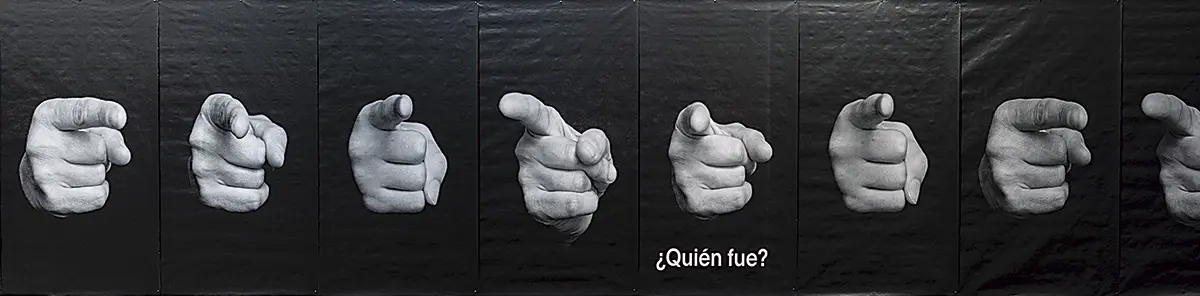
However, “Tribute to Graciela Sacco” does offer an introduction to one of the most important Latin American artists. From her pioneering heliographic works (a technique she used to print images on spoons, suitcases, or shoes), matchboxes (with the message “A single spark is enough to burn down the prairie”), to the conceptualism of her one square meter shoes-sidewalk, or her plastic door consisting of an image of people waiting. Always committed to various causes, her work addresses conflicts that remain current: migrations, domestic life as a political reality, censorship, social alienations, and lack of freedom. Sacco, one of the members of the venerated “Tucumán Arde,” knew how to tension, like only a very few have known, the limits of the media and the advertising language. As she once said, “To me, creating works is a way of thinking, a way of understanding what occurs around me,” and her work ¿Quién fue? (Who Was It?)—another project conceived for the outside—points to that direction; Index fingers pointing accusatorially. In the work titled Esperando a los bárbaros (Waiting for the Barbarians), the eyes are now asking the questions, forcing us to sketch an answer. In her exhibitions, visitors and not the works are the ones being observed.
However, as I was saying, this latest tribute to Graciela Sacco (which stemmed from a 2018 exhibition at the Museo Nacional de Bellas Artes, in Bueno Aires, where a video performance was presented in her honor) suffers from certain shortcomings. Also in 2018, a more gratifying experience took place in Sacco’s hometown of Rosario. “Territorio Sacco. Magical-Primitive. Graciela Sacco and Rosario” presented events organized both indoors and outdoors, that were more coherent with Sacco’s legacy, thanks to the curatorship by the artist’s assistant, Belén Antola. Like the passengers in the video installation Metro cuadrado T4 (Square Meter T4) recorded at Madrid’s airport—which shows the shadows of travelers circulating under prison-like bars—we will perhaps have to wait a little longer for a better celebration of Sacco’s oeuvre. The subtitle for that work, by the way, was Cualquier salida puede ser un encierro (Any Exit Can Be a Confinement). Enough said.