Vía Láctea (Milky Way, 2016), a project carried out by Gonzalo Lebrija (Mexico City, 1972), documents a group of cigar smokers from a variety of backgrounds and with diverse identities, aficionados of Cuba’s high-end tobacco purveyors Vegas Robaina, gathering for a public-space intervention in the courtyard of Havana’s Palacio de Bellas Artes.
The initial image celebrates the architectural relieves and blocks, in dialogue with the empty space, a container of modes of the living. On the other hand, Lebrija’s work emphasizes the act of smoking as a practice of connection, the constant presence of which highlights tobacco production as one of Cuba’s dominant economic activities.
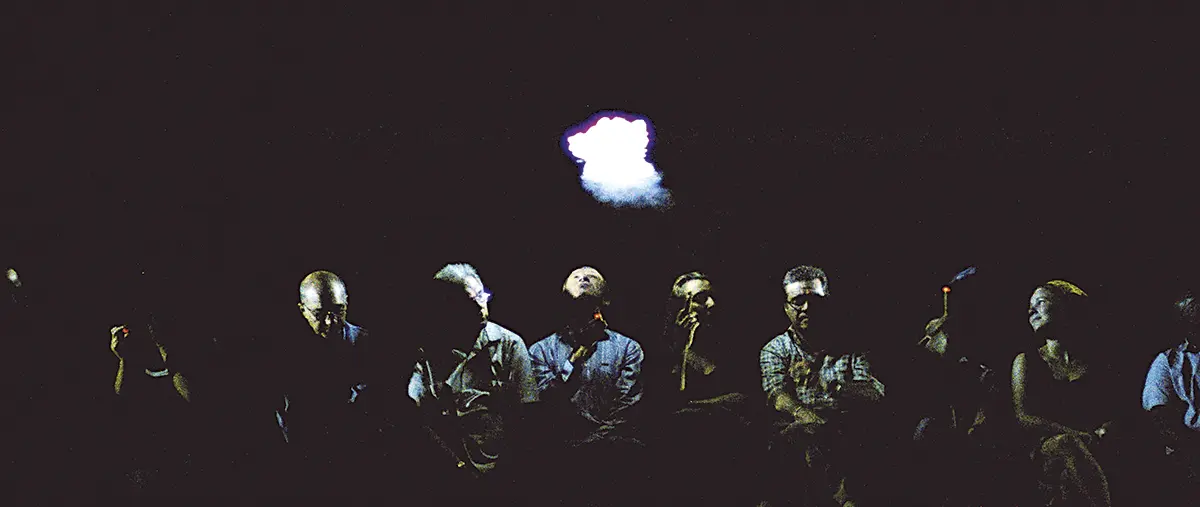
Through the motions of the smoke, this project connects with other contemplative explorations of time in Lebrija’s career, and with his use of video and photography as supports for the gathering and gleaning of instants.
The setup of Vía Láctea takes us from the panoramic photograph of a line of people (more men than women), all seated as they smoke Havana’s finest cigars, to their portraits in pairs or alone, blurred by the smoke and the shadows of the night. Could it be that, like the sidereal agglomerations that come to form galaxies, the contrast between a panoramic shot and a portrait signals towards nuances in what we perceive?
We are invited to travel from what would seem a practice accessible only to the few, to a photographic metaphor of the mutable condition of living and being. Many distinct possibilities unfold in the compositions that the smoke evokes, braiding areas of clarity with others that vanish into the bodies.
Within the incidences and obscurities of the luminous, the faces fade, like the lived situations, leaving behind—like the smoke—traces in our emotional memory and also, as is the case here, in the gestures of the body language of enjoyment, the way our arms are posed, the posture of our back, the way a cigar is held. A seemingly superficial situation becomes poetic as it is rendered personal in the smallest of actions.
In addition to digital photographs, printed on cotton paper, a video works as mobile support of the event. The changing light conditions allow the contemplation of the human and the physical dynamics of the puffs, by intermittent light inputs that reconcile us with the sensitive observation and the experience that gives: geometries of chance, light dance, its possible origin, the twinkling light beam of an old projector, devices that have always caused creative fascination in Lebrija.
Gonzalo Lebrija’s work has been the focus of solo exhibitions at venues such as La Casa Encendida (Madrid, 2015), Vancouver Art Gallery (2011), and Museo de Arte Moderno del INBA, Mexico City (2011). It has also been presented in many group shows organized, among others, by Museo Jumex (Mexico City), Museo Amparo (Puebla), the City of Paris Museum of Modern Art, and the Museum of Contemporary Art Denver.