The question-artwork posed by Gabriel Sierra, Si el sol es redondo, ¿por qué hacemos las ventanas cuadradas? (If the Sun is Round, Why Do We Make the Windows Square?), is relevant in our days. Suffice it to remember that the first TV screen was round, being an entire odyssey to turn it into a square, which later became a rectangle, the parallelogram most loved by our culture. In fact—and this is something Sierra has explored—we are always inside a rectangle: my computer screen, the surface of my desk, the ceiling above my head, the floor under my feet, they are all rectangles. My cell phone is a rectangle, even if the hole from which it peers out into the world is, as my eye, round.
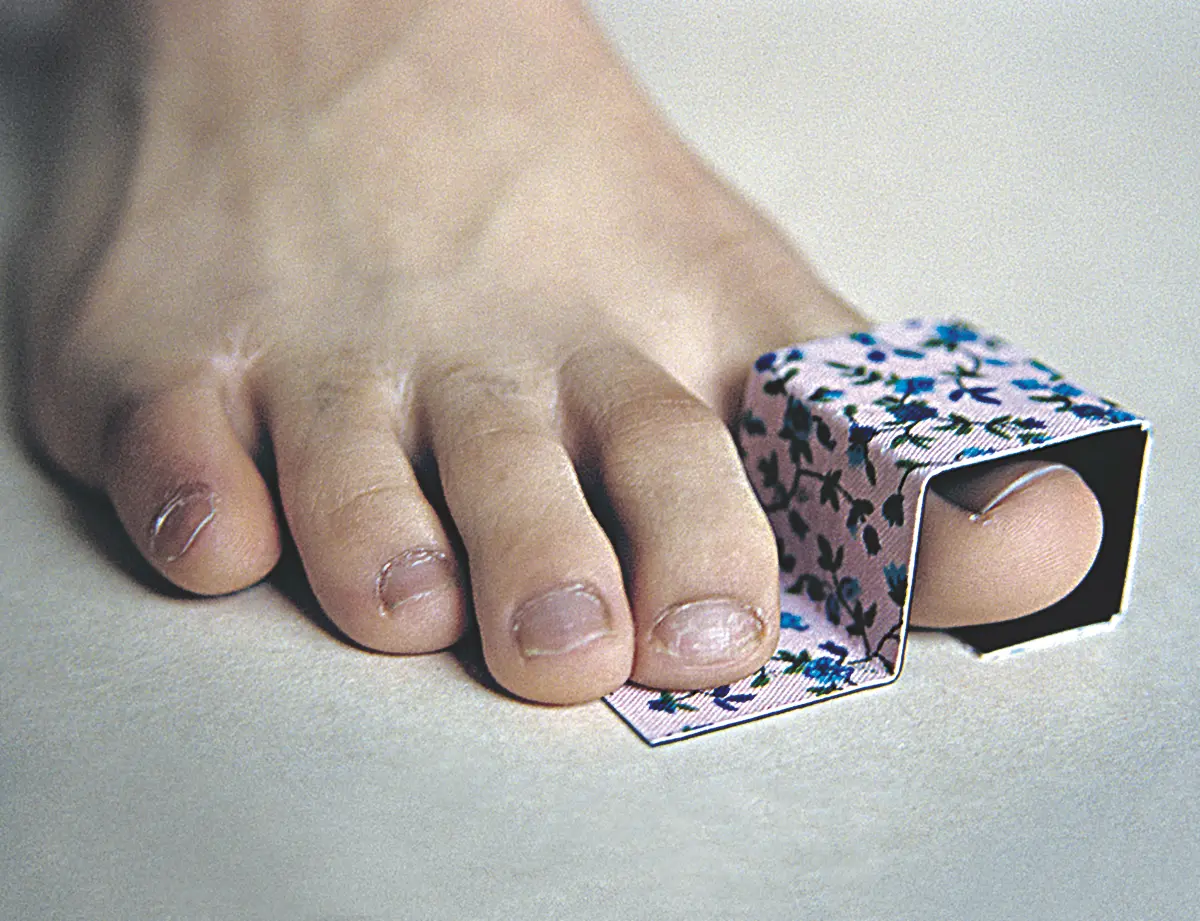
Gabriel Sierra reflects on this rectangular prison in which we have confined ourselves on our own will, and tries to find alternatives. To get out of prison, to escape from the rectangle, for which, the first task is to point out its limits, its borders. Sierra’s work Sin título (Tratamiento para dedos maltratados por objetos) (Untitled [Treatment for Fingers Abused by Objects] (2002), from the series Objetos y estructuras parafuncionales (Parafunctional Objects and Structures), is particularly significant in this respect. In it, a big toe, flattened according to its gravitational tendencies, is framed by a kind of rigid ribbon that, rather than serving as a cure, works as a frame, a mold that points to the finger and confronts it at the same time, opposing its organic form.
From the foot, we move out into space, and from space into time. Always suspecting that, if we cut one into squares, we are doing the same to the other. Indeed, in Sierra’s work, spaces reveal their condition as rectangles, while days and hours act as receptacles in which titles and colors can be poured.
In 2015, the title of the exhibition held at the Renaissance Society of the University of Chicago changed every hour. The visitor arriving at 10 am would enter “Monday Impressions,” the one arriving at 1 pm would see “The Room Is in My Eye. The Space Is Under My Body,” and the visitor arriving at 5 pm would find himself at “Do You Know Who Built Your House?” Thus, without any physical alteration, the nature of the space shifted every hour, in a cycle where Monday was at the start of every journey, except for Monday’s journey itself, since museums close on that day of the week.
It goes without saying that the exhibition was filled with rectangles. Some bases enclosed a space where a group conversation could take place and white walls that—although they could be jumped over—divided the world into small areas. There were also straight lines on the floor demarcating territories, and a couple of receptacles that could be used to take a nap, the first one filled with straw and the second one with newspapers. Materials that, subtly but sharply, distanced this pair of adjacent containers by hundreds of years, because while Sancho Panza could sleep in the first one, only someone from the 20th century could rest in the other one. Maybe someone from the 21st century, but this material, the newspaper, is already vanishing in our times.
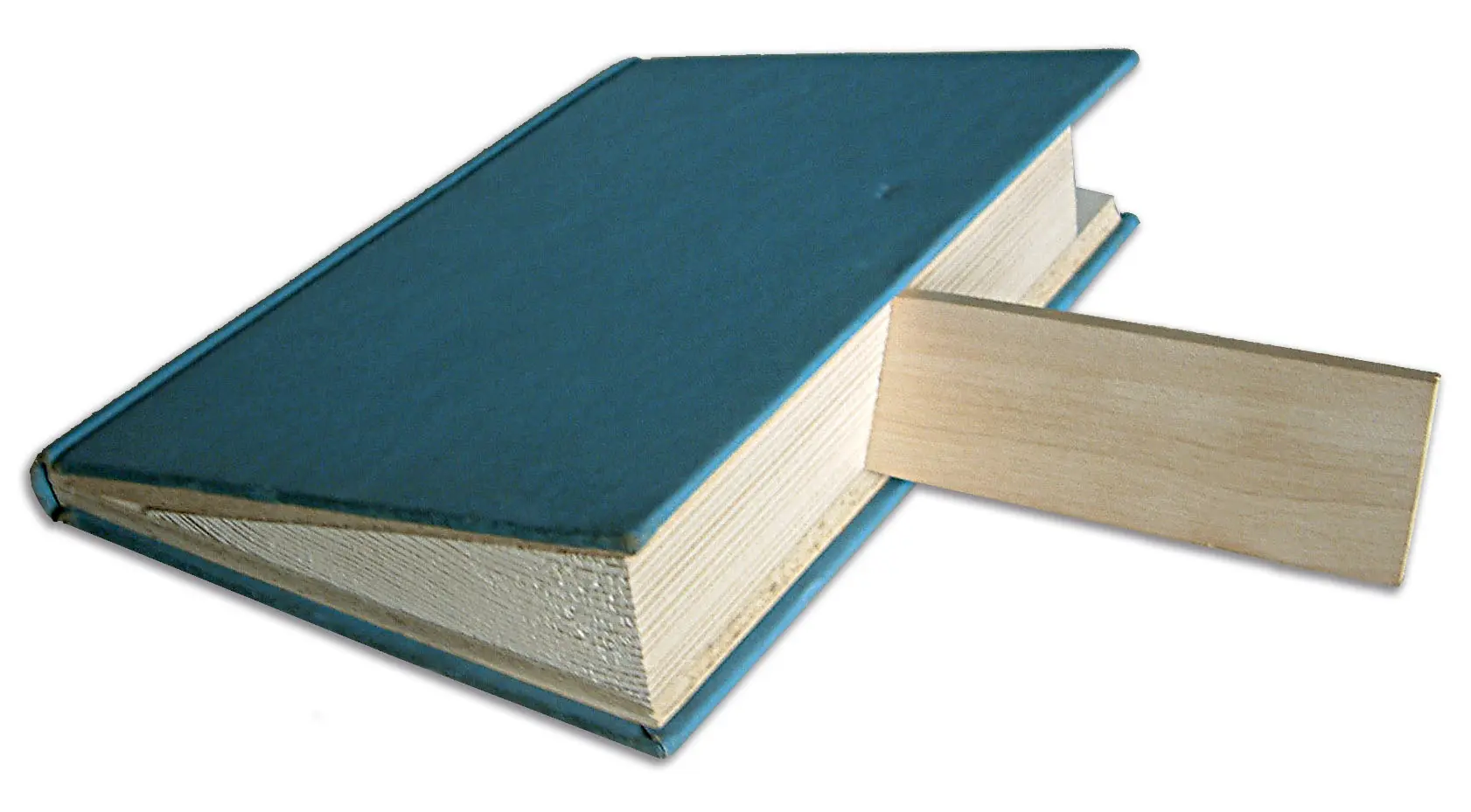
Sin título (Tercio de torta, marca páginas) (Untitled [A Third of a Cake, Bookmark]) (2003), carries in itself the seed of this space-time game. A bookmark is a time-marking device: we place it on the page the same way we mark the days on a calendar. Sierra installs that kind of bookmark transversally, touching almost all the pages (in truth, a wooden piece), as though producing a cut where time becomes a pyramidal solid. The artist transforms the sequential character of the sheets of a book into a present volume. I am revisiting Sierra’s earliest works because they already contain the future of his artistic exploration. It is not by chance that in a 2011 interview, referring to his evolution, he said: “I think that every project is different and at the same time, in a way, the same.” 1
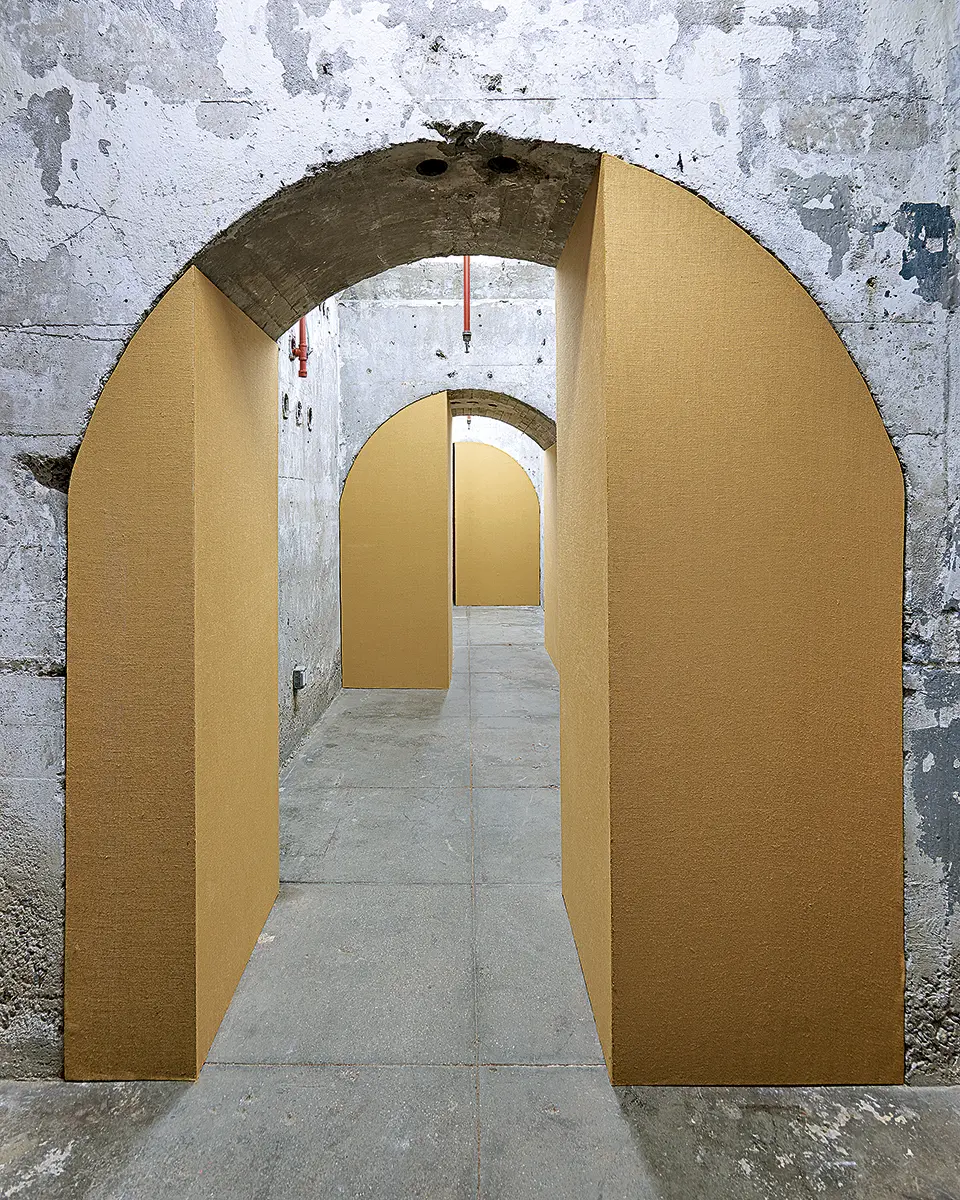
“Thus Far,” Sierra’s 2013 exhibition at the Peep-Hole contemporary art center in Milan, did not change its title in a sequence but instead deployed yet another resource intended to mark the passage of time. On Thursdays, visitors had access only to specific galleries; on Wednesdays, to others. A specific number of spaces was assigned to each day, or, to put it another way, each day became a specific fragment of space. The project was intrinsically connected to an idea Sierra has mentioned several times: to build a house where rooms are assigned by day. To paraphrase the artist: if you left something in a room on Monday, you would have to wait six days to get it back. Here, despite Newton and his Principia, time acquires a qualitative dimension, unmeasurable and specific, non-homogeneous and, furthermore, cyclical. In sum, time reveals its specificity, since we can all agree that every day has a character of its own, with Thursday’s being opposite to Tuesday’s, for example.
It is not surprising to learn that, in 2009, Sierra proceeded to create a calendar, an almanac resembling Xul Solar’s piano in that, just as the Argentine transformed music into colors—musical tones, tones of pigment—Sierra translated days into combinations of the chromatic scale. Based on the almanac invented by Enzo Mari five decades earlier, in 1959, the new calendar substitutes days for hues, ranging from white (Sunday) to black (Monday). In turn, the numbers of the dates are replaced by a random selection of colors, while the rainbow rules the months. Thus, each day of the year becomes a specific and unrepeatable combination of three hues.
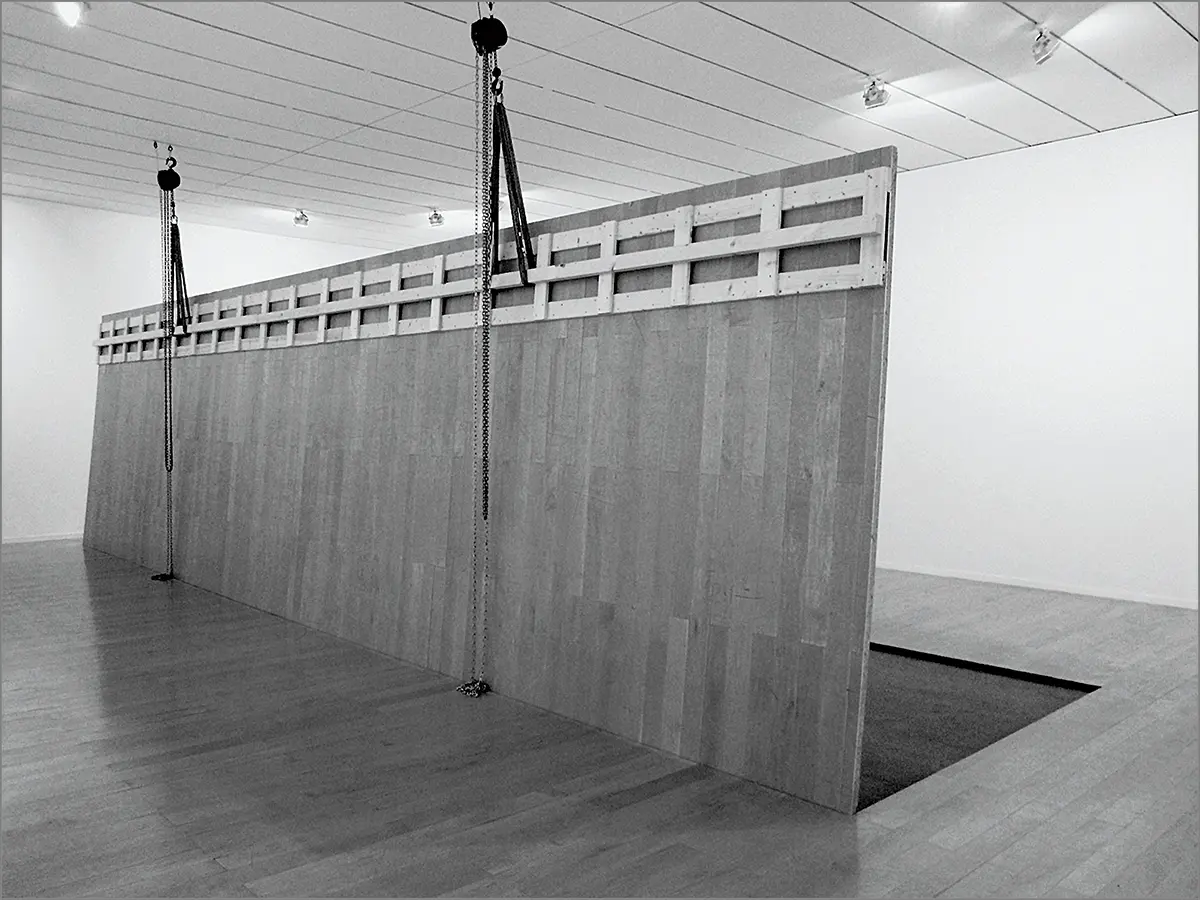
Another allusion of time, which a spatial problem resolves, appears in Sin título (El día como hueco en la mitad de la noche) (Untitled [The Day as a Hole in the Middle of the Night]) (2011). Presented at the Lyon Biennial, this work consists of a large, ten-by-three-meter rectangle taken from the gallery floor and suspended from cables attached to the ceiling to form an almost-90 degree angle. Thus, the floor becomes a wall, leaving behind its horizontal condition; without changing an atom, something ceases to be what it was and becomes something else. The work alters the gallery space entirely; even though, when you think about it, only two cables have been added. All that has shifted is the arrangement, in a gesture that is as light as it is forceful.
Visitors will turn around this formerly two-dimensional “floor” that has now acquired volume, a three-dimensional condition, without ceasing to be a sheet. This work takes up the whole problem of Concrete and Minimalist art: it brings a two-dimensional object into a three-dimensionality, thus shifting our perception of space, the relationship of the viewer’s body with the room, while at the same time changing the name of the object with a simple twist to its physical place in the world. In this regard, in an interview for the Biennial, Sierra says: “This (…) work is about the relationship between architecture, the human body, and the materiality of space. How the materiality of space influences our behavior, and how we live. All my work is about language and how we build the material world.” 2
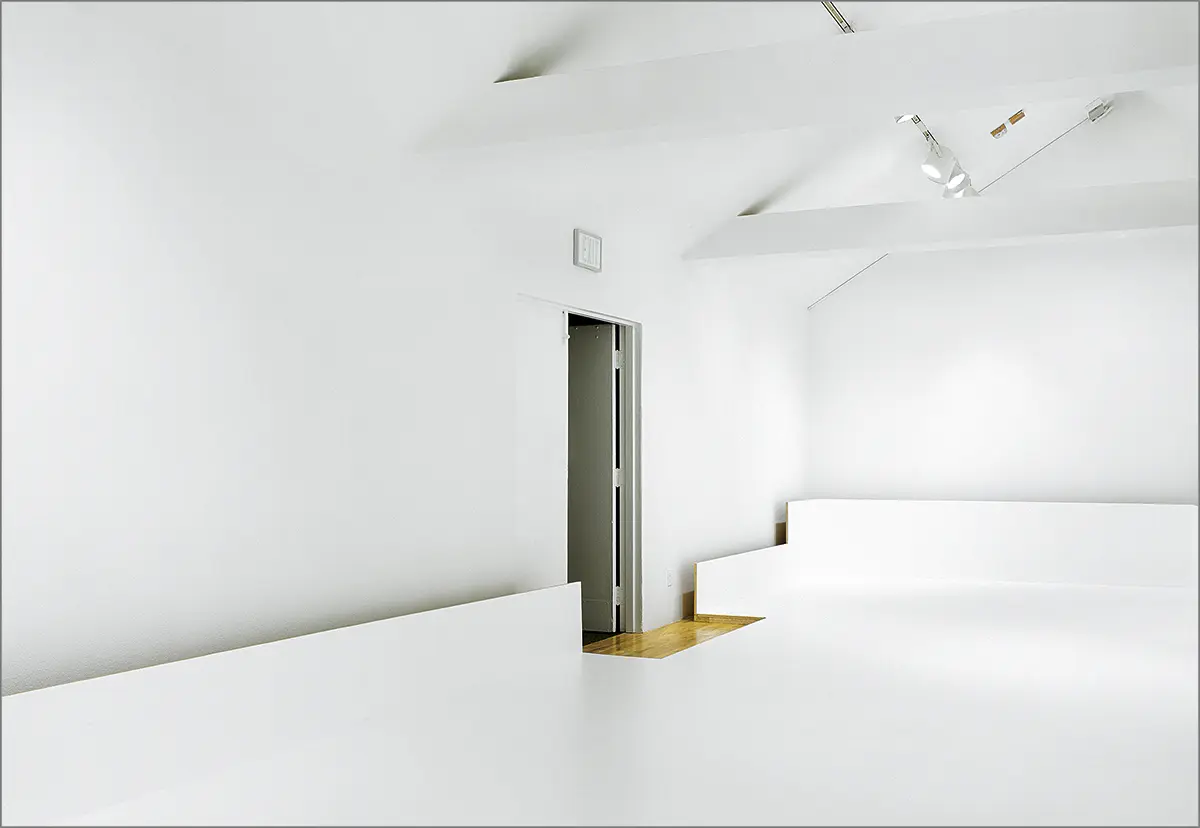
Sierra explores how architecture guides and pigeonholes, places limits and imposes rules. Architecture is a series of norms in a solid state, codes that cannot be overcome because they appear in the shape of walls, albeit sometimes a physical barrier is not even necessary; in fact, drawing a line on the floor of a supermarket may suffice to make people hesitate to cross it and turn around. In that sense, Sierra says: “We constantly forget that we are contained within buildings.”
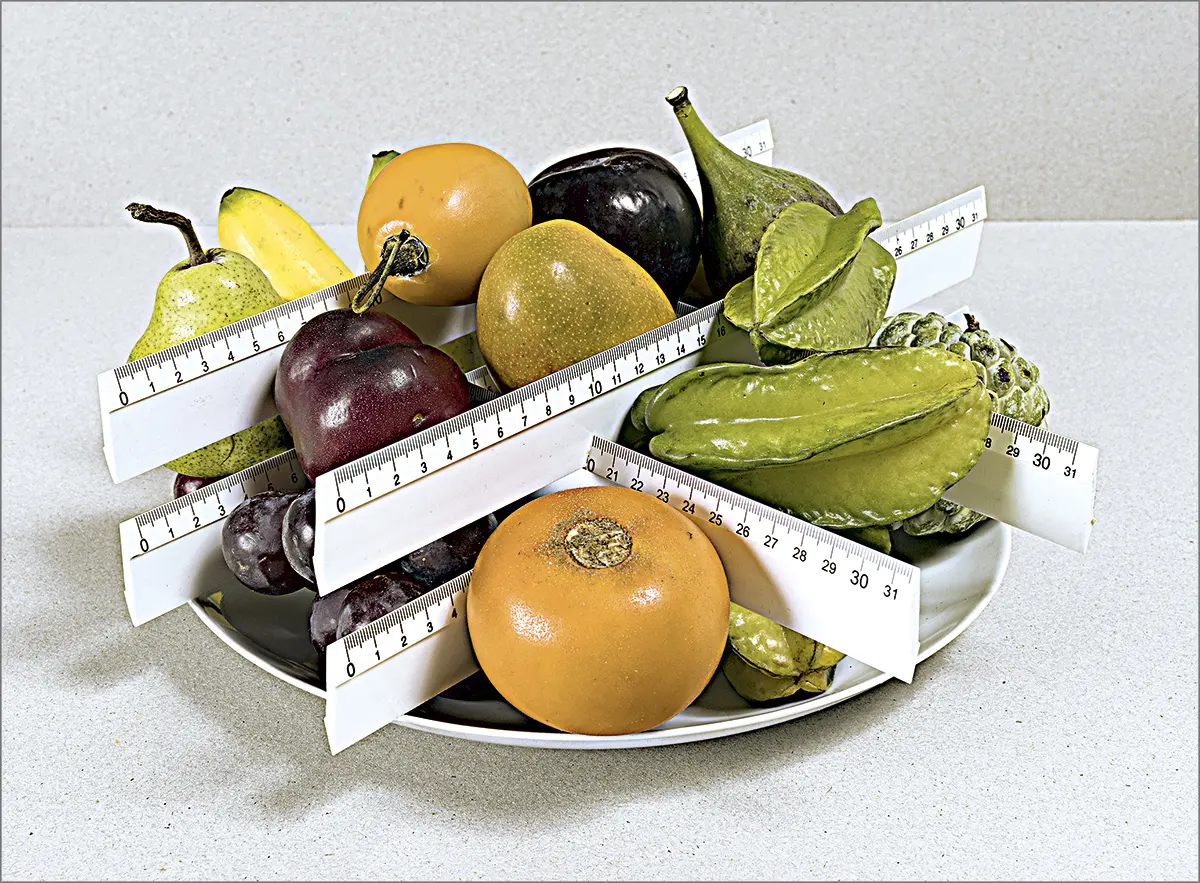
The built world regulates our bodies and behaviors, an issue that Sierra’s work never stops pointing out and exploring, rendering it tangible and factual. In that order of ideas, the relationship between moral rules or customs, and the ruler used to measure (for example, an architectural plan) must not be overlooked: it is not a coincidence that both devices, one mental and the other physical, have such closely related names. They both judge and measure, they both divide and classify; from the architect’s drawings, we will get the walls of a room. In Sin título (Unidad para lección de matemáticas) (Untitled [Unit for Math Lesson]) (2007), Sierra arranges apples, oranges, and other fruits separated by wooden rulers. I see the still life, and I wonder what Cézanne would have made of it. Each fruit’s space becomes a cubicle, cubes that the mind finishes drawing after seeing the first lines in tangible reality. Here the grid organizes the organic, demarcating, molding, and constraining it in the same way the big toe, mentioned above, was disciplined by a frame.
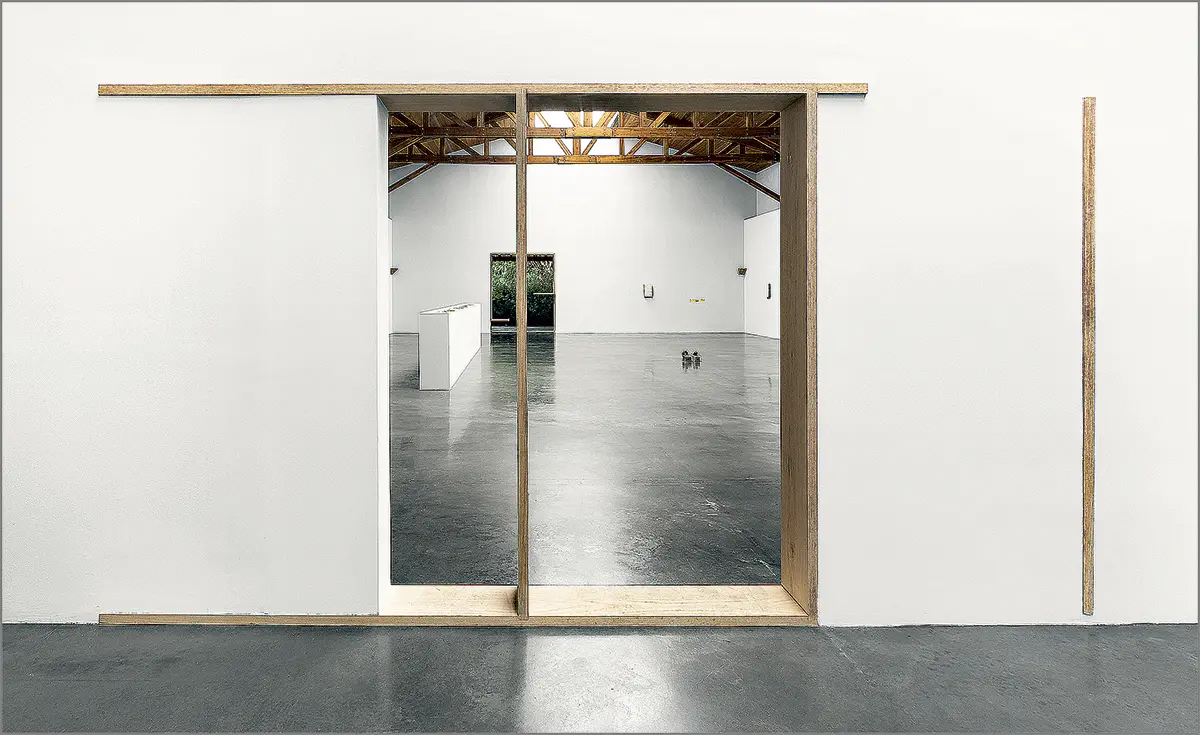
Anticuartos (Antirooms) is a series of works created using industrial objects inside the walls of the exhibition, in such a way as to make them appear flat, two-dimensional. Interestingly, while in the Lyon intervention the floor—the flat plane—was given volume, here objects acquire the condition of paintings.
The objects, organized and framed by receptacles made explicitly for their dimensions, are fitted into spaces so tight that it would be challenging to slide in a finger in order to pull them out. I will mention two that seemed particularly claustrophobic. The first one was on the wall of the exhibition Untitled (The Devil in the Shape of a 2×4) (2011). It was a closed ladder, installed inside a rectangular cavity so that we could only see its profile. The ladder was rigid, and it seemed that it wanted to be freed to return to its pyramidal condition as a three-dimensional object: as if it wanted to stretch its legs. The second object, included in the exhibition Thus Far, mentioned above, was a curtain made with parallel bands, an object that, it must be noted, has been used by the artist repeatedly as a separator, marker, and organizer of space. On this occasion, the curtain was closed and framed on the wall by two converging rectangles, a horizontal one for the rod and a vertical one for the fabric. Thus trapped, both by the rod and by the fabric’s rectangles, this curtain could not be opened nor closed; it had lost its ability to be a curtain, its curtain-ness, even its name “curtain.”
Finally, among so many other matters left out of the rectangles that comprise this article, I cannot end without mentioning Sierra’s obsession with those thresholds that, in architecture, take you from one room to the next. The threshold, a door frame, for instance, signals a shift both spatiotemporal and epistemological. Indeed, if a Tuesday is different from a Wednesday, what can be said about the difference between a living room and a bedroom? Between a social and private space, a street and a building, the hallway and the salon, the first and the second? Who determines which is which?
Moreover, what do terms like “first” and “second,” implicit in any threshold, refer to? Is it a question of duration, place, or hierarchy? Every threshold implies a categorization. Sierra underscores this fact, especially in the homogeneous, empty spaces of contemporary art galleries, which, despite being the most fiercely categorizing sites in our culture—because what is inside them is art—hide behind the neutrality of the color white—an issue that the artist has also engaged (Background Figure Figure Background, Aspen Museum, 2008-2012). Let us not lose focus. In some occasions, Sierra fragments the frame; in others, he expands it, stretching with his gesture the present of a given instant, turning a passageway into a threshold, a trajectory. The works from the series Estructuras para transición (Structures for Transition) are examples of this.
Similarly, in his exhibition “ggaabbrriieellssiieerrrraa,” at Kurimanzutto Gallery, in Mexico City (2013), the artist worked these thresholds in detail, highlighting them, giving them an expanded moment in two works of the series Estructuras para transición (Structures for Transition). In sum, Sierra stops at those architectural spaces to which we usually do not devote more than the second it takes to place one foot in front of the other. The attention paid to the thresholds in that exhibition coincided with the attention paid in its title to the letters of the artist’s name. For the viewer, reader, walker, there was thus no other option than to stop at every one of the phonetic signs, which have been duplicated to extend their stay in the world.
The name of the artist expands and so do, inside the gallery, the risible thresholds charged with the anything but risible task of connecting one space with the next, a before with an after, a first with a second, a Sunday with a Monday, and what an abyss there is between those last two places of our environment
NOTES
1. Interview with Gabriel Sierra by Ruba Katrib, Mousse Magazine No. 28, April-May 2011. Milan (Italy).
2. https://www.youtube.com/watch?v=HGH340WPHZI (last accessed in January 2019).
JULIA BUENAVENTURA