Since the eighties, Florencio Gelabert has researched different ways to expand the possibilities offered by sculpture, installation, and drawing, as a means of visual expression. During his stay in New York (2005-2013), he became interested in everyday materials such as vitroceramic slabs and construction debris. From that moment on, his work focused on the exploration of these elements. The use of these materials has allowed him to create works that alter the viewer’s experience concerning space, as shown in the exhibitions he has presented since then and particularly in his most recent show presented at Ideobox Gallery, in Miami.
According to Gelabert, “Displacements” presents a new way of seeing the landscape, a personal proposal that offers a unique body of work consisting of sculptures and reliefs. The title suggests a play on words between movement and the traditional view of the environment. Through the works, and even the curatorship carried out by himself, Gelabert invites us to see the surrounding reality “with a wider and more imaginative pupil, to approach the landscape and its objects with other vibrations, and to receive their physical strength from another perspective.”1
His previous works have started from the use of everyday items and objects found casually on the street. Whether made of stone, steel bars or ceramic, each piece begins with the exploration of its physical characteristics, and from there he alters its perception. Ultimately, it is about recreating similar or allusive scenarios to urban environments.
At first glance, the sculptures look like simple ceramic slabs or broken marble plates. When carefully observed, it is possible to perceive an intention behind the rupture, which not only alludes to the violent way in which the material is fractured but also “recalls the large excavations made by Land Art artists in the seventies.”2 In this case, it is important to note that, in Gelabert’s work, these fractures are fundamental both formally and conceptually. On the other hand, he breaks pedestal sculpture tradition by using marble and granite as part of structures that, while still three-dimensional, are hung on a wall.
The exhibition begins with a white marble sculpture made with two fragments resulting from the breaking of a square, assembled in an X shape and placed on an oxidized metal base. When set in front of a white panel, the piece “moves” through the reflected shadow. On the main wall of the gallery, there are three sculptures in which the pieces of black granite—this time carefully cut—are superimposed in elegant forms and become mirrors due to the brightness of the perfectly polished surfaces. The shadows that result from the reflection of light on the different cuts create interesting “paperless drawings” on the wall, which recall the works by Gego. On the other hand, the central piece of the exhibition, made of two slabs of black marble cut in a wavy shape, refers to the sense of balance and the concept of yin and yang.
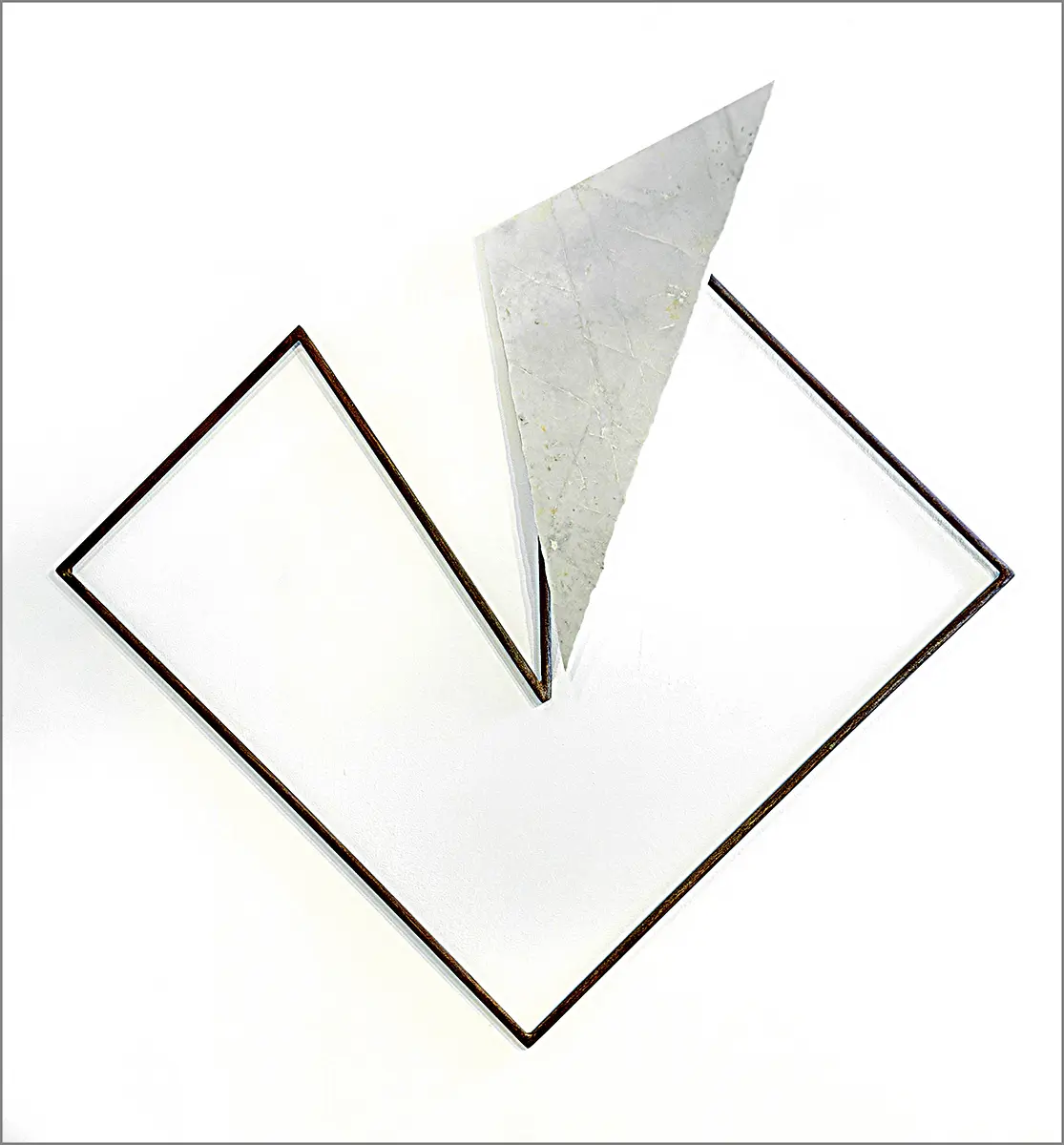
On the next wall, Displacement IV, an abstract-geometric piece made with an oxidized steel bar and a slab of white marble, simulates a kind of “fold” that comes out of the wall. In this work, which in some way is the centerpiece of the exhibition, we can see a clear transition between drawing and sculpture and the consolidation of his language which combines aspects of Minimalism, Arte Povera and Conceptual art.
In the second gallery, in contraposition to the work displayed on the opposite side of the wall, he presents a square piece made with a thin rusty steel structure from which hang several pieces of white marble on two of its sides. The gallery features two additional pieces. A wall piece features an imposing rectangle of white marble with two cuts in the shape of “wings” or “fins,” so delicate that it gives the appearance of observing cut paper, and a second sculpture. Displaced Sculpture I, located in the center of the space, is made of three pieces of white marble, which, based on its composition, can be interpreted as a solar clock.
The exhibition invites us to reflect on the acceleration of urban development and, at the same time, on its deterioration. Materials such as fractured marble and granite and rusted steel bars, oxidized through the use of acids, abstract the social character of the piece and, at the same time, emphasize its materiality, thereby enriching its cultural meaning. The pieces—which start from basic geometric shapes such as the square or the rectangle and become complex when broken and combined with metallic elements prefabricated by the artist—establish a close relationship between the urban environment and its deterioration or destruction. Gelabert proposes an interesting concept, nuanced by a new approach to drawing and sculpture, which studies how the material itself is communicated, without assuming that the mind sees what the eye perceives.
NOTES
1. Florencio Gelabert, interview by the author, Miami, January 8, 2019.
2. Ibid.