In August of 2018, Federico Herrero (b. 1978, Costa Rica) completed a site-specific commission for the Museum of Contemporary Art, Chicago, entitled Alphabet. To create the work, Herrero painted flat, pastel-colored blocks across the Museum atrium’s walls and ceiling. He also applied translucent shapes in yellow, blue, and green to atrium windows so that, as light passes through the glass panes, it casts colorful shapes onto the floor.
While Herrero’s first solo exhibition with James Cohan, Open Alphabet, was conceived more traditionally than the museum’s work, it unmistakably evokes the artist’s public murals and immersive installations. The show comprises nine, new paintings – ranging in size from 118 x 157 3/8 inches to 11 x 13 7/8 inches – mounted on the walls of two interconnected spaces. All of Herrero’s imagery is contained within the edges of his canvases; yet the works’ particularly exuberant palettes, effervescent geometries, and alluring organic elements activate the entire gallery space. In the same way that the title Alphabet encourages the viewer to associate individual forms with the building blocks of language, Open Alphabet summons the idea of elemental sound, while stimulating and freeing the viewer to construct meaning and visual narrative within and between each exhibited work.
The vision that emerged during a recent visit to Open Alphabet was that of a lively biosphere. Indeed, the white walls and tall, industrial ceilings seemed to encapsulate an idiosyncratic combination of natural and urban components, further animated by work titles such as Robot, Caravan, Cactus, Cangrejo (Crab), and Laguna (Lagoon).
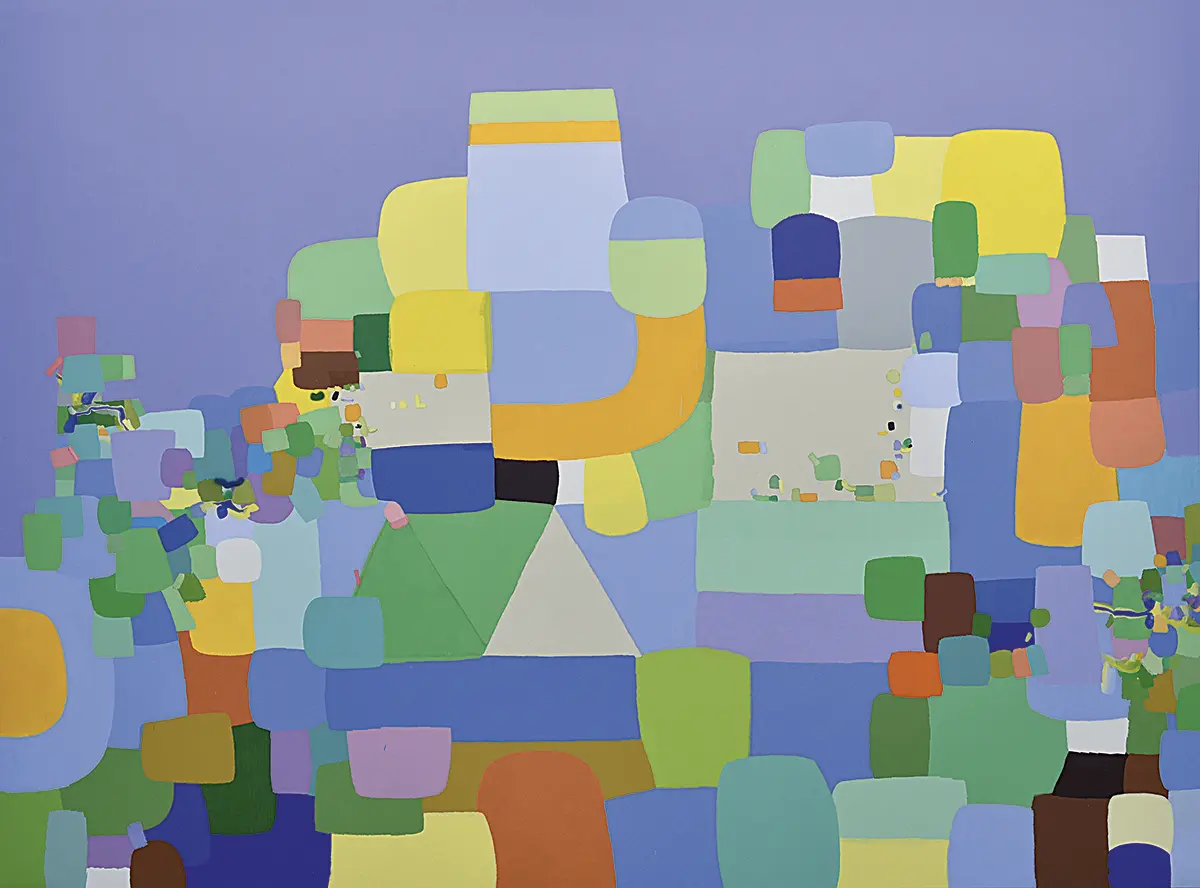
Caravan (2018), an enormous canvas filled with Herrero’s characteristic vividly-colored blocks, greets viewers as they enter the first gallery. Even without the knowledge that his work often references San José, Costa Rica (the artist’s native city), these accumulations of abstract shapes evoke a playfully stylized urban map. While it is not essential to one’s understanding or appreciation of the work, familiarity with a tropical, developing metropolis can undoubtedly enrich the viewer’s experience. Imagining that the canvas presents a bird’s-eye view, the viewer begins to identify roadways, plazas, alleys, and athletic fields, with gardens of overgrown flora abutting abandoned patches of concrete. The blocks of burnt orange, glowing tangerine, and sunny yellow that punctuate the canvas seem to suggest landmarks. When looking at the painting from a frontal perspective and not from above, the background in spring greens and vibrant lilacs reminded us of a changing sky on labyrinthine hills.
Other works in the exhibition—distinct from Caravan in size and formal composition—promote an active viewership that combines intimate examination and removed reflection. The seven large, rectangular slightly curved shapes in limited yet luminous color pairings within Flava (2018), for example, seem to spring forth from the neutral gray background against which they are set—thus rewarding observation from a distance. Robot (2018), an unusually small painting, does not proffer a beguiling neon palette; yet its size alone calls for a close study. Upon complying with this appeal, the viewer will discover a small creature with a dome-shaped body and four dangling appendages silhouetted against a violet background. This creature’s body also contains a map-like array of pastel-colored blocks. While at first glance these shapes appear painstakingly delineated, they are fuzzy-edged, semi-transparent, and unevenly-textured. This discovery prompts a return to Caravan, where equally close study reveals unexpected, almost hidden moments in the painting. Towards the right and left edges of the canvas, for example, small passages of blue pigment outlined in yellow seem to liquefy and run like streams through green rectangles. These areas easily conjure the image of a river traversing a backyard – a space of calm within a bustling neighborhood.
As the viewer zooms in and out of these territories, surveying its creatures, structures, and oversaturated hues, he or she becomes a part of the biosphere. One gets the sense, however, that this environment continues to function whether humans are present or not. Herrero’s paintings seem to be in constant flux: chugging, crawling, blossoming, bubbling up, even drifting away.