The single most important event in the last sixty years in Colombia, the demobilization of the Revolutionary Armed Forces of Colombia (FARC), the oldest guerilla in the continent and perhaps in the world, was the culmination of long and complicated negotiations that led to the signing of a historic peace agreement in November of 2016.
The work by Doris Salcedo titled Fragmentos (Fragments) responds to a peace event that could forever change our future and our children’s future. Her commitment to the proposal required the collaboration of people victimized by the very arms surrendered by the FARC as part of the peace agreement.
Reluctant in the beginning, she accepted this commission by a Colombian government that wanted to erect a monument to peace with the weapons used during the war. It became clear that, at that moment, more than ever, it was necessary to reconstruct our past and recognize the things that we had willingly decided to ignore. Among them, were the impact that violence has had on us, a continuum that silenced the voices of the dispossessed by an excluding, racist, and classist society that has rendered invisible and hidden the pain and suffering of our peasants, indigenous peoples, Afro-Colombians, and everyone else who has suffered this useless war.
Therefore, the reason for being of Fragmentos is, in Doris Salcedo’s own words, “to assert the possibility of thinking about brutality.” With this in mind, she proposed an anti-monument from a perspective of history and memory removed from a continuous, infinitely repeated, narrative: an anti-monument radically opposed to a single narrative that, supported by political violence, extinguishes people’s ability to think and gain awareness while also destroying our social ties and community structures.
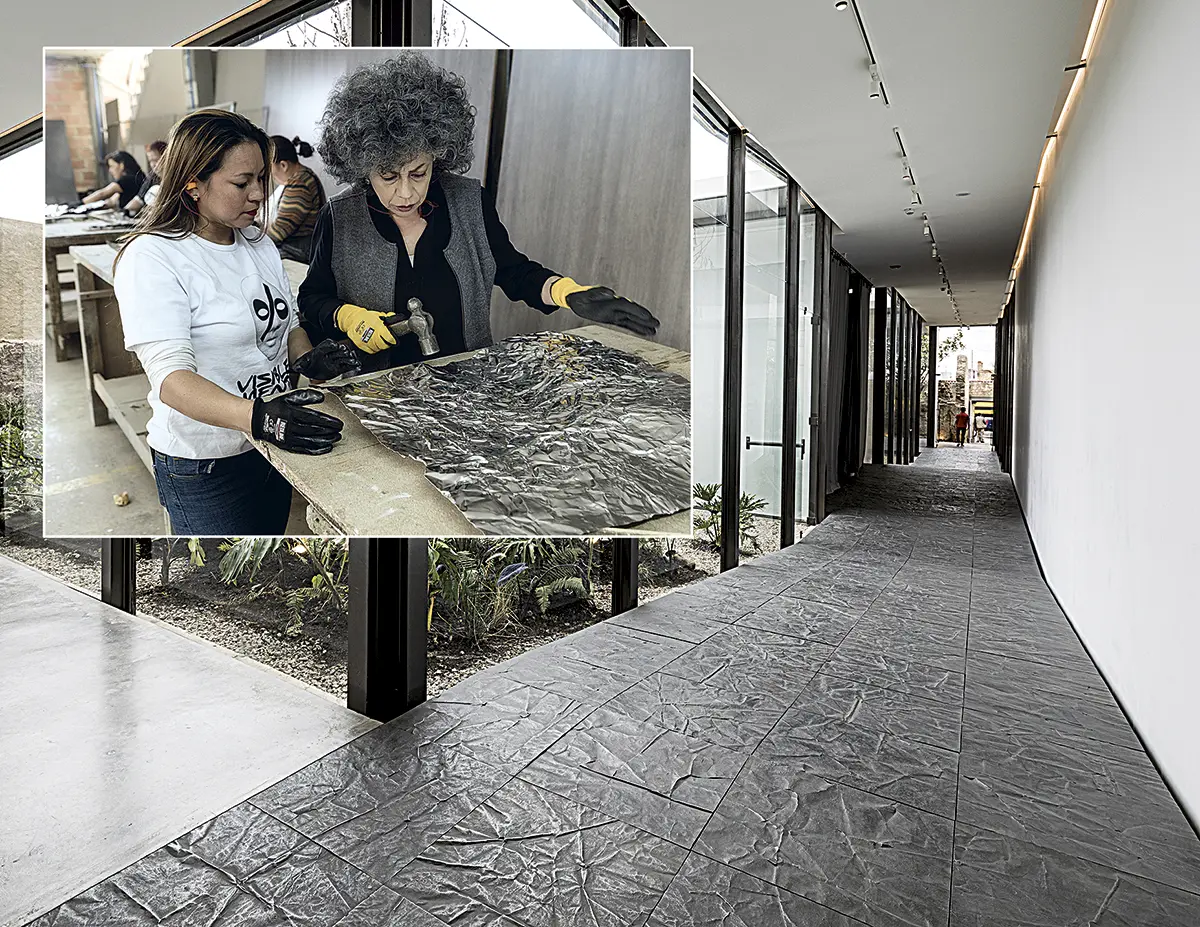
Rather than proposing a glorious and eternal object erected not to evolve throughout centuries, conceived for the glorification of war and violence, Salcedo chose instead to build one from the bottom up. In the words of James Young, one of Salcedo’s sources of study, it “is worked from the ground and not on it, so the burden of memory can be returned to those looking for it.” This anti-monument is raised as an architectural/sculptural space that stands on a floor made with the 36 tons of arms—more than nine thousand weapons—surrendered by the FARC, melted down and recast as tiles. The tiles were cast in molds, hammered into shape by a group of women that had been victims of sexual violence. Salcedo invited them to perform this act of remembrance and mourning set against a backdrop of ancient ruins also located in the place, which have been preserved and used as an allegory for the disastrous legacy of war. In this manner, the space designed by architect Carlos Granada is a box of parallel times where an attempt is made to reconstruct the past from the future of new generations, even those yet to be born. Fragmentos articulates, through the Colombian Ministry of Culture, a 53-year program of support for artistic creations and the collective memory processes pertaining to the internal armed conflict; perhaps, the same amount of years that it will take us to process this trauma.
Fragmentos constitutes “a silent and empty space that I do not attempt to fill;” a space where Salcedo expresses, “the completely irredeemable nature of war” and one that, on the one hand, serves as symbol of our willingness to abandon violence and, on the other, cannot be used by either of the factions involved in the conflict.
It is precisely about disrupting a violent time, about forming a shared space in which to think about the cruel past as part “of a process that will never quite end,” in order to recognize it and bravely confront it. It is a common place in which we can look at the same historical event from many different points of view and ways of thinking while becoming aware of being “others” and “ourselves” at the same time. As José Luis Brea would say, a dialog is what gives us our humanity; that “endless return” in which social awareness is forged through the multiple and heterogeneous gazes of a society fragmented by war. We have already demonstrated that we can abandon violence in favor of dialog; it should be a new era for Colombia, a country that cannot afford a return to barbarism—caused both by the war and by our actions as a permissive social body that has given violence a space in which to grow. It is a dangerous instant that demands our willingness, desire, and decisiveness to incorporate our ability to transform into the reconstruction of common spaces. “All things are changed by fire, and fire changes in all of them,” says Heraclitus. This can be seen in Fragmentos, which has subjected 53 years of war to a fire, melting arms and turning them into new ground, within this enormous floor that is now a scar, but no longer an open wound.
M. BELÉN SÁENZ DE IBARRA