This exhibition reviews the role played by the graphic arts as an articulating axis in Demián Flores’ artistic practice. It explores the meaning of his connection to older experiences in Mexico, like the Taller de la Gráfica Popular or the Suma Group, with social movements in his native state of Oaxaca, and with processes of community organization in the face of natural disasters, like the 2017 earthquakes, in Oaxaca and other Mexican jurisdictions.
In Itinerarios gráficos (Graphic Itineraries), curators Iván Edeza and Sol Henaro highlighted a variety of Flores’ projects as recoveries and constructions of new meanings with hybrid iconographies and shifted or new motifs, be it as concentrations of faceplates or as displays of etching plates set to dialogue with texts arranged on pages. They also featured editorial projects, catalogs, artist’s books, sketch notebooks, all of which show the evolution Flores’ processes and incursions, at various scales and in different supports, towards different media, as in Los desastres colaterales (The Collateral Disasters, 2012, based on a work by Francisco de Goya), Sombras de plata (Silver Shadows, 2001), and many others.
The exhibition includes some of Demián Flores’ collaborations with Gandalf Gavan, including elements from the series Merma (Weakening, 2004, Taller Copcarte Editores), silk-screens and etchings that suggest different relationships between text and image, arriving at juxtapositions that add greater complexity to our readings.
In some of Flores’ works titled Estarcidos (Stencils) from 2011, in which small perforations on the paper outline human figures, the gambit is towards a more corporeal gesture-based language that can break through the colorless invisibility of the scenes.
The lithograph series Familia feliz (Happy Family, 2011, Paris, Éditions Atelier Clot) harks back to an imagery of women comfortable in their role, detoured by the artist’s interventions: drippings, splotches, trickles, and dark areas, all of them questioning the order of circumstances that determined the apparent joy in the characters’ expressions.
The exhibition revisits series in which Demián Flores shows his interest in disrupting and blurring the boundaries of the graphic arts, exploring visual instruments in order to translate them into farther-reaching intellectual and sensible articulations.
In the series La afición (based on electrographic reproductions of the June 1, 2001 edition of the daily newspaper of that name) and Novena (Ninth, 2001 and 2002, London Print Studio)—and, within the latter, Pelotas patrias (Patriotic Balls, 2003), which expands graphic art in a three-dimensional way—Flores connects the emblematic body language of baseball players with other expressive practices. He intervenes news magazine sheets, interplays with dark and light zones, creates lines that suggest framings, and shows the back-lit outlines of ballplayers who appear suspended on the paper. These are displayed side-by-side display with publications where the images appropriated by the artist first appeared.
Demián Flores proposes artistic re-readings of other sports, which are generally informed by the journalistic handling of the image, in the following series: Cómo ser goleador (How to Be a Top Scorer, 2009, La Curtiduría), and in the boxing-themed lithographs of Arena México (Mexico Arena) and Coliseo (Coliseum), produced in 2009. In Pajarito (Birdie, 2004), human figures appear back-lit but this time against backgrounds that cite and at the same time blur the folk visual environment of the traditional sports’ sites in Mexico City. In other works, the figures are printed directly as xylographs onto promotional posters, an early version of Arena México created in 1999.
Along with more anthropologic-tinged lines, connected to what Demián Flores has brought forth as a way to understand himself by expanding his practice towards the interrogation of concepts of territory, memory, and identity, he revisits imaginaries produced earlier in broader socio-cultural and political circuits and intervenes them visually. El buen salvaje (The Noble Savage, 2016, Taller Tigre Ediciones de México, hand-printed etchings), the lithographs La destrucción de las Indias (The Destruction of the Indies, 2017, Taller Ochoa), are examples of this. The latter launched a political critique of traditional modes of representing native realities, the exotic, the picturesque, the local, and other topics that helped entrench the disciplinary-scientific element of anthropology and other social sciences, as well as the State’s nationalistic discourses, via a reformulation of the iconography of historical figures. In Juárez (2007), a series of lithographs the eyes of the main character resemble the hagiographies of Catholic saints and martyrs, perhaps to prevent the titular President from seeing what has become of the country he led.
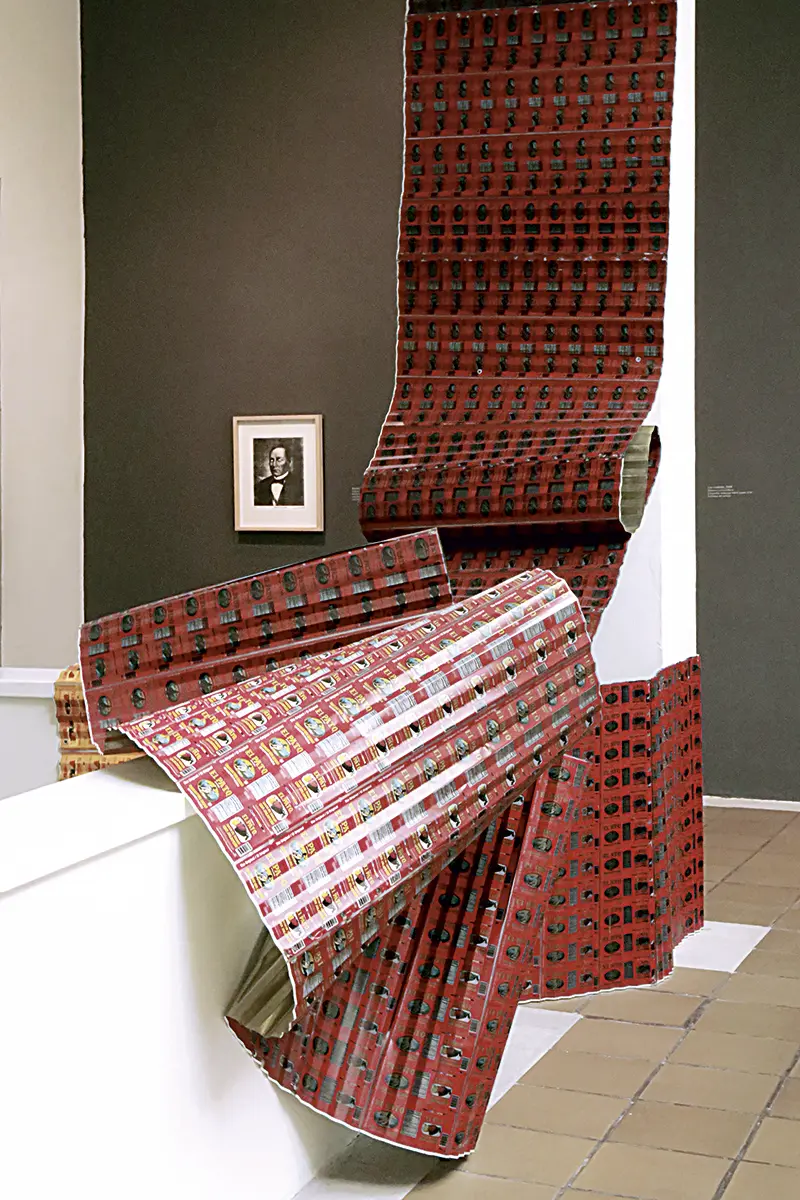
The exhibition presents climactic connecting moments between the artistic, the curatorial, and the museographic aspects of the project. There are some instances of unrestrained experimentation of the graphic element on three-dimensional supports. Such is the case of Merma (2018, Ochoa Artes Visuales), large prints of logos on a broad band and its marked folds, which exceeds in itself and seems to accompany viewers with its undulations and drops. Representations of unusual supports are also connected with the visual contexts that Flores has explored in other projects, such as the embroideries on fabric using techniques from Santa Ana Zegache (Oaxaca), used in his series La patria (The Fatherland, 2010), shown hanging between the gallery floors, in a suspended concentric dance. Another example is the use of the floor as a wall for a human figure that extends beyond the boundaries of our standard scale, in No atravieses tu paso largo porque dejo de crecer (Do not Step Over With Your Long Stride Because I Will Stop Growing, 1996). He makes us play with our perception and also with the bounds of the exhibition as such, the graphic arts, and inspires us to reflect on art, history, identity, and people’s traditions.