The MSU Broad of Michigan State University presented an important exhibition of the Argentine conceptual artist David Lamelas (Buenos Aires, Argentina, 1946). Curated by Carla Acevedo-Yates, the show Fiction of a Production included a selection of drawings, sculptures, projections and interventions that allowed the public to experience different facets of the artist’s career. Interested in repositioning sculpture in relation to space and time, the project was especially attractive to Lamelas who had the opportunity to take advantage of the unusual spaces of the Museum, designed by the renowned architect Zaha Hadid.
At just twenty-two years old, Lamelas represented Argentina at the Venice Biennale in 1968, where he met Marcel Broodthaers, a poet and artist recognized for his introspective and irreverent works. Subsequently, Lamelas moved to London and studied at Central Saint Martins School of Art, where he had Anthony Caro as his teacher. It is important to note that, while he was studying in London, he maintained a close intellectual exchange with the Argentine journalist and writer Raúl Escari who studied in Paris at L ‘École Pratique des Hautes Études in Paris with Roland Barthes. As Acevedo-Yates explains, the title of the exhibition comes from a text by Escari published in 1970, which, according to her, is indispensable to understand Lamelas’ work.1
Throughout his career, his fascination with travel and his tireless research into the process of creating alternative modes of communication have fueled a body of work that encompasses multiple media including sculpture, film, photography, and performance. In addition to making sculptures and creating works for specific spaces, Lamelas has used film to explore how its sequential structure influences sculptural practices and how time can be transformed into a kind of sculptural material. In the catalog’s essay, Acevedo-Yates mentions that “inspired in part by the sequential structure of film, his early sculptural works are “aware” of their liminal relationship to architecture, revealing themselves through a process of deconstruction. For Lamelas, sculpture, much like the time-based medium of film, is an activity—a physical and mental construct, a fiction. In the context of the exhibition Fiction of a Production at the Eli and Edythe Broad Art Museum, amid the geometric, prismatic volumes of Zaha Hadid’s architecture, Lamelas’s work creates a time-based ‘architectural parcours’ that negates the conventions of not only the autonomous art object but also the space of the museum.”2
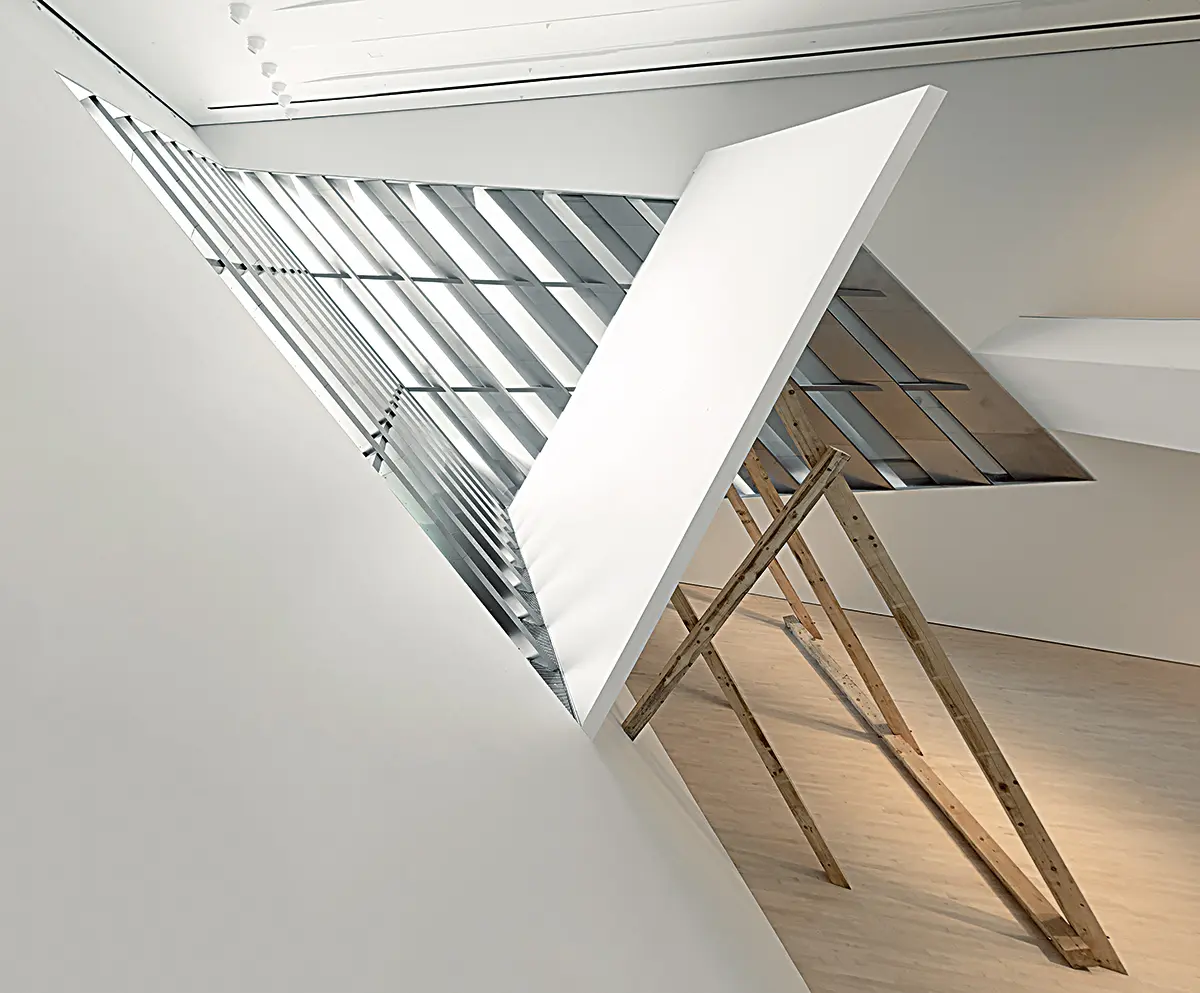
Undoubtedly the most impressive work of the exhibition is (Untitled) Falling Wall (1992/2018), a monumental piece recreated specifically for the space, in which Lamelas places a sizeable white wall supported by beams made with local endemic woods that seems to break away from the angular windows of the Museum. In addition to being the largest version of this work to date, it is the first time that the wall does not hang from the floor but rather from the lower edge of a window. The installation masterfully exemplifies the minimalist materiality of his work and the ingenious way in which he intervenes the spaces. It is important to clarify that the viewer’s perception is essential in the conception of the work. In this case, the artist not only plays with the sensations inspired by the possibility of the wall falling, but he also optimizes the optical effect by tilting the wall, symmetrically opposed to the windows designed by Hadid, integrating it to the surface of pleated steel and glass in a geometric game of great precision.
Another intervention that plays with the architectural space and the viewer’s perception is Corner Piece (1965/2018). In it, a reverse pyramidal construction emerges from the ground in one of the corners of the gallery. The surface of the sculpture, made of white drywall, is perfectly incorporated into the wall giving volume to what is normally an empty space. According to Lamelas, “the idea of Corner Piece is to invert the space between an angle to convert the negative into positive. This empty space is what becomes the work.”3 It is striking that the photograph that illustrates the piece in the catalog shows the artist observing it. The human figure appears not only in other photographs of the publication but also in the sketches and drawings that are presented as an integral part of the exhibition. The presence of the individual is paramount since the relationship established between the human scale and the scale of the work is fundamental in the conception of the latter.
In the adjoining room, his goal of giving volume to the void and creating an immaterial sculpture acquires new dimensions -in fact, it no longer has them- in the works Limit of a Projection I (1967) and Limit of a Projection II (1967). Upon entering the dark space, the viewer observes two projections of light on the floor. Upon adjusting his sight, he perceives a cone and a dim light pyramid that end in a white circle and a white square projected on the ground. As he gets closer, he discovers that each of the sides of the projected square has an acrylic square of the same size that, because of the absence of light, is almost imperceptible. This aspect of the installation recalls Carl André’s floor pieces and undoubtedly refer to Minimalism. However, Lamelas’ process is much more complex as it not only “dematerializes” the installation, but also reduces the composition to the space itself and, in some way, to the purest of forms.
Another work that is part of his research process, inspired among others by the sequential structure of cinema and the use of audiovisual media, is Untitled (1967). In it, a slide projector projects the light devoid of the image on a wall while another one directs the light towards the room where the viewer is located. According to Acevedo-Yates, “at the time this piece was created, Lamelas was interested in technology as a medium and in the theories of the Canadian philosopher Marshall McLuhan, with his famous words: ‘The medium is the message’—which means, in this case, that the mechanism that produces light is the actual content. By focusing on the projectors, Lamelas emphasized the process and the transmission, and, therefore, he stressed the concept of time.”4
Time is precisely the theme of one of his iconic works entitled Time (1970-2018). For this performance, staged for the first time in 1970, the artist draws a line on the floor and places a group of people along it. The action begins when the individual located at one end of the line tells the time to the person standing next to him. This person waits sixty seconds before saying the time to the person located on the opposite side. The process continues until the last person announces the time in the language of his or her choice. Once again, Lamelas uses the form—in this case, a straight line—as a means to establish a sequence, alluding to the cinematographic quality generated by the fact that the people who perform the action and even those who observe it, question the relativity of time and space.
In the end, Lamelas’ conceptual work, impeccably presented in this exhibition, invites us to question relativity. As he explains, “I would say that my work is often a sculpture that is not sculpture, a documentary that is not documentary, an architecture that is not architecture, and a time that is not time. That is exactly what I would like to achieve in my work: a moment without time in time. I would like to create a work that would disappear, that would not exist”.5
NOTES
1. Carla Acevedo-Yates, telephone interview with the author, Miami, December 2018.
2. Carla Acevedo-Yates. “Fiction of a Production”, in Fiction of a Production, catalog of the exhibition David Lamelas: Fiction of a Production (June 1, 2018 – January 6, 2019) presented at the Eli and Edythe Broad Art Museum, Michigan State University (East Lansing, MI: The Michigan State University Press, 2018), 17 and 19.
3. David Lamelas cited by Aimee Walleston. “Conceptual Pioneer David Lamelas Works All the Angles” Art in America (January 30, 2012). https://www.artinamericamagazine.com/news-features/news/david-lamelas-maccarone-gallery/
4. Ibid, 28.
5. David Lamelas. Fiction of a Production, exhibition catalog, 17.