In his recent exhibition at the Museo de Artes Visuales (MAVI), Cristóbal Cea (Santiago, 1981) presented a series of 3-D animations and site-specific installations that take as their starting point news clips gleaned from the Internet, about large-scale floods across the world that now seem to have receded from memory. The artist subjected this archival material to a unique treatment of digital animation that, as in previous works, gives them a phantasmagorical aura. The result is visually seductive, conceptually ingenious and richly suggestive. We are not talking here of the simple reprocessing of tragic situations with a purely evocative purpose, neither alarmist nor much less sobering, but of how the artist has managed to make these records, outside the context of the mass media. Within the space of art, they slow down and show their minimum details in the midst of the superabundance of globalized images, and before the more intimate exercise of sharp perception, towards which they finally lead us. It is to the contemplation and attentive observation of these images of massive-circulation, of rapid consumption and oblivion, where Cea invites us, in order to connect us—in a sort of quasi-mystical experience—with these events, shortening the distance between them and us as observers.
Is it possible to awaken a now-dormant empathy towards such unfathomable global disasters, which we tend to perceive as outsiders? What action do we take towards them? How do we distinguish today the simulated from the authentic and the fiction of reality? What information should we choose and what should we discard from our memory’s hard drive? What impact do these images of the past that we have “discharged” have in the present and other contexts?
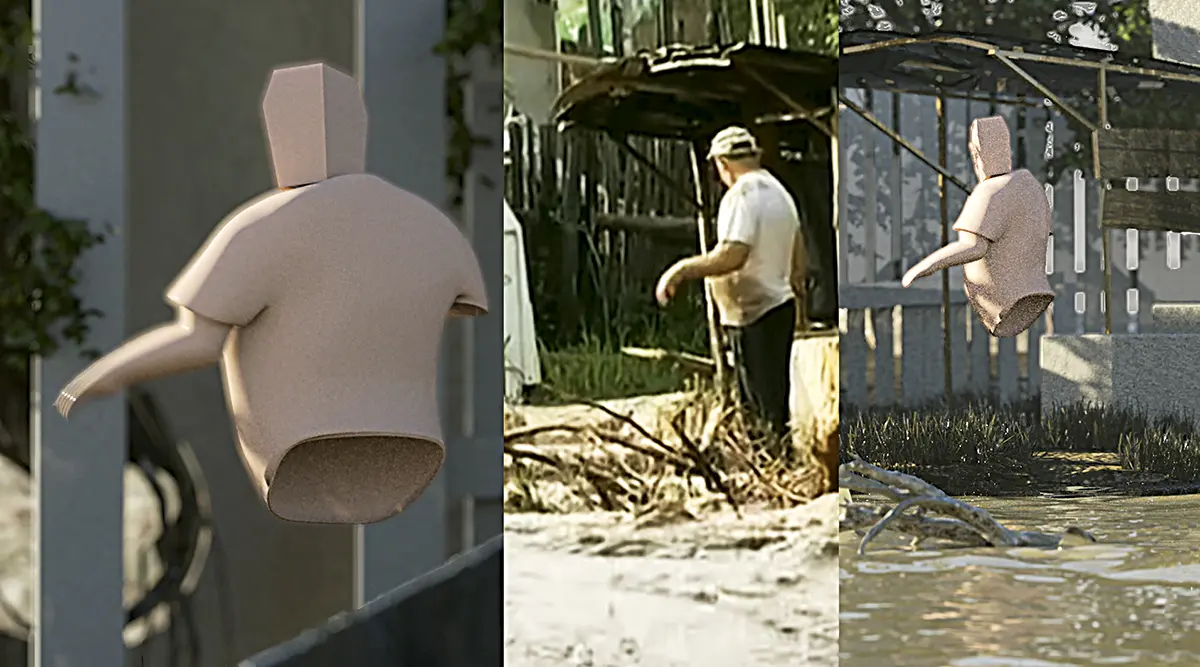
Inside the MAVI’s dimly lit gallery, Cea creates an environment with several playback devices, proposing a random trajectory in which sounds and voices mixed. Some of the monitors run a playlist of news clips about floods compiled by the artist since 2015, reworked in MatchMoving, a 3-D post-production technique that recreates the point of view of the witness or camera operator, thus highlighting the distance that exists between the viewer, the eye witness, and the news event.
These digital interventions turn the protagonists of the news into ghosts and the flooding waters into specters of a debacle. Alternatively, in the liquid modernity of which Bauman speaks to refer to the processes of sociocultural change that are occurring nowadays, and that is provoked, among other reasons, by the omnipresence of information and communication technologies.
Cea’s exhibition is titled Seguidores del diluvio (Followers of the Flood), which seems to be describing us as at once creators and consumers of today’s dangerous, slippery-slick, ever-shifting liquid culture. We are the passive and reactive spectators facing the screen. We are the witnesses who record and share the “spectacle” of disaster in real time, even risking our own lives; us, the fans—the followers—who click and click “like” as though driven by an accelerating, often automatized compulsion.
Beyond, in the same gallery, a set of small monitors arranged vertically (a cellphone’s visualization format) show animations created from scratch by the artist. One of them depicts a child—in truth, an avatar of Cristóbal Cea—trying to remember life in Chile in the 1990s, a decade that marks the beginning of the transition to democracy in the country. The charming character narrates events that impacted him during those years—news items that, like those floods, are now confined to oblivion. In particular, two visitors: the Comet Halley and Pope John Paul II. There is also the arrival of fast food and the plebiscite, in the middle of the consumerist “flood,” that define the return of democracy to Chile. By referring to these and other emblematic events of the past, whether from the autobiographical, national or world level, Cea reflects on the notion of “witness” and how this figure that we all embody determines the construction of realities, past, present and future, and everything that this implies on a human and planetary scale.
ALEJANDRA VILLASMIL