Throughout her career, Carmen Mariscal has focused on the private lives and general situation of women, approached from a variety of perspectives and expressive modes. It all seems to have begun when her great-grandmother, days before her passing, gave Carmen her wedding dress. The artist tells the story of how she kept the dress in storage for several years. One day, she decided to bring it out of its box and use it for photographs, installations, and even an artist’s book, “in order to interrogate traditions that are transmitted from generation to generation, as well as what it means to be a mother, daughter, and wife.”
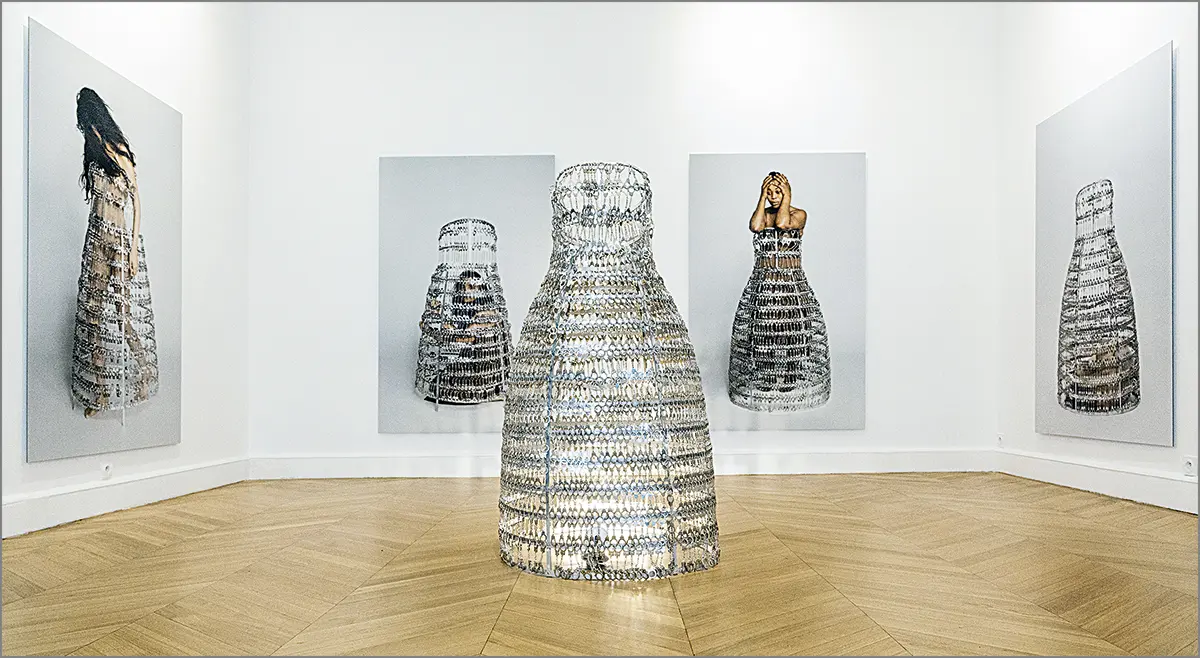
In Mariscal’s work, the dress becomes, on the one hand, an image of the female body, and on the other, a powerful, multi-layered metaphor. It was on clear view last year in a solo exhibition titled La esposa esposada (The Shackled Wife), held at the Maison de l’Amérique Latine, in Paris. Far from directing our attention to the idyllic virtues of marriage, Mariscal intended to unmask its underside. Being forced to remain in a bad—or even bloody—marriage is one of the worst forms of physical and emotional violence inflicted on women.
The idea of the wedding dress as a beautiful garment representing femaleness disappears here, in a way. That is the meaning of the exhibition’s title, La esposa esposada. Mexican-born Mariscal appeals to a semantic paradox in the use of both terms in Spanish, the word “esposa” meaning “married woman” but also referring to the manacles or handcuffs used to detain suspected criminals. Thus, Mariscal used more than 1,500 small iron manacles to create a beautiful and at the same time terrible wedding dress that she placed at the center of the gallery space, on display as the nodal point of her photographic exhibition.
Mariscal’s dress is a suffocating prison. It terrifies. It imposes itself with its metallic solidity. At the same time, paradoxically, it “feminizes” itself under its lace-like appearance, a visual effect that results from the interweaving of the small handcuffs. It is an open, almost “transparent” sculpture that becomes a “dress/prison” when a person enters it. The artist invited twenty-one women to “wear” her dress and give testimony of the violence they suffered, as they experienced, from inside, the new sensations provided by this new imprisonment. The result of this performance is the series of life-size photographs arranged in the exhibition space. These images, the dress, and the testimonies comprise Mariscal’s photographic, sculptural, and sound installation. Besides helping these women confront their deepest feelings, the project sought to prompt a reaction in its viewers, first as they found themselves in the middle of all those images, and second when they saw their faces reflected in the pained body of one of the women in the photographs, whose face had been replaced by a mirror. The artist uses this resource to engage the audience in the drama.
Christine Frérot, the exhibition’s curator, notes that Mariscal can imbue a deeply private situation with distinctly collective and social connotations, even global ones since the women in the photographs come from a variety of backgrounds. Their voices are heard in different languages, and one has the impression that the images are in dialogue with one another. Their faces and attitudes express anguish, fear, shame, and, in some cases, despair. Entering the dress was to be once again imprisoned, and this brought back for them a perception of marriage as a trap.
In this way, Mariscal revisits one of the axes of her work: confinement. In the past, she has worked with wooden boxes containing objects that evoked memories. Now, with her dress/prison, she has created a space that contains memories and at the same time activates emotional situations.
Confinement and the resulting loss of freedom shed light on human frailty. The latter, as the artist points out, is also a recurring theme in her work. Frailty is expressed in contrast to the solidity of the manacles and locks, both ultimate instruments of power and coercion. Completing the exhibition are two works made using ceramic locks, and some glass houses entirely covered by small locks. Despite their dark symbolism, these are luminous works of art: literally, light emanates from them.
Equally important to note is the video created by Caroline Emmett, which not only explains how Mariscal has treated the subject matter in the past, but also presents the process of producing the current project, from the making of the dress, through the interviews and experiences with the women, to the photographic sessions and, of course, the exhibit’s installation.