In a series of lectures titled Sei proposte per il prossimo millennio (Six Memos for the Next Millennium), Italo Calvino began an inquiry that contrasted lightness and weight, arguing that literature and its language developed an operation that consisted of subtracting weight and regarding lightness as a value that would condition reflection and poetic production for the new millennium. While these lectures were first delivered in 1985, we continue to find great, almost prophetic, coincidences with cultural and technological development, as well as with numerous transformations in contemporary art.
Lightness is an unavoidable sensation when exploring “Visible/Invisible,” the exhibition by Colombian artist Ana María Rueda (Ibagué, 1954) at the Galería Jenny Vilá, in Cali, Colombia. The show features a series of works in which the subtraction of elements, concealment, and the subtle suggestion of natural phenomena direct our gaze towards something that is not there and something that appears. To arrive at this moment in her work, Rueda has experimented with many processes that range from photography (light) to painting (matter), and even the use of the space to capture specific, fragile, or silent perceptions. Her work exposes our sensibility to something beyond objects, something like, for instance, the marks or echoes from burning or damaging trees—in pieces like Bosque sin sombra (Forest Without Shadow, NC-Arte, 2013), for example—or, in this instance, the reciprocity between showing and hiding.
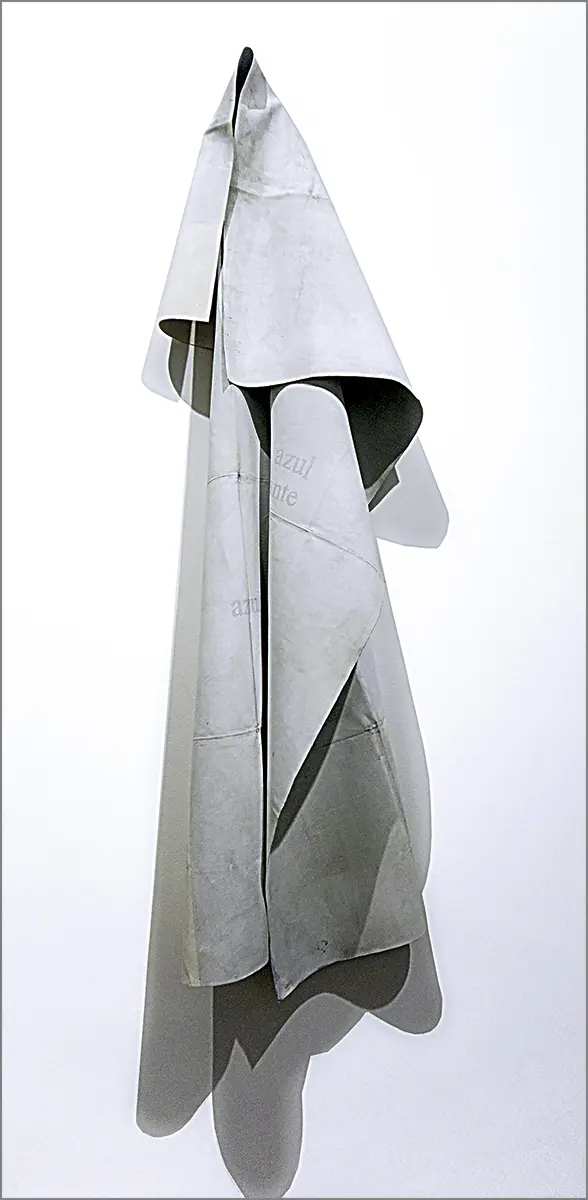
The entire exhibition at the gallery becomes a single installation resulting from the strong connections between works (non-semantical, given the absence of a curator offering a discursive thread). The installation projects the pieces as a whole to be explored and inhabited. In Boris Groys’s terms, space acquires another sensibility entirely dictated by the artist. In “Visible/Invisible” we are passers-by among ghosts. While not being a play on words, it does take into consideration the way the paintings hang on the wall: like buds or wrapped like skins, they all hang from a single anchoring point, enclosing a void or showing a little bit of their back—it is impossible to distinguish between fronts and sides. The “Story Series” (black and white paintings from 2018) and “Figure Series” (color paintings from 2107-2018) to a great extent challenge our relationship with the pictorial. The canvases suspended from the ceiling seem to embrace something that we cannot see, a matter that exists but does not require our gaze to do so; an autonomous entity resulting from a secret or intimate process that whispers certain words written on the canvas (white light, blue light).
This secret is present in all the works exhibited. In, for instance, the drawing interventions on a series of photographs to create shadows and textures, forming improbable images that, like the piece titled Del eco (Of the Echo, 2018), offer harmonious rhythms that disguise the process. Photography, a mark left by light, does not appear retouched, and the forms that we observe in it acquire a logic of their own; all because of the movement suggested by the shadows.
Back to Italo Calvino, the Italian writer proposed three essential circumstances for lightness to occur: a lightening of language, a high degree of abstraction, and a subtle image that assumes an emblematic value. Such circumstances seem to be the statement of the exhibition. First of all, there is the lightening of semantic elements in the form of little rhetoric. Then, abstraction, as it pertains to a hidden matter, a secret process, and a tendency towards fragmentation that offers a contradiction: the sum of the parts does not result in a whole because the nature suggested by Ana María Rueda lacks any all-encompassing notions—which is evident in works like Un jardín propio (A Garden of One’s Own, 2018. Lastly, the symbolic value in these works may rest on their non-confrontational nature, on their ability to make themselves smaller and expel us from this world that we believe to be ours when an image is offered to us opened. This subtle gesture (a single anchoring point for the canvas) expresses the complex nature of the installation, of a non-structured environment that directly appeals to our sensibility and suspicion.
To visit this exhibition is to experience a choreography that turns us into passers-by alongside ghosts. Carolina Ponce de León had already identified in the text titled La intimidad de lo imperceptible (The Intimacy of the Imperceptible) such rhythmic relationship between viewers and paintings when she wrote that: “(…) these dynamics of observation become part of a free choreography that connects the other—the viewer—with the works. They exist when they are walked around, surrounded, and explored.” We walk expecting the appearance of that which is hidden to us and end up finding more concealment, perhaps because what is shown to us in no more than the reverse of a nature that we are not supposed to see—if seeing implies resorting to tools to systemize and measure, to control and capture the moment and the apparition.