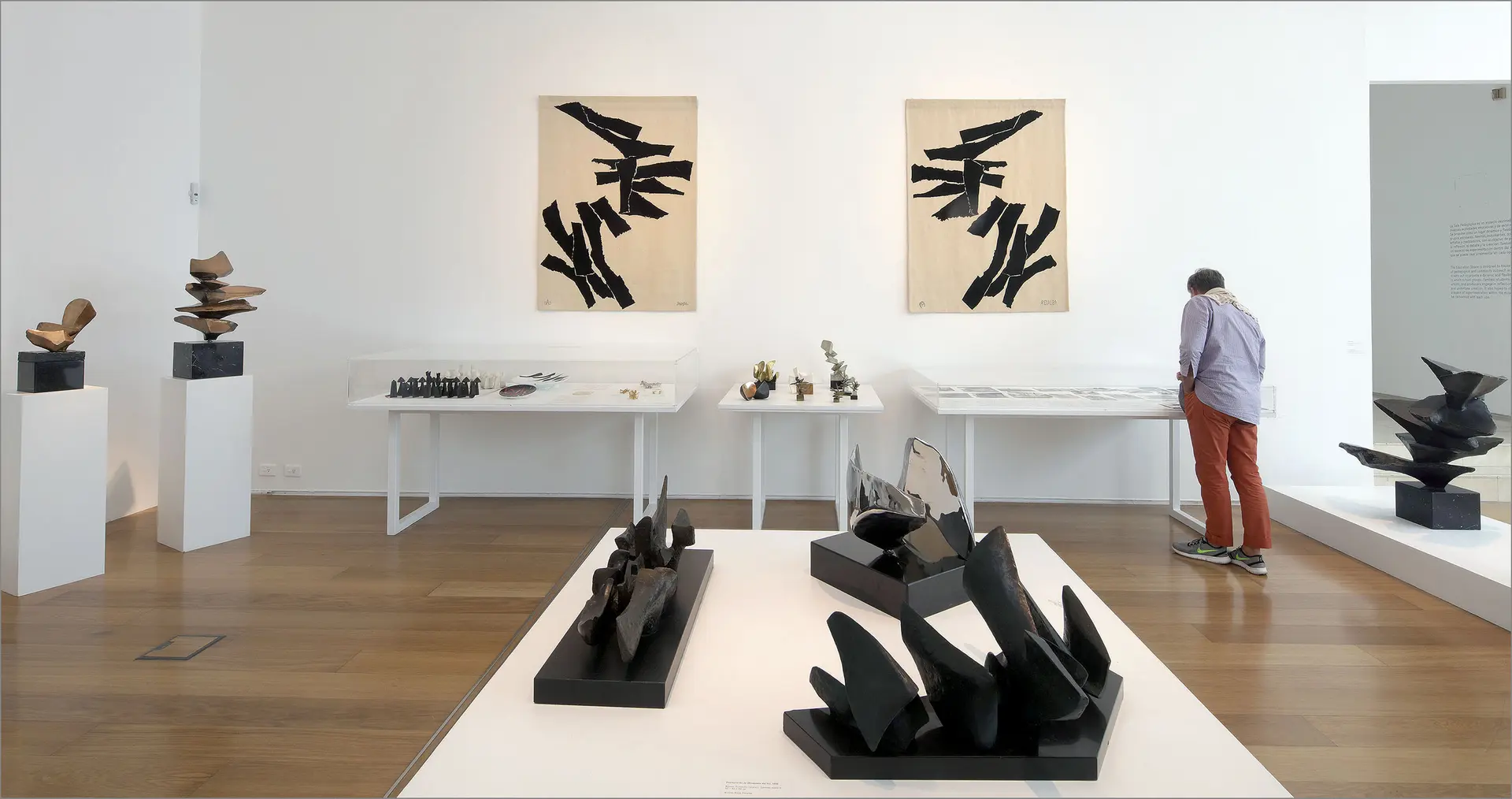
Alicia Penalba, escultora, a joint publication from RM Editorial, the Alicia Penalba Archive, and Malba launched in July 2016, and an exhibition of works by the artist presented at Malba’s Sala 3 between October 14, 2016, and February 17, 2017, are both important contributions to unveiling the myth of Alicia Penalba, especially for Argentina. The artist was born on August 9, 1913, in San Pedro, Buenos Aires province, and moved to Paris in 1948; her entire artistic career took place in the French capital.
The life trajectory of this outstanding artist was marked by unconventional rhythms, by extended cadences, visible in the delayed way in which certain events took place. One of the keys to her universe is to consider the phenomenon of a dazzlingly successful international career in the 1950s, 60s, 70s, and early 80s that nevertheless only had an indirect, belated echo in Argentina. News of Penalba reached Buenos Aires via press releases, from people who visited her studio or her exhibitions abroad, or from Argentine curators, museum directors, or diplomats connected to her participation in international events such as, among many others, the 6th São Paulo Biennial in 1961, where Penalba won the International Grand Prize for sculpture.
Both the book—the result of an exhaustive investigation in the artist’s native country—and the exhibition at Malba are part of reality a century after Penalba’s birth. It is possible to speak today of Alicia Penalba, a modern artist, with a renewed reception and understanding of her journey. After living as a child and a young woman in Chile, in Patagonia, in San Juan province and in Buenos Aires, and after studying Fine Arts and launching her career as a painter, Penalba traveled to Paris in 1948 thanks to a French government fellowship and decided to established her residence there, until 1982, when she passed away unexpectedly at the age of 69.
Exceptional conjunction of chronos, time as it flows irreversibly, and kairos, time as it allows a silent and attentive observation that can change destiny in radical ways, accompanied Alicia Penalba and contributed to charting the course of her life, a uniquely singular story.
In Paris, Penalba began a wide-ranging activity that put her in contact, after 1949, with such luminaries as Pablo Picasso, Paul Éluard, and Louis Aragon, while Henri Matisse drew her portrait in pencil. In short order, she received a medal for foreign students in printmaking, decided to devote herself to sculpture, and was accepted to the Académie de la Grande Chaumière. In the early 1950s, Penalba studied with the Russian sculptor Ossip Zadkine, and her first solo sculpture exhibition was held at Galerie du Dragon in 1957. Claude Bernard, an important art dealer in Paris, quickly signed the emerging artist in an exclusive contract. Many opportunities opened up for Penalba, who responded with great competence and skill. The power of her personality and her talent was becoming evident.
There are innumerable examples of praise for Alicia Penalba in Paris, a city that at the time was beginning to share its dominance of international art with New York. And while such recognition was sustained since the beginning of her career, it was in the 1960s that the heights of her achievement were fully revealed. A beautiful and forceful proof of this is a letter dated February 3, 1964, written by Jean Cassou, chief curator of the Musée National d’Art Moderne in Paris (a post he held for more than twenty years), which serves as a symbol of the high esteem in which Penalba’s work was held in France and in the international arena during that period. The context for the letter was the artist’s need to move to a more adequate studio for the volume of her work at that moment, one of the peaks of her career, which in the end resulted in the purchase of a property at 4, rue Roi de Sicile, in Le Marais area of Paris, where she lived and worked until her death. Cassou expressed the French government’s commitment to supporting the artist in such circumstances and put it in similar terms to the institutional support given to Constantin Brâncuși when the eviction of his studio was halted. He wrote: “I see you […], and my case is not an isolated one, as one of the greatest sculptors of our era.” Such a statement, of course, meant “one of the greatest in the world”—a world that, as we know, was smaller at the time, but at the same time enhanced the superlative degree of the praise offered. Cassou displayed three sculptures in his office: an African carving, a work by Penalba, and a “toba” carving from Argentina. This was noted and remarked upon by many intellectuals who visited him there.
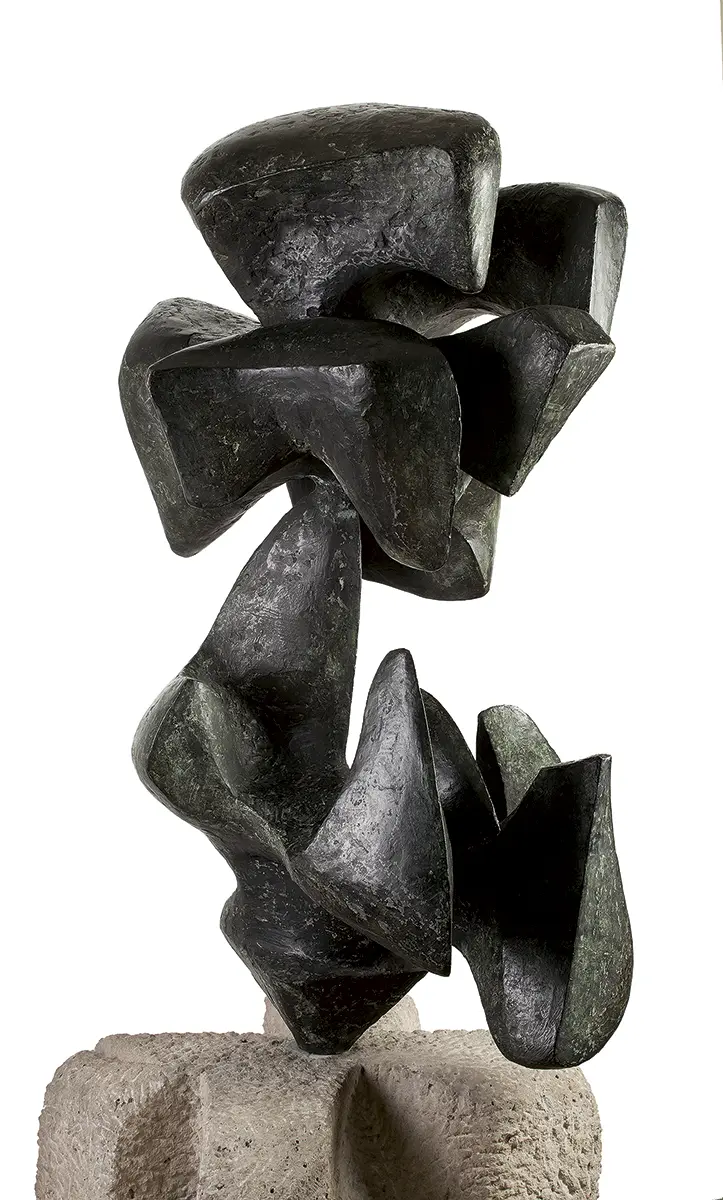
Nevertheless, the triumphs and waiting periods that time had in store for the artist were set in an irregular manner between her native country, Paris, the rest of Europe, the United States, and even Japan. In 1959, Jorge Romero Brest, the director of the Museo Nacional de Bellas Artes in Buenos Aires, invited her to exhibit there. It was her first proposal from an Argentine institution, and it was to be followed by a long list of similar invites. But the quick and emphatic success of Penalba’s Parisian career and its international repercussions, the resulting commitments, and the complexity of the circumstances—in particular the cost of international shipping—delayed Penalba’s public appearance in a Buenos Aires gallery until 1990, as private collections and museums acquired their work. And her museum exhibition took place in 2016 and 2017 at Malba, fifty-seven years after it was first imagined.
The Work. Materials, Will to Form, and Interpretation
“Clay is my preferred material. It does not impose any beauty of expression a priori. It yields to my quests more than stone does.”
With its malleability, clay allowed Penalba an exercise of lyrical return to the primitivism and the magnificence of the landscapes she had seen in her childhood in Patagonia, in Chile, and in San Juan, as if she were attached to them by a magnetic fusion. In consequence, such memories invested her with the power to erect her abstract works, while transfiguring the artist herself. Finally, these works were cast in bronze in France or Italy.
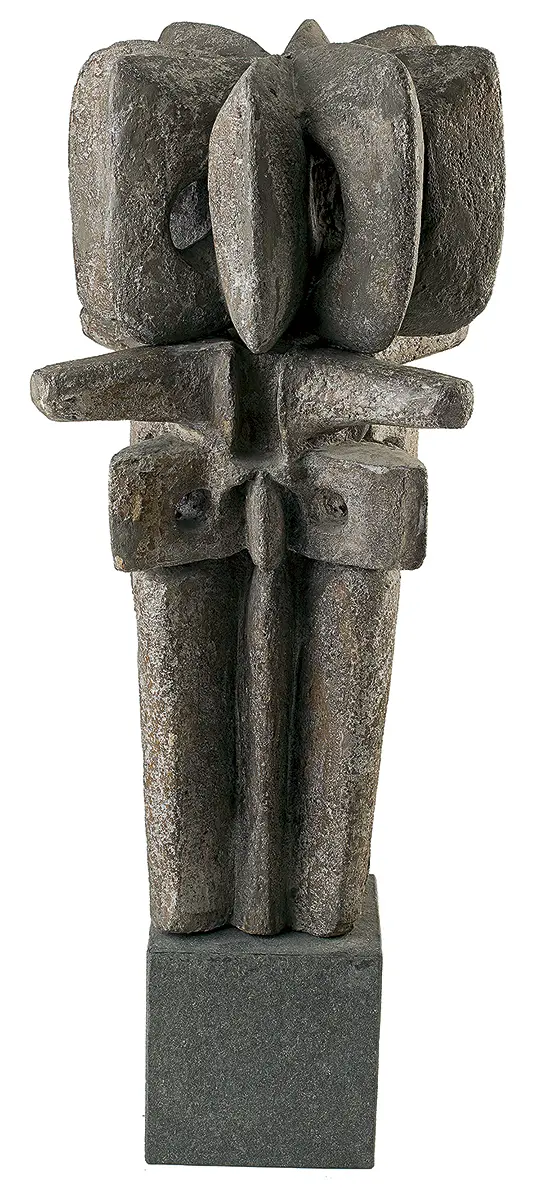
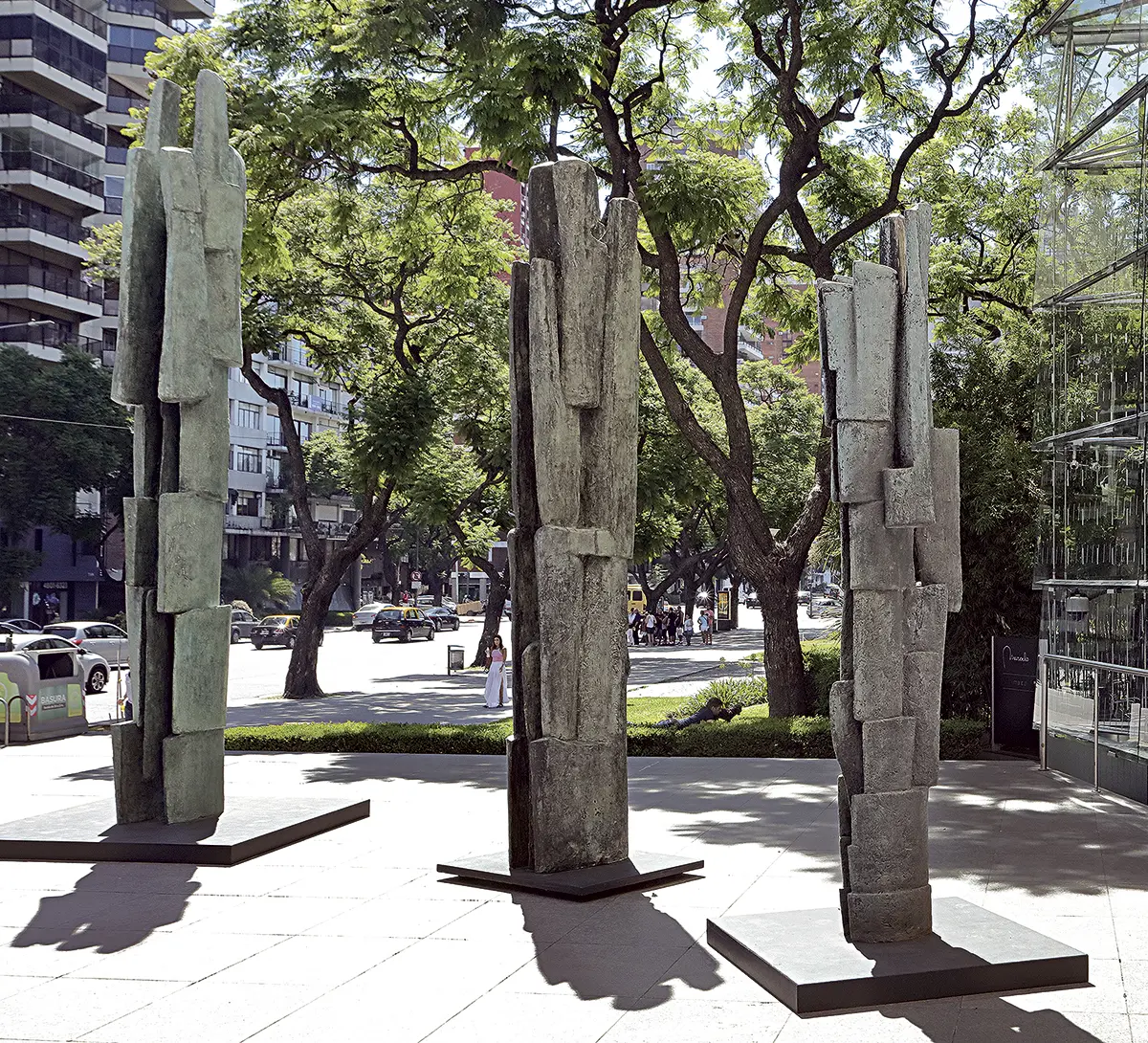
Passion de la jungle (Passion of the Jungle), from 1953, one of Penalba’s earliest works, presides over the first great period in her career: “My vertical period was guided by the need to symbolically spiritualize eroticism, the source of all creation, as the most sacred state in the life of Man.” It comprises a vast series of works that rise in space, erect, seeking height, and closing into themselves on an imaginary central axis: the totems. Penalba appealed to a return to a poetic sense of integrated, civilized humanity that was nevertheless in need of evoking an ancestral, natural, and archaic state, sacred in some level. In that way, she found an adequate expression in various totemic forms filled with primitivist allusions. Petit sorcière (Little Witch), from 1953; Tres tótems de amor (Three Totems of Love), from 1954; Ancêtre papillon (Butterfly Ancestor), from 1955; Gran liturgia vegetal (Grand Vegetal Liturgy), from 1957; Sombra habitada (Inhabited Shadow), from 1957; Bosque negro (Black Forest), from 1958; and Lunar III, from 1965-70 are some of the titles of her works during that period.
Penalba’s totemic-primitivist period—which left a strong trace in her later work—harked back to the inspiring vibration of the climates she experienced in her youth. At the same time, it recovered, by means of reminiscence, the symbolic condition in which the original force of such magnificent geographic surroundings reverberated.
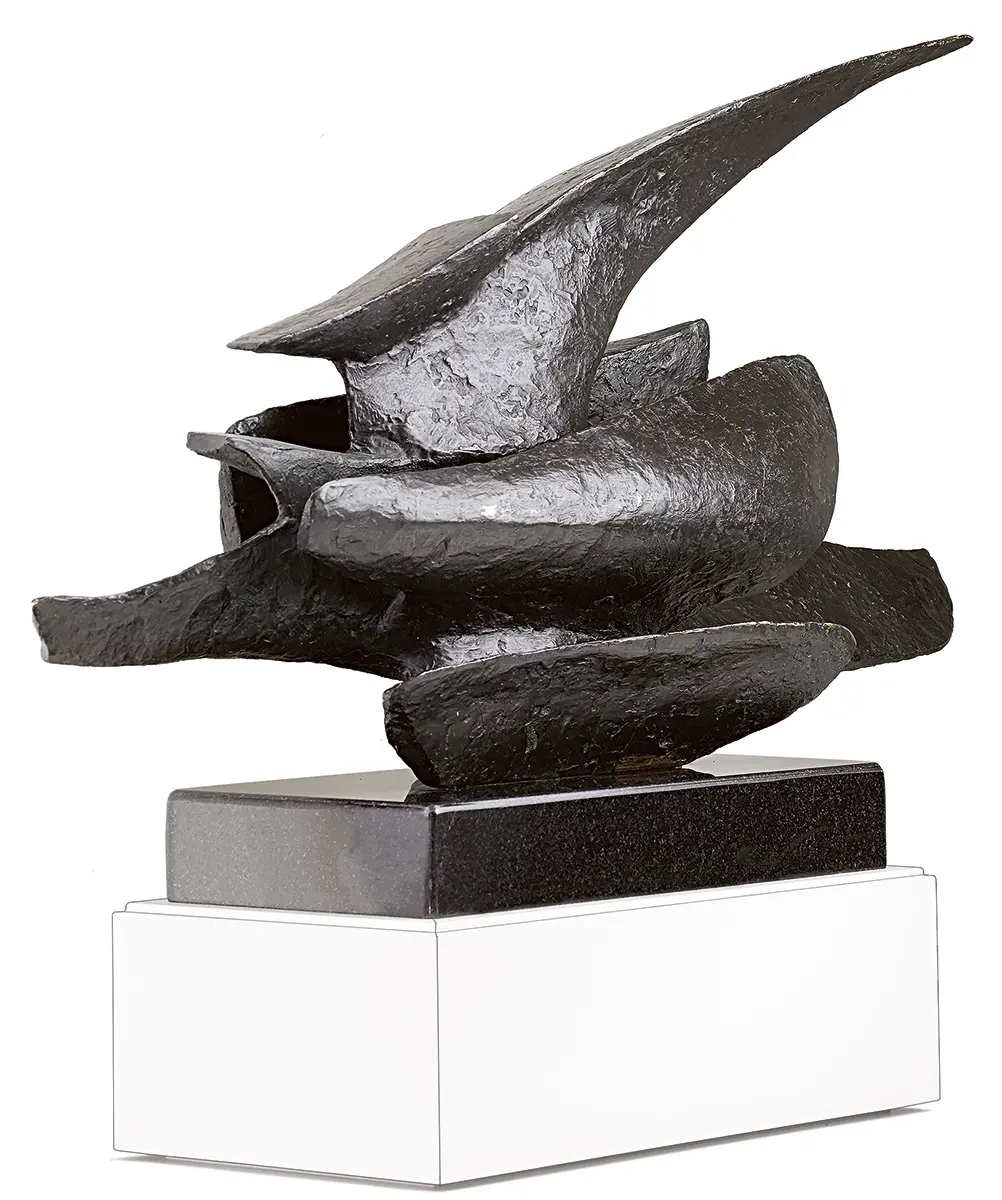
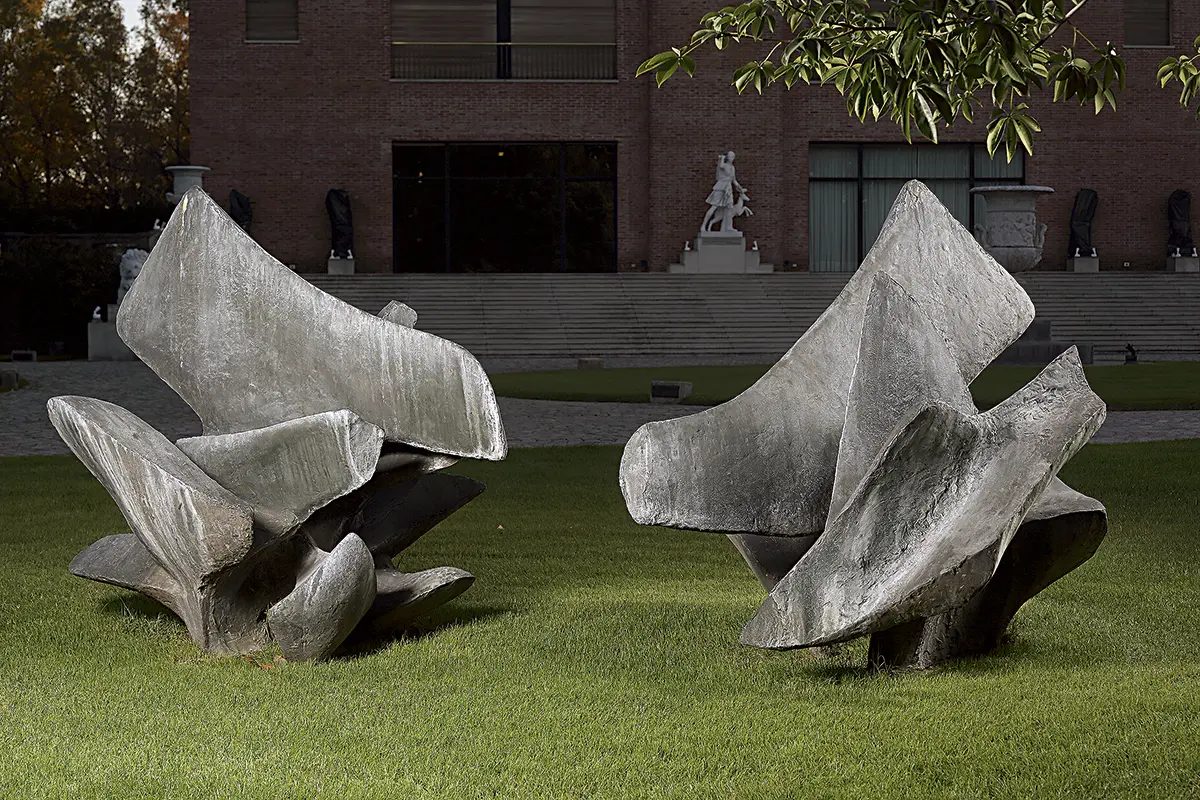
The other grand series is comprised of the Ailée (Wingeds), and it was started in the 1950s and early 1960s. The axis remained in these works, but no longer as a vertical, but as a mobile, curved, zigzagging spine. Emerging from it in an irregular, overflowing manner are several planes in a variety of directions that not only make the axis dynamic but also render the whole multiple and centrifugal. Penalba’s multiplication of this procedure in a large number of versions (and not just in sculpture, but also in the modeling of utilitarian works and in two dimensions, in lithography, in flatware designs, and more) was astounding.
Chrysalide (Chrysalis), from 1961; Absente (Absent), from 1961; Annonciatrice (Harbinger), from 1963; Ailée (Winged), from 1963; Grande Ailée, Mistral (Grand Winged, Mistral), from 1970; Viento (Wind), from 1970; Saccadée (Jouncy), from 1970; Altiplano (High Plateau), from 1974; Rumeur d’ailes (Rumor of Wings), from 1974; Soleil (Sun), from 1974; Cinq ailes (Five Wings), from 1975; Sirène (Mermaid), from 1981, and Météore (Meteor), from 1981, are among the titles that signal the necessary conjunction experienced by Penalba between the natural and human worlds. In formal terms, some observers have seen in this series a search for solutions to the issue of symmetry that emerged in the previous period.
According to Jörn Merkert, who produced the first survey of Penalba’s work, published in 1971, in this series, the artist “tackles the issue of time, how to integrate motion, how to see velocity and dynamism in the unavoidably static structure of a sculpture, without having its traditional immobility be obliterated by actual motion.”
In Penalba’s archive are documents that round our understanding of her aesthetics by demonstrating the artist’s admiration for so-called primitive art. As she studied it in Parisian museums, she noted in it modes of communication that were much more direct than in their “civilized” counterparts. And she marveled at the conception of such balance between form and content, which could only be achieved in a state of “absolute belief.”
Penalba’s own individual identity centered not only on herself as such, but also on an expansive force that moved towards nature, space, the world, and that which remains unnamed. Because of this fundamental reason, the chapter of her oeuvre referred to works related to architecture and the landscape, among them such magisterial examples as her work for Universität St. Gallen, in Switzerland, a site-specific project, and others like her Gran doublé, 1972-74, at MGIC Plaza in Milwaukee, USA, rising 840 centimeters in height. All of this finds Penalba moving towards the Latin American roots she had experienced in her youth. Particularly relevant in that regard is the 1968 exhibition Totems et tabus. Lam, Matta, Penalba, which had her sharing the space with two great masters of Twentieth-Century Latin American art, Wifredo Lam and Roberto Matta, at the Musée d’Art Moderne de la Ville de Paris. This exhibition was organized by André Berne-Joffroy and coincided with the events of May 1968 in Paris. Many years of uninterrupted production awaited Alicia Penalba. As has been said, “Penalba closes, like the last link in the chain, the continuity in a time of a regional modernity in fertile dialog with the European avant-garde.”
* Photos: Gustavo Sosa Pinilla.
MERCEDES CASANEGRA
Professor in Art History, UBA, and independent curator.