“Uninhabited Order” expands Alexandre Arrechea’s interest in working with objects, something that has probably characterized most of his artistic production. Among these, architecture occupies a central place that underscores the quality of that discipline as an institution of power, a theme that has likely interested Arrechea since his early artistic production as part of the group Los Carpinteros. However, the role of architecture is most visible in monumental sculptures. Notable among them are the ones shown at his 2013 exhibition titled “No Limits” in New York City. There, he displayed several monumental pieces throughout the city that paid tribute to various famous buildings. With them, he reflected on ways in which constructions are subjected inescapably to changes imposed by the passing of time, such as values and ideologies that serve or represent any given government or context. As a result, architecture becomes something more than a living or working space.
In the current exhibition, Arrechea draws our attention to architecture and the role of the public space at the social level. To do so, he relies on the Agora concept. Agora, a Greek word for “gathering place” or “assembly” and a vital part of ancient democracy, is used by Arrechea to address contemporary social processes like migration. Modern stadiums have replaced the venues where the Ancient Greeks met to debate ideas. In this exhibition, it becomes the representation of a space where beliefs and ideologies are abandoned and transferred to new contexts. This idea is explored in depth in the piece titled Matterfall, from the series Agora, a piece created by the artist in collaboration with musician Pavel Urquiza. It consists of a yellow “stadium” with a video placed at the center of an endless blue ladder whose sound becomes part of the work. Visually, it reminds us of a waterfall, an idea further emphasized by the contrast between the highly pure colors of the work.
The pieces Agora and History Matters also use the idea of the stadium as a point of departure. The former depicts an enormous hand with several bullrings of different sizes rendered across the palm and fingers. In this work, Arrechea draws from the idea of those venues as points for diversity and centers for gathering and absorbing information. Based on the potentially high concentration of people at any given moment in such places, he talks to us about changes and exchanges, modifications and individuality, amid the collective melting-pot.
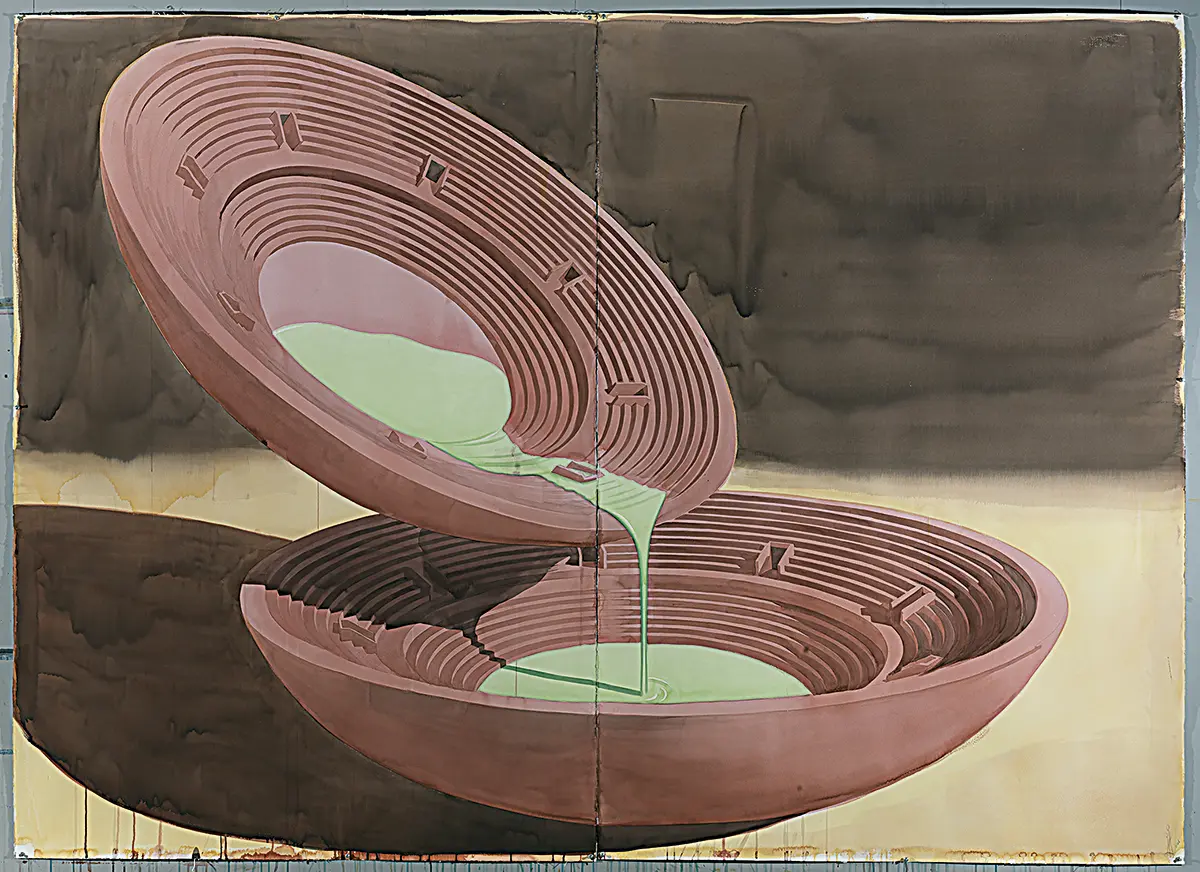
History Matters is the piece that perhaps best conveys the central idea of the exhibition. By addressing the importance of history—whether individual or collective, personal or social and as part of any given process of change—it emphasizes the need not only to look back to the past but also to take it into account when reacting to the present or conceiving the future. The stadiums in this piece are shaped like two clay horns. One of them pours a green liquid into the other, representing the continuous, uninterrupted flow between one time and another—essential in these processes.
Two other works in the show, Order and Leyes (Laws), refer to an aspect of architecture often unnoticed. At first sight, these two pieces appear to be walls constructed with traditional concrete lattices—so prevalent in the tropics—that offer irregular surfaces and textures. While several white linear strokes rendered on them do not appear to make much sense, a closer look reveals the words “order” and “law” created with the white lines. For these images, Arrechea relies on the language used in murals by street and graffiti artists who adapt their message to the architectural structure. It is an approach that involves the history of the surface (building or wall), the intention to transform them, and the message conveyed. The goal is to reorganize the space and, consequently, to offer a new dimension based on transforming the content and, therefore, its function and place in the area.
This idea can be applied to the fact of emigration, in which the adaptation to the new space, place, and culture, involves two processes: remembering and accepting, creating a new dimension of the present and future, between tradition and assimilation.