In the filmed performance of fragments of a private concert, a single character builds the entire scene in Learning the Language (Present Continuous I). This video installation was produced for the Jeu de Paume Satélite 11 program, as was presented between October 17, 2018, and January 27, 2019. It is part of the series of portraits on paper or film created by New York-based Uruguayan artist Alejandro Cesarco (Montevideo, 1975).
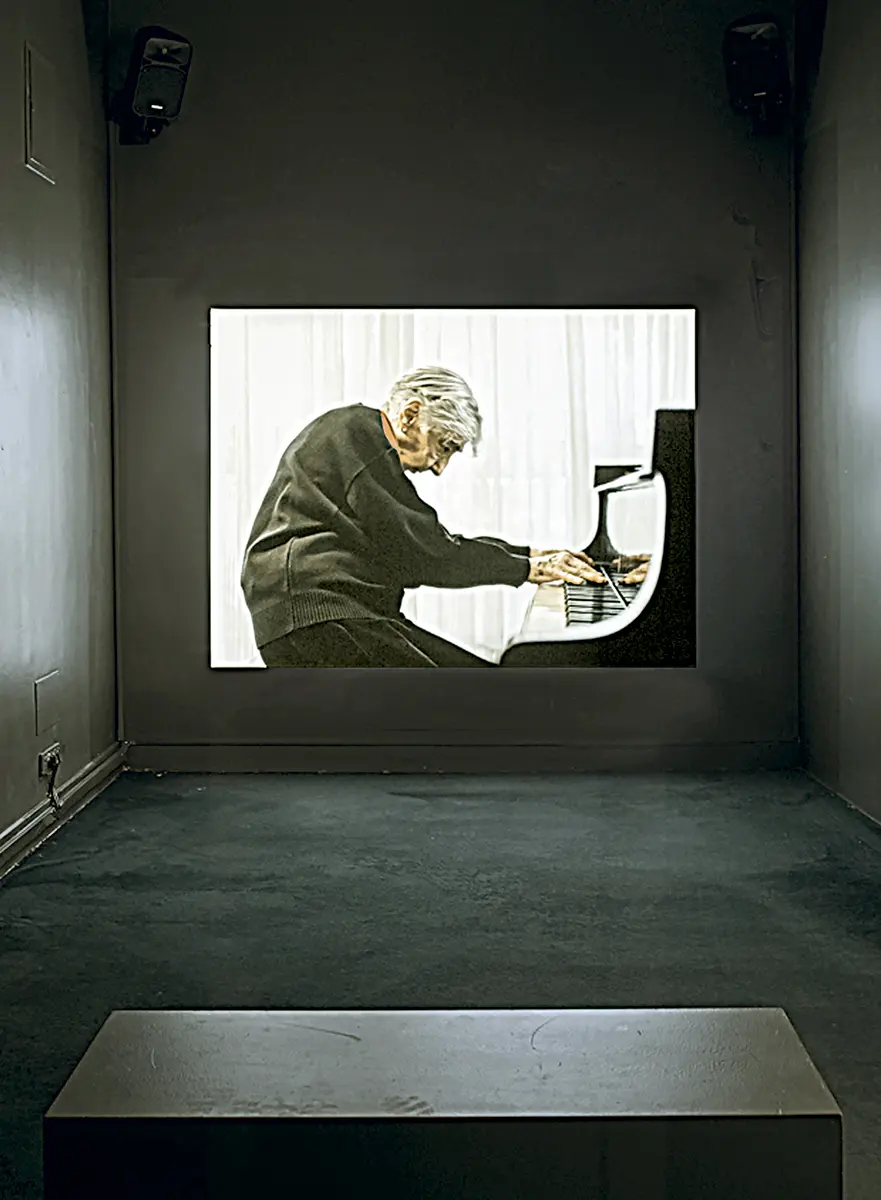
The installation comprises two spaces of the right-side entrance of the Jeu de Paume. The first space contains a text explaining the cycle and, to the right, a reproduction of the written score for Manuel de Falla’s Pour le Tombeau de Paul Dukas.
The projection is in a second space. The duration of the work is around 17 minutes. The backdrop is also—according to some paragraphs in the text—a curtain alluding to memory.
Cesarco focuses his work on a single plane. It is a video-portrait of the nonagenarian Argentine artist and musicologist Margarita Fernández, recorded in Buenos Aires.
The dynamic centers on a musical rhythm that alternates an off-camera voice, still images, parts of a concert, and staged parts. In the foreground, the pianist plays the Andantino from Franz Schubert’s posthumous Piano Sonata in A Major, part of the musical theme that serves as a thematic pretext and speaks when not playing the rhythmically selected fragments. These are some of Alejandro Cesarco’s sophistries to introduce the appearance and translation of the texts and the rhythmic interplay of images both still and in motion, establishing a seemingly open structure where viewers find themselves confronted by a work that includes musical automatisms, indirect references, mirages of memory, and a variety of narratives.
The set décor is minimal. The image appears frontally and shifts between the presence of the pianist and the spoken word which refers to reflections of this erudite, in Spanish. The translation of these thoughts appears on a black background, written simultaneously in English and French. Viewers hear the inserted texts. Elements of an eternal return recomposed from society, in which a cyclical process of values are at play. The theme that emerges from the Sonata in A Minor Andantino is the theme of things unfinished or unresolved.
The visual presence of Manuel de Falla’s score is a landmark. Falla’s Suite was first debuted in Buenos Aires’ Colón Theatre, on November 18, 1929, conducted by the musician, who had recently relocated to Argentina. It is an adagio for string instruments on solemn chords for brass instruments, and we hear a few fragments from it. Like a requiem, it completes the era’s autobiographical and symbolic character. Manuel de Falla died in Argentina, where he had arrived as a political exile.
The video technique allows for autonomous collages. In this mix, the female protagonist is the one who directs. Everything is reformulated into a simultaneous present, with a spectral ambiguity, based on free associations and sound affinities. Kosuth’s conceptual work and Cage’s silent metamorphosis are inescapable references, as are other forms of Southern Cone literature and the creators of great intellectual labyrinths, such as Cortázar or Benedetti, with a Sábato tempo.
Along with Cesarco’s presentation, the program in this contemporary art center includes two simultaneous shows devoted to photography. In one sector, Dorothea Lange’s historical photojournalistic and dramatic narratives, and in the upper levels, the mythical, frenzied Ana Mendieta confronts the forces of nature.
The entire selection predisposes the viewer’s perception of a general tone. A profound commitment to transversally in the use of visual culture, in the production of images, and the invention of thematic meaning, characterizes the programming at Jeu de Paume.
Of the three exhibitions, Cesarco’s is the most visually static. The structure fits the character well and derives from it in the construction of a unique individual identity, achieving extremes of minimalism and conceptualism and flowing into the irony of an eclectic language: musical and spoken.
The video artist offers a portrait of Margarita Fernández autonomy at the subjective and concrete levels.
This work is firmly inscribed in the creative process of other works by Cesarco, like Mirrored Portrait (2015) or A Portrait of the Artist as a Young Man (2012). A sense of humor, intelligence, and urban irony emanate from the solemn dialogue between voice, vision, and music in this artist’s composition.