The Centro de Arte Contemporáneo Wifredo Lam in Havana exhibited a solo show by Cuban artist Alejandro Campins titled “Fear to Death is Fear to the Truth.” The exhibition featured “Lethargy,” one of the most compelling series produced so far by this artist. Through the integration of paintings and photographs, Campins (Manzanillo, Cuba 1981) invites us to reflect on notions of loss and transformation associated with death based on the strange constructions tensioning the landscape of many countries: bunkers. It is possible that the curiosity often elicited by these fortifications increases upon learning of their numerous and diverse presence across several regions of the globe. This reality, which Campins personally corroborated with his own eyes when he visited some of them, led him to wonder about the reason for their existence and attempt to change their fate by representing them in his work.
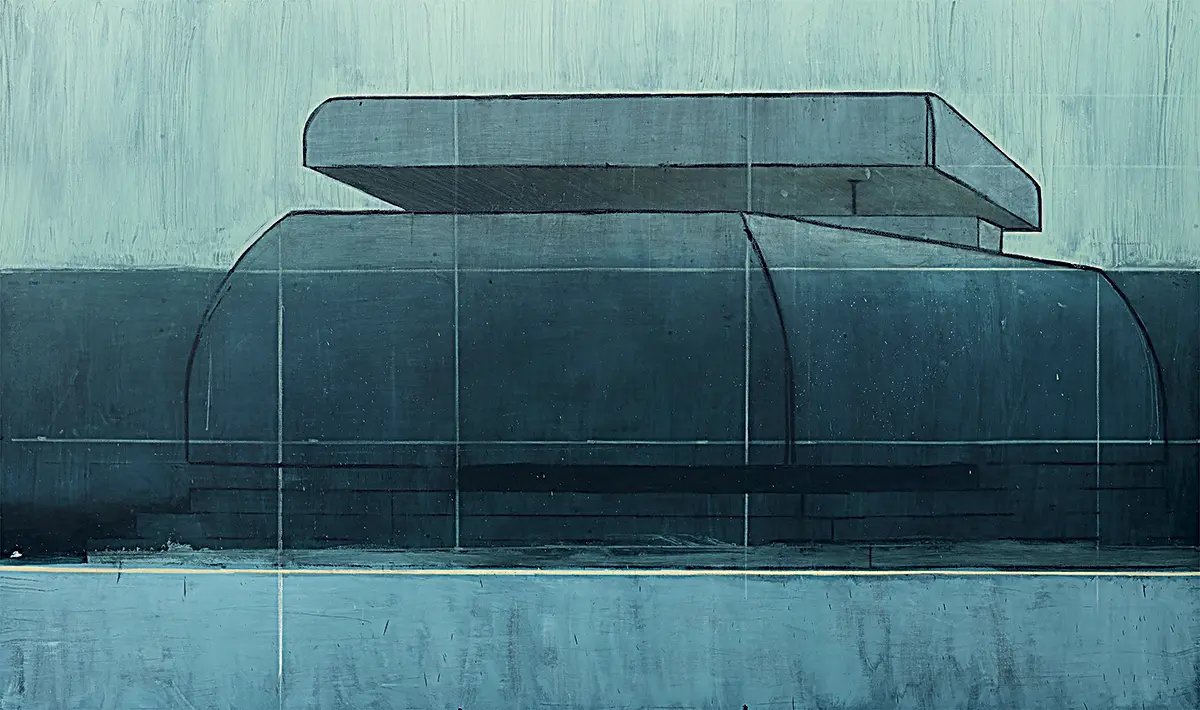
Bunkers were built as defensive military fortifications by nations immersed in wars. However, according to Campins, they also express the fear of loss. At all levels, whether personal, family or national, defensive and protection systems are created not only out of fear of loss but also out of fear of change. According to the artist, constant change, impermanence, is what we are afraid of. We are continuously constructing mental and physical systems for protection against change of all orders. Many bunkers have been built in periods of history darkened by the menace of wars, the impulse to dominate, or by any other reason. Their ominous presence makes us wonder whether the reasons that originated them will one day disappear or if coexisting will ever be possible. However, the function and identity of these fortified enclosures are not always clear. Thus the reason for bunkers to be associated with hidden, at times anonymous, powers filled with tension. They are clearly highly emotional sites on their own right. For Campins, they represent an excuse to talk about those mayor themes that rule life and that remain very much relevant.
With the intention of underscoring their identity as war remnants, ghosts of the past, but, above all, to depict them as if they were hibernating, Campins confers a slightly blurred appearance to some of the bunkers and a clearly and deceivingly peacefulness to others whose centrality and/or size nonetheless renders them menacing. To complement such effects, he relies on neutral tones, a range of ochre yellows and blues used to elicit the responses mentioned above but also to put into practice formulas employed by the Great Masters. It is an approach that allows Campins to give his icons and the very practice of painting with a convenient aura.
In some of the works, titles like Gruta (Cave) and Hipnotizador (Hypnotic) respond to the forms that the “real” bunkers suggested to the artist, while others reflect the experience that he had at the site, like in Rebaño (Herd), Carruaje II (Carriage II), and Pleamar (Hight Tide), among others. None of the information labels accompanying the works include the country and date in which the bunkers were built to keep the show from turning into a didactic exhibition. However, this does not mean that Campins did not take it into account. As part of his investigation, Campins toured bunkers built during Spain’s Civil War; the so-called “Atlantic Wall” -formed by the countries that border the coasts of that ocean-, and those of the North Sea, erected in Italy and Switzerland in the years of the Second World War; and those built in the United States and Cuba during the Cold War. He visited all the bunkers reproduced in the exhibition; photographic records are displayed in a separate gallery.
The decision to eliminate the references and bring the semblance of the bunker almost to the abstraction, and with it to reinforce its anonymity, has, among others, the purpose of giving prominence to the space, element that has become the center of his work and character in itself as part of the evolution that his personal discourse has experienced.
The solo shows presented by Alejandro Campins at important institutions and galleries in France, Switzerland, Italy, the United States, Spain, Mexico, and Cuba, showcase the space and its components as the best way to convey impermanence, continuous change, transformation, temporality, the ephemeral, and, at the same time, the perennial and lasting. That is why he endows his representations with a timeless character. His landscapes underscore their attributes as scenes, their theatrical nature, their ability to tell us a story on their own, to move us with or without the presence of humankind—he favors inhabited places.
Campins pulls our attention through the landscape; he is interested in maximizing its narrative power as he embraces all of its positive and negative aspects. He knows that he can change the terrible fate of bunkers by painting them, transform their hidden and destructive power by elevating them to the level of art. Like in other paintings by Alejandro Campins, these representations make us think, offer metaphors for relevant issues about the existence that he observes in the landscape.