Alberto Asprino’s exploration of the object as an emotional experience offers us a way to approach the remnant, the trace, from the point of view that transcends the effect of physical changes. Anchored on inner perceptions, on the readings we can bring to bear on the interaction, Asprino’s work creates new frameworks for the understanding of our everyday world. In more than forty years, his workshop traversed the coasts, the streets, the ruins of buildings or the most hidden paths. He gathers objects that capture his attention, which cease to be mere “things” and become fragments of memory and of the passage of time. In this way, Asprino has been able to articulate a kind of archeology of sensibility—a cartography of emotions—that expresses the object’s energy. With the title, Desde la orilla, la otra orilla (From The Shore, The Other Shore), the exhibition was presented at the Andrés Bello Catholic University’s new Los Cubos Gallery.
Asprino’s Desde la orilla project began in 1984, at the Ateneo de Cabudare, Lara state, with an action intervention based on objects gleaned throughout the Venezuelan coastline. Asprino carefully placed the objects on the sidewalks of a commercial street; as people walked by, they became participants in the action, and they even picked some of the objects and took them to the large-format text that unfurled like a memory manifesto. Throughout more than twenty years, the seashore moved towards the urban space, so that, starting in 2004, it was clear that Asprino’s passage through the streets would result in new registers in his comprehensive emotional map. Desde la orilla went through the Museo de Arte Contemporáneo del Zulia and the University of Carabobo’s Sala Braulio Salazar, where it was seen in its full dimension, in 2007. The work, which in its earlier stages came from Venezuela’s shores and beaches after the landslides in Vargas state, now focused on Caracas’ streets and spaces. Asprino carried the process forward as the country itself transformed into a remnant, a trace, the “that which is left” from the tyranny’s programmed destruction. In Caracas, the sidewalks are filled with vast amounts of garbage or homes torn apart. The objects create the text of a defeated daily life, and in that fragile domain, Asprino planted an aesthetic project that had its first field of expansion with this 2018 exhibition. The history of the last two decades is drawn between those two shores and in those landscapes, in the alienation, the privations, the different ways of existing that the objects reveal.
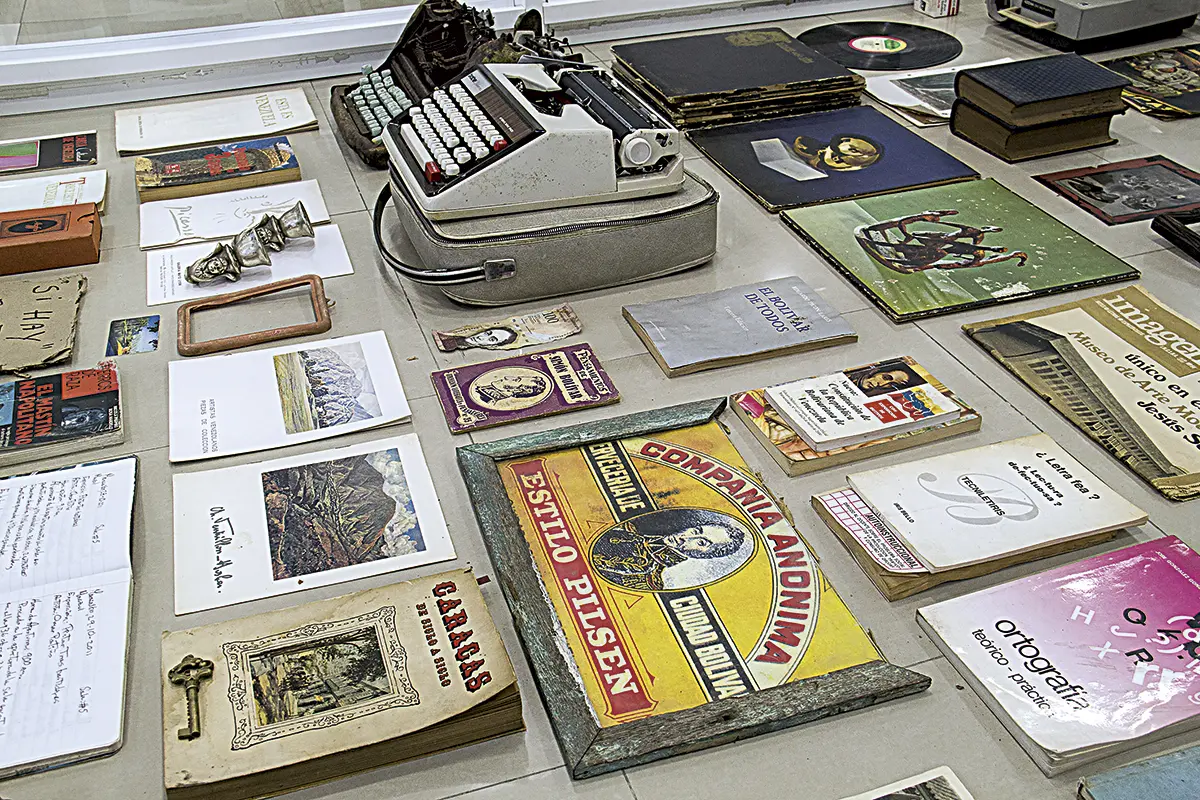
The site chosen for the show consists of seven square cubicles with glass walls, set on a straight line on the fourth floor of the library, with a view of the whole building and the surrounding gardens, which are reflected on the glass windows. Hundreds of objects were arranged inside each of the cubes according to their similarities and the possible dialogues that could be established between them, producing what Asprino called emotional landscapes of everyday life. The seven stations worked as site-specific proposals. The organization of the entire display was based on a unique classification system, as it was the site itself that produced the correspondences. Each landscape begins with a quotation from an author selected by curator Humberto Valdivieso, ranging from Hölderlin to the Venezuelan rock band Sentimiento Muerto, and including Jorge Luis Borges, Marcel Duchamp, Octavio Paz, and Rafael Cadenas. These quotations activate a poetic trigger within the territory of the objects and at the same time allow us to establish connections and build narratives for each installation. Each object is a fragment severed from its function and origin, but also part of the total sculptural body of the installation to which it belongs. Each shore becomes one, as objects from the seaside and from the city mix together in the cubicle. Books, small cups, pieces of wood, typewriters, suitcases, toys, paintbrushes, vinyl records, plastic dolls, advertisements, balls, electrical devices, keys, coins, protective helmets: the result is an immense archive of the beach and the city, an archeology of the shore with things that have been fated to inhabit the margins, the outer edges. In the process, the two shores intertwined, and so did various disciplines: the project was conceived as a performance, with the audience following the artist proposing changes in placement and expressing their own remembrances. The journey ends in a cubicle containing only two suitcases found abandoned in an old hotel, belonging to immigrants from the 1940s, accompanied by a text by Rafael Cadenas that points us in the direction of the future: “We flower in an abyss.” Years of contemplating oblivion, of classifying remembrances, of transforming reality into a stage for memory, of creating an alphabet of the cast-off.
MARÍA LUZ CÁRDENAS