Agustín Estrada is a dedicated Mexican photographer focused on the production of original artwork and the application of his mastery of the photographic medium in editorial collaborations. Subtle and meticulous observation defines his work in both spheres. “Shizen: On the Art of Looking at Nature,” the title of his most recent exhibition at the Department of Visual and Dramatic Arts of Rice University, points precisely to such subtle and meticulous observation. Insisting on the value of paying attention and spending time observing, in order to see, has been central to the experience of those who look at artistic creations. It is a close correspondence that yields gratifying results.
The exhibition features thirty-two digital images printed on cotton paper with an inkjet printer, each measuring 42 by 60 cm. About this work, Agustín Estrada said: “I have been working on themes in Japan. This selection includes two series of photographs taken there. The first one is titled “Koika” (which can be translated as passion for carp or love poem, depending on the way it is written in Japanese), a series I created in 2009 and 2010, presented at the Miguel Lerdo de Tejada library of the SHCP (Mexico’s Office for the Treasury and Public Credit), in 2012. Titled “Momiji,” the second series was created in 2017 and centered on the fall season. The project is an Asian trilogy completed by the inclusion of a little book titled Tokyo, written in 2015 in collaboration with my daughter Inés, and published by the Mexican Ministry of Culture as part of the Colección Círculo de Arte [Art Circle collection].”
Mentioning Estrada’s interest in Japanese themes is the appropriate introduction given the great response and attendance that his exhibition at the Lerdo de Tejada library generated, in 2012. For those of us who had the opportunity to see it, the show established intimate connections between perceptions, time, and visual and cultural narratives that offered a window into this artist’s subtle creative process. As we well know, contemporary artists are decisively nomad, and the content offered in this show confirms it. The admiring gaze directed at Japan by this Mexican artist was initially presented in Mexico and later in the United States. These photographs are as representational as they are abstract, and they focus on nature, in the close observation of it. At the same time, some images of this portfolio offer variegated textures, and other photographs insist on revealing the ethereal, in expressions where the lightness of the leaves of the trees articulates the depth of the space.
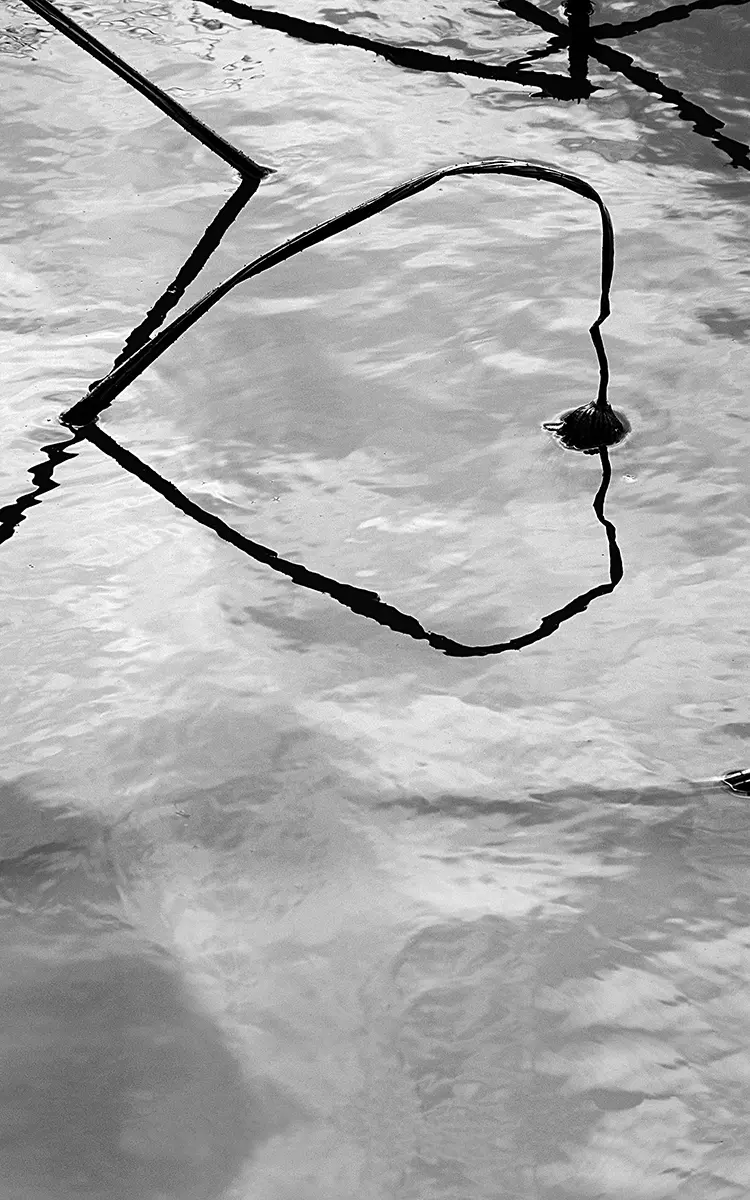
Contrary to what one may think, the exhibition does not offer a central theme. Nature itself is not a motif chosen by the author but rather the medium through which he shows us the way he sees as he invites us to follow suit. Some photographs depict calm situations, and others show movement, rounded forms, or angular elements. Others show sticks emerging from the water and fish under liquid medium, blooming trees, tree trunks and oversaturated branches that reveal the leaves of the same tree, shapes drawn by nature across space, branches bathed by the sun or darkened by shadows, which generate an infinite scale between black and white. While some scenes may include ducks or other animals, the images are not about living things or anecdotes; they instead focus on the lapses of time that each of the components reveals to viewers.
Whether animal bodies or plants, the elements depicted in the images shown represent references in the space. Neither intrusive nor meaningful, they serve to verify the essences that constitute the artist’s narrative. Agustín Estrada proposes a work about conduct that is not necessarily in line with any of the usual photographic themes. The behavior of any of the elements offers a series of dichotomies like the genetic and environmental ones, both highly relevant today. The photographs that include fish convey the duality of a motionless being—frozen in time through the photographic shot—and the reality of its actual behavior, which consists of continuous movement. The high point of the images including this species of fish is the symbolic value offered by the eye of each fish, which appears to be speaking to the art of looking at nature. It is as if when looking at nature—no matter how familiar it is to us—the very art of observing can make us stumble upon a particular type of plant of the rush family, abstract an unique.