The impetuous image of a burning house opens a door to explore and examine the installation titled “The House on Fire” by Colombian artist Víctor Laignelet (Barranquilla, 1955) inaugurated at the Galería Jenny Vilà, in Cali. This exhibition is one of the sections in the book titled Jardin acosado (Besieged Garden), which could be defined as a grand codex, a visual document that takes us through an exploration of archetypical images of humanity and, of course, of the collective unconscious.
“The House on Fire” was created on a napkin, a sketch that reminded Laignelet of a ranchería in La Guajira. A man and a woman from the Wayúu community lived in the house. The habitat shaped by fire became more into focus when he associated it with the biblical image of the burning bush, visualizing in this manner a spiritual state and the exodus of Israelites. “Archetypes are the forces that govern the world of human beings, in the same manner, that physical forces govern the physical universe. This is the reason why social struggles and spiritual evolution emerge first in the symbolic realm of images. It is also a prelinguistic psychic-biologic force that has existed for millions of years, before history,” affirms Laignelet.
To enter this universe of complexities and enigmas it is necessary to open doors and mechanisms created by the artist. Being a work with many vectors, it first and foremost requires careful observation. Viewers are called to bring the work into focus. Once they adjust their gaze, viewers enter into a dialogue with visual poetry that intertwines several aspects of the history of mankind with personal micro-stories until—in agreement with William Blake—the doors of perception open and a sensitive and singular experience is developed.
The second clue offered by Laignelet to decipher the mysterious and visionary images of his work required paying careful attention to the paths proposed in this installation. It is not just about a journey into the collective unconscious—a common substrate shared by all human beings throughout history and everywhere around the world—constructed with symbols and that reaches beyond reason. It also opens the possibility of entering the individual unconscious and be immersed in various depths, with journeys and intersections approached from mythical, oneiric, historical, and personal perspectives.
How to walk through the fire of this house? Laignelet has created a “poetic and visual machine” that consists of three interfaces: the first is a working board where images are deconstructed, stripped, left without the protection of meaning. We could venture to say that this space of images reaches a neutral state, without discourses, deprived of all the layers acquired throughout time. Then, an exploration process that relies on associations and a free-flowing imagination serve both the artist and the viewers. Observing this archetypical image evoked in my mind a series of images and events associated with the burning house: the stable where Jesus was born, Rome burnt by Nero and, by extrapolating the icon to Colombia, I remembered the photographs of a Bogota burning on April 9, the Palace of Justice set ablaze in 1985, the raging fires in LA and Greece, as I visualized the end of an era in the history of the West.
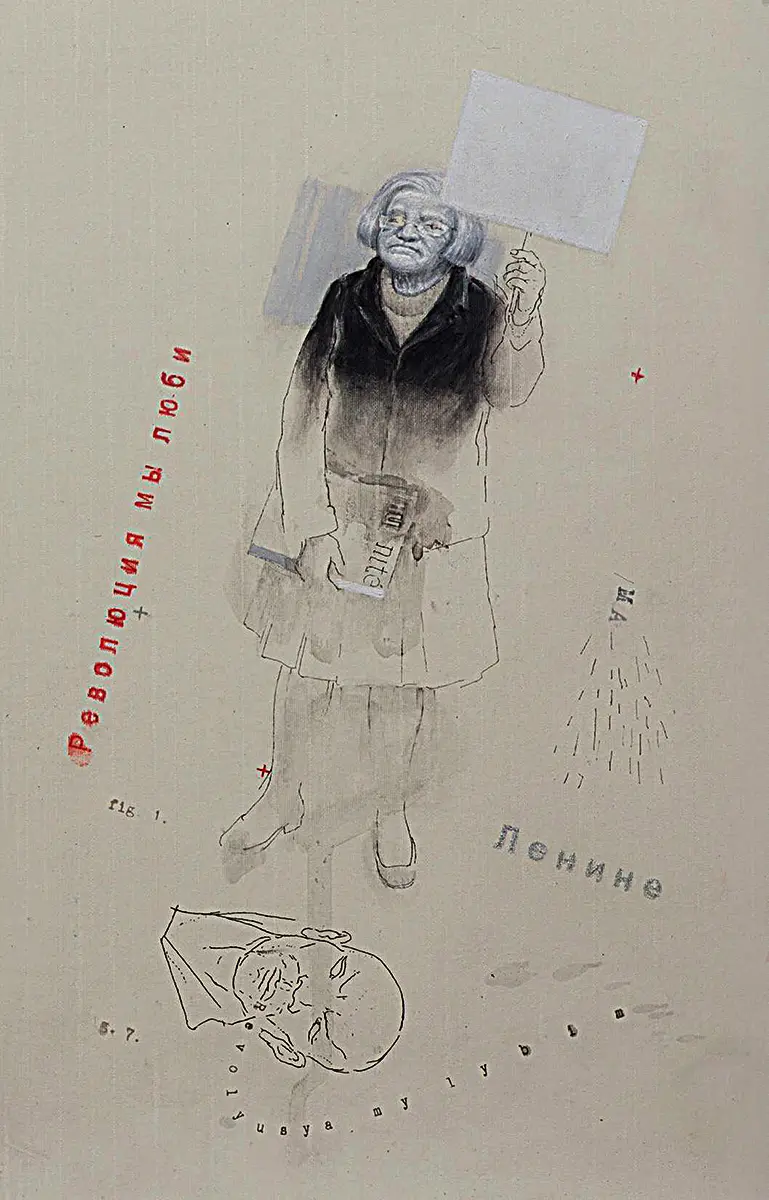
After this free-association process, Laignelet transfers his visual work into a paper scroll that shows drawings, paintings, gestures, traces, and word combinations. A visual text expands before our eyes, a comprehensive codex of humanity. It contains utopian failures, lighting striking towers, undecipherable languages, women marching for their rights, the tree of knowledge, priests preaching like politicians, arcana with their secrets and revelations; and the wise and cunning serpent appears as well. Another board shows small heads, a sort of detective who can find clairvoyance amid the blindness.
After surveying this entire construction, the images migrate to other planes. The exhibition is a series of flowing associations constructed with language, with visual grammars that offer endless possibilities. Víctor Laignelet has created a singular system, a “matrix” with which to create his work. He has intertwined mystical, poetic, and cryptic images to create a text that is essentially alchemic. In other words, by establishing a dialogue with “The House on Fire” we become participants of a purifying experience in which painting can turn us into seers able to find their way back home; to rebuild it and bury the ashes so the garden of our paradise lost can be reborn.
MARÍA ELVIRA ARDILA