
There is absolutely no doubt that the impressive project On Air by Argentinean artist Tomás Saraceno (Tucumán, 1973) is at the same level as any other important art installation presented in recent years in Paris, including Leviathan Thot (2016) by Ernesto Neto at Le Panthéon; Chute d’étoiles (Falling Stars, 2007) by Anselm Kiefer at the Grand Palais, on the occasion of Monumenta; and Dirty Corner (2015) by Anish Kapoor at Versailles.
On Air is not only an exhibition in the strict sense of the word, but is also an artistic and intellectual reflection, a large and comprehensive ecological and political (prophetic?) project-manifest “in the form of a moving ecosystem,” as described by the curator Rebecca Lamarche-Vadel. It is an unprecedented visual and sensitive experience that combines inquiries and scientific knowledge with artistic dimensions and formal beauty. It is also a collaborative project that involved the participation of scientific institutions, biology and astrophysics researchers, sociologists, ethnologists, philosophers, musicians, activists, and local communities.
A walk that requires the full participation of viewers, it heightens their curiosity, inviting them to leave their reflective abilities behind and enjoy the instant, delve into the physical and poetic interpretation of interpenetrated, living and fragile universes that construct “invisible stories.”
From the Anthropocene to the “Aerocene” (from the Age of Mankind to the “Age of Air,” the latter a term invented by the artist) visitors follow a connecting thread of “stories” that challenge them and question the nature of mankind’s relationship with the world. As celestial phenomena, non-humans (spiders) take part in that impalpable life that is no longer ours, as we have been alienated by the preponderant materiality in the world.
On Air is the largest project ever created by the Argentinean artist. Two floors in the enormous Palais de Tokyo immerse us in an “artistic, poetic, and political odyssey;” a journey through elements and transitions of lights and shadows, blacks and whites. In fact, visitors are initially surprised by the deep darkness that must be negotiated almost blindly as they move through several rooms. The exhibition walk reaches its full meaning through the succession of the eighteen themes that underscore different aspects pertaining to our ability to perceive. We find ourselves immersed in kinetic cosmologies that alternate between vibrant, translucent, mobile, and brilliant atmospheres. In Webs of At-tent(s)ion, the vast space opens with a group of seventy-six hybrid webs (500, if we count the different species). Every arachnid habitat suggests a “floating,” untouchable, world levitating under the light. Aesthetically speaking, it is a magnificent sight that invites us to reflect on “our interaction with them” as well as on the fragile and fleeting beauty of nature.
Next, Saraceno summons air and its sound: Sounding the Air and Events of Perception resort to changes in temperature and the flow and breathing of visitors, which are translated into sound vibrations and frequencies. In this manner, the air becomes voice. Particles and vibrations are invoked as one listens to the sound produced with the silk threads of the webs. At times, visitors are inadvertently sent to a sort of lunar journey in which they lose track of time as they are projected towards an interstellar constellation. Then, they joyfully leave reality behind with all of their senses.
After leaving darkness behind, viewers enter a basement flooded with dazzling white light that exposes them to new sensitive, visual, and sound perspectives. The section “Aerographs” offers a perspective on the various manners in which the movement of mankind, of non-humans, and the winds affect, and are affected by, the surrounding air. In this manner, the movement of several pens tied to balloons is dependent upon the direction in which the air flows. As they move, the pens draw random planes or playful spider maps on the threads that form the webs—courtesy of the PM2.5 black carbon dust from Bombay’s pollution. A beautiful photograph of the Salar de Uyuni [the world’s largest salt flat, in Bolivia], titled Event Horizon 199.000 Light Year (2018), opens a new section of the exhibition. It is followed by the section titled “Cosmic Levitation,” featuring a video of cosmic dust particles combined according to the vibratory rhythms generated by sound frequencies. Without being connected to any electronic circuit, the black crystal radio reads ecological frequencies while also serving as a traditional crystal receiver.
Dust, crystal, sand, solar energy, air, and light: everything resounds. From the microscopic to the cosmic, everything comes together to convey “the flow of the world, the invisible and permanent action of the elements of the universe,” according to the president of the Palais de Tokyo, Jean de Loisy.
In Algo-R(h)i(y)thms, one of the most spectacular sections of the show, visitors are invited to provoke sound works “in real-time” by plucking nylon cords, some of which are connected to sensors that amplify the sound. In the same manner, these nylon cords form structures that are reminiscent of webs or the structure of atoms, which visitors explore to produce sounds through their steps on the floor.
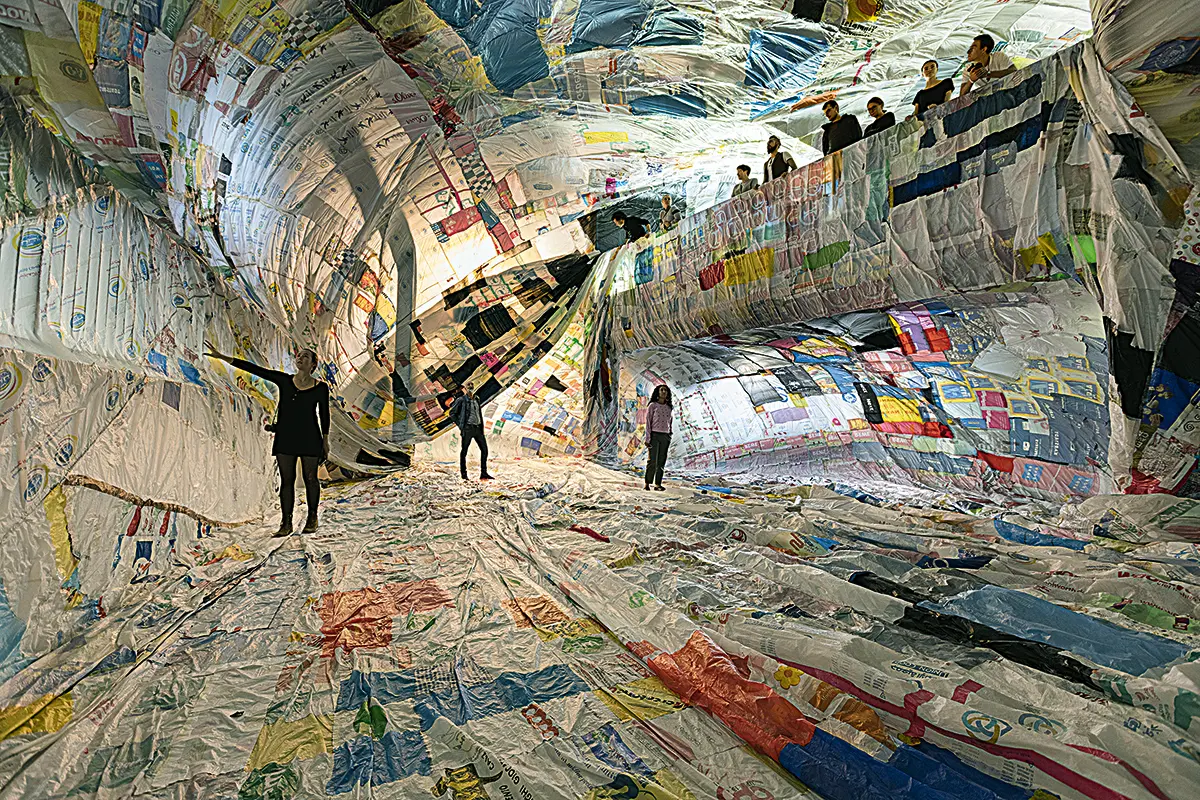
While difficult and demanding, by revealing the secret beauty of nature the exhibition is also an aesthetically joyful experience. The show concludes with Saraceno’s interdisciplinary artistic project “Aerocene.” It requires a collective commitment by visitors to ethically collaborate with the environment to imagine “new ways of inhabiting the airs, without borders or fossil energy.” El Museo Aero-Solar (The Aero-Solar Museum), which consists of a structure rendered with used plastic bags that visitors can enter, ends with an ironic tone in the last section of this walkthrough an unprecedented exhibition marked by multiple visual and sensitive brilliance.
CHRISTINE FRÉROT