In the Symposium, Plato defines the term poiesis as “the cause that makes anything we consider the change from non-being into being.” A poiet is a creator, a privileged subject who possesses the ability to make myths tangible, to show the path to others, even to “remember” the future; this is to say, to foresee what hasn’t happened yet, but which has definitely begun and will soon reveal itself forcefully; it is a kind of antenna receiving invisible signals of the feeling of the multitude. His relationship with words is intimate: the poiet knows and recognizes himself in them: the poiet is who named them for the first time and who has the power to know things by the word he reads in them. With the poiet we understand that the word is the origin of the world and that whatever we can’t call by its name, which must necessarily be a word, does not exist fully. Only that which we can name has space and time, it accompanies us because we have it present. The word is thing; each individual is word and phrase, even. These are the poiet’s raw materials, or of the poet, as such persons are now known: strange and necessary beings.
Adolfo Bernal (Medellin, 1954-2008), without a doubt one of the few poiets this land has produced, of as rare a type as it is scarce in these times, stated forcefully that he would exchange all of its work, everything he had achieved up until that afternoon in 2008, for having learned how to paint a still life. Looking at him in surprise, but also pleased by what I heard, my memory placed between his face and mine a small pastel painting of five or six empty jars on a table by Giorgio Morandi, an Italian painter who spent his life doing a single thing: again and again, the same painting, an austere still life with a clear April light and a sad, dramatic serenity, as much as the few objects that over time he memorized, in a stubborn exercise that can be achieved only by a special individual, someone Intent on understanding life in the silence of things.
I did not ask him why; it seemed to me that his assertion was highly eloquent by itself. I continued to think about Morandi. Clarifying things were unnecessary. Now I would like to know, with all certainty, if what I felt when I heard his statement was really what he was trying to convey.
This poiet knew himself to be a guardian of the city—a city he knew better than anyone; he was an expert player of the simulacrum that represents life; he was a great expert in didactics and pedagogy, as he always gave himself to others to his pupils; he was a peerless instructor who sustained the creative tone of his initiatives, both inside and outside the classroom. He turned the city into a giant classroom and traveled along its nervations to find unexpected angles with his friends, his pupils.
Adolfo was a great lover of fil and imbibed insatiably from that well; especially, words. He began early on to formulate uncommon questions in writing. As a young man, he walked with the Nadaístas and experimented with haiku, without intending to. He simply sprouted short-form poetry; he even thought that way, in equivalent and contrasted nouns that sparked the imagination. Sharing a moment with him meant witnessing a process of invention, the construction of the meaning of things and of phenomena. To have witnessed the unfolding of an unperceived horizon right there on the table, guided by his voice, is, perhaps, the most vivid memory I have of this individual whom a common friend once described as “tree-shadow man.”
“¿No jerto?” (something like “ain’thatright?”) was his typical way of closing a sentence. Said in his deep and mysteriously comforting voice, that pet phrase was a call to believe and to create, to agree with someone surrounding but something that was just being created. His creativity included, definitely, the other; he did not give himself license to go it alone.
At the age of twenty-two, Bernal published a poetry chapbook: Antes del día (Before the Day). Its loose leaves escaped the order of the bookshelf and brought it close to a different type of product. Soon enough, paragraphs appeared too long to him and began to be simplified, until only two lines were left: in each, only a noun. In this way, words began their transit towards the image, a result of the sum of meaning achieved by the other reader.
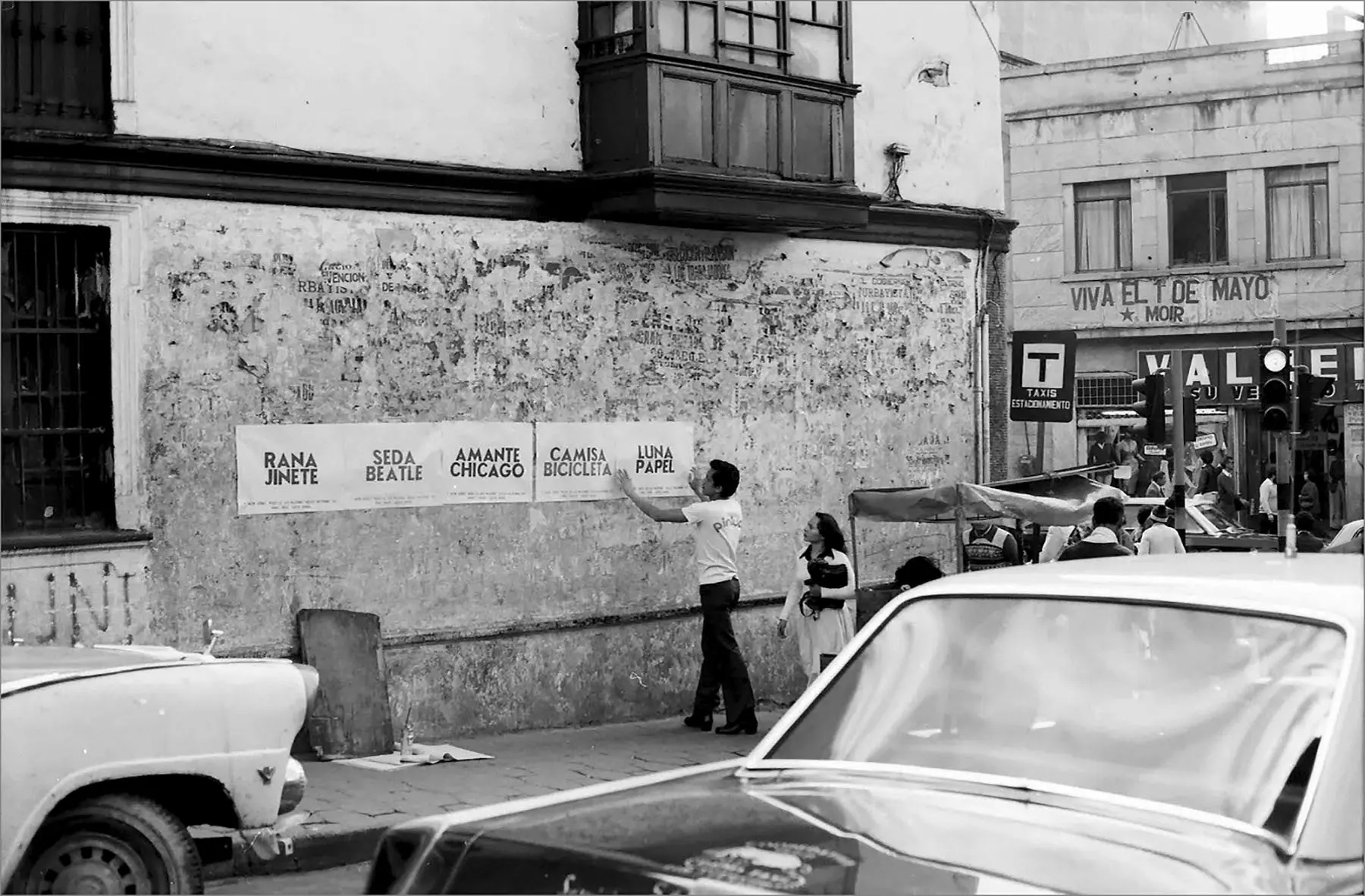
In 1975, Adolfo Bernal began his assault on the city. Without any knowledge of the Situationists, much less of Guy Debord and his reflections about “the derive,” Bernal invented a no-=vel way of relating to the urban space: he began to label streets with two juxtaposed names, in simple yet forceful compositions. Pairs of words began to appear in arbitrary locations. Any spot in the city was important; he was turning the city itself into a possible canvas.
Up until May 68 in France, it was thought that conventional arts, such as painting and sculpture, had to evoke concepts in the viewer, words that would echo in his or her mind and guide an excursion in thought, while literature and poetry had to produce images, scenes, and temporalities. All of Adolfo Bernal’s work erodes that logical knot. His great contribution is evident in the transmutation of the meaning of words when it comes to a consideration of the signifier image and the signified form-and-line in each letter. Similarly, the poietic configuration of his actions depended by necessity on collective work, on an effective evasion of the market that he exercised with decisiveness since any glimpse of economic exchange limited his machinations and, ultimately, the anonymity that was the strategic position for the communicative exercise. This triad was his happiness: he only did what he enjoyed most greatly, something that made his unexpected proposals transcendent.
Signals
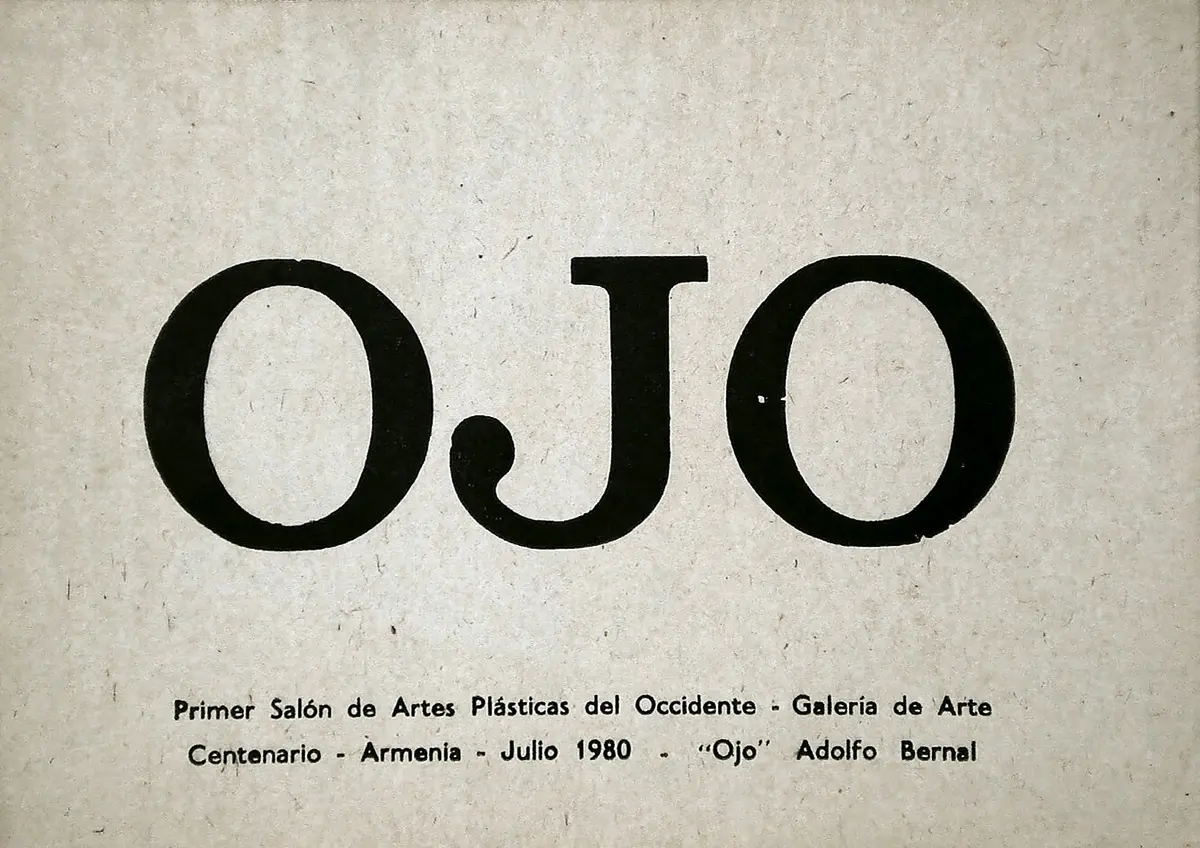
Señales (Signals), in general, was the word that the poiet used to name his work. The skin of the city—with its changing walls, thanks to the fleeting advertisements for shows and its edicts, all glued and ripped and glued again, again, and again in an incessant palimpsest—filled his gaze with emotion. Horches is how this kind of urban bills and posters have come to be known—the kind that seals newsprint with pure inks and is used for the massive diffusion of information. There, where no message was glimpsed, between layers and layers of paper, Adolfo Bernal put his own messages in the play. The result: a name for a place that had not to be named before, an ambiguous gesture that prompted us to live the city with different eyes, to observe rather than simply seeing. He understood quickly that authorship was not only an obstacle between him and his fellow human beings, those others who allowed him to be. Each poster he arranged lasted exactly as needed, waiting for those who would stop, turn, or see themselves:
AMANTE
CHICAGO1
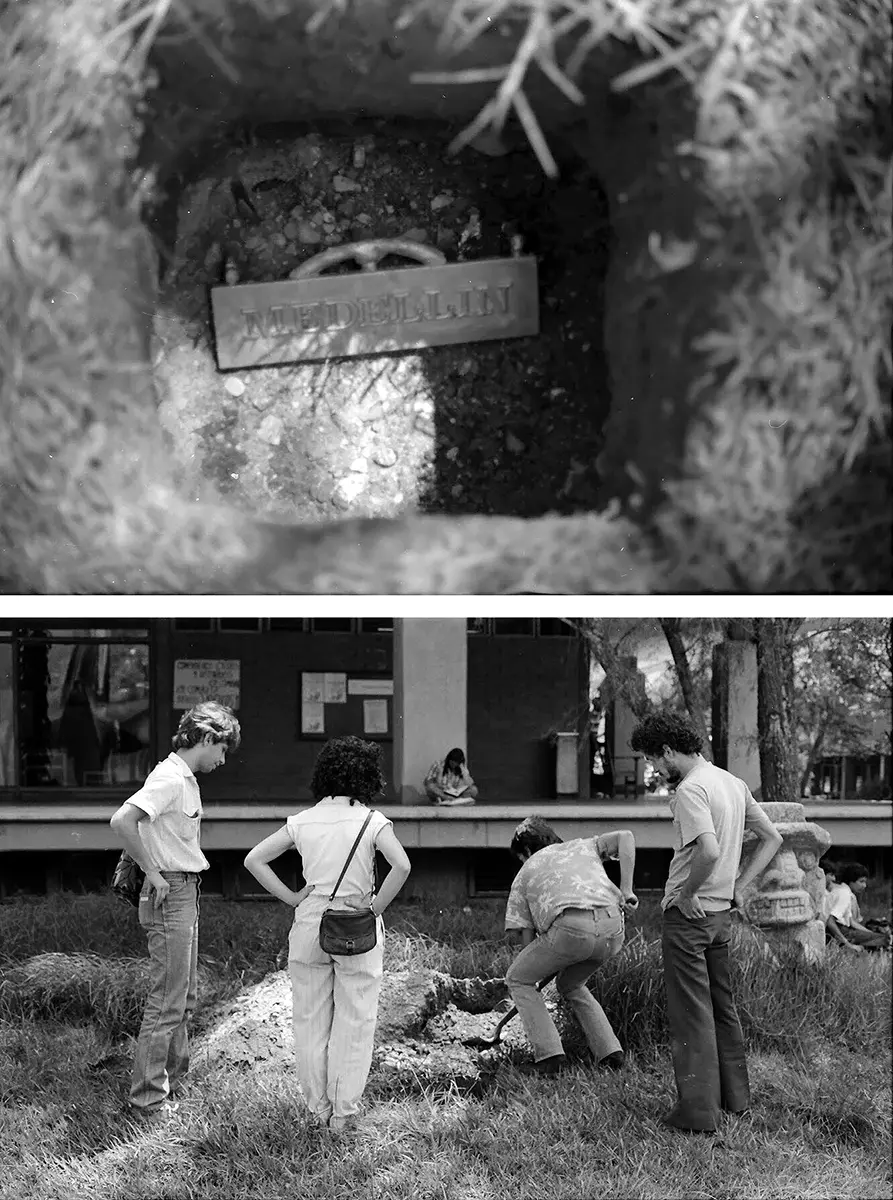
Adolfo Bernal studied journalism but soon changed gears: he graduated as a graphic designer. Yet. Words remained with him. The image, which came to him from the world of design, entered into his word in a decisive way: in 1981, in the concretization of a short-form poem, he brought pick and shovel to bear and buried a word in the sculpture garden adjacent to the Museo Universitario building at Universidad de Antioquia. In this way, the word became a verb, motion, action, and evidence. Medellín, the word he chose for this action, had been melted in lead, a prime malleable metal that also has a strong symbolic presence in Colombian history and in the future imagination of the homonymous city (which was, at the same time, the site of the burial).
The location of the “future archeological site” was chosen strategically: the area occupied by copies of pre-Hispanic stone carvings by what is known as the San Agustín culture, surrounding, gargoyle-like, the alma mater’s center for cultural conservation. Bernal’s idea was to plant a trace, a signal loaded with multidirectional meanings, a contemporary Rosetta stone that transcended our own culture, in the expectation that in a different time, beyond any we can conceive of now, this shape will speak for us to other peoples or other beings; that this word-object will tell stories, like the fact that we were experts in the handling of lead, withal, that implies.
Signal: Medellin. 1981
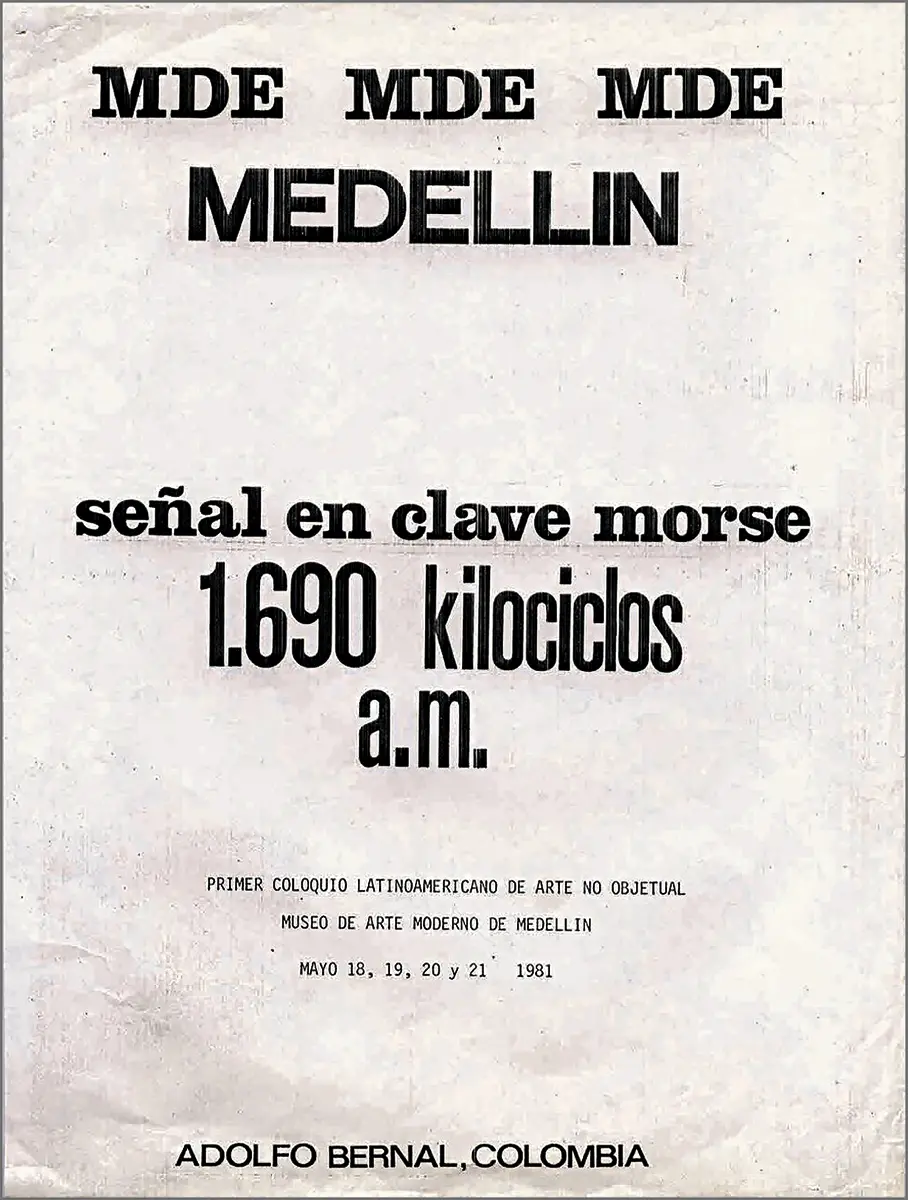
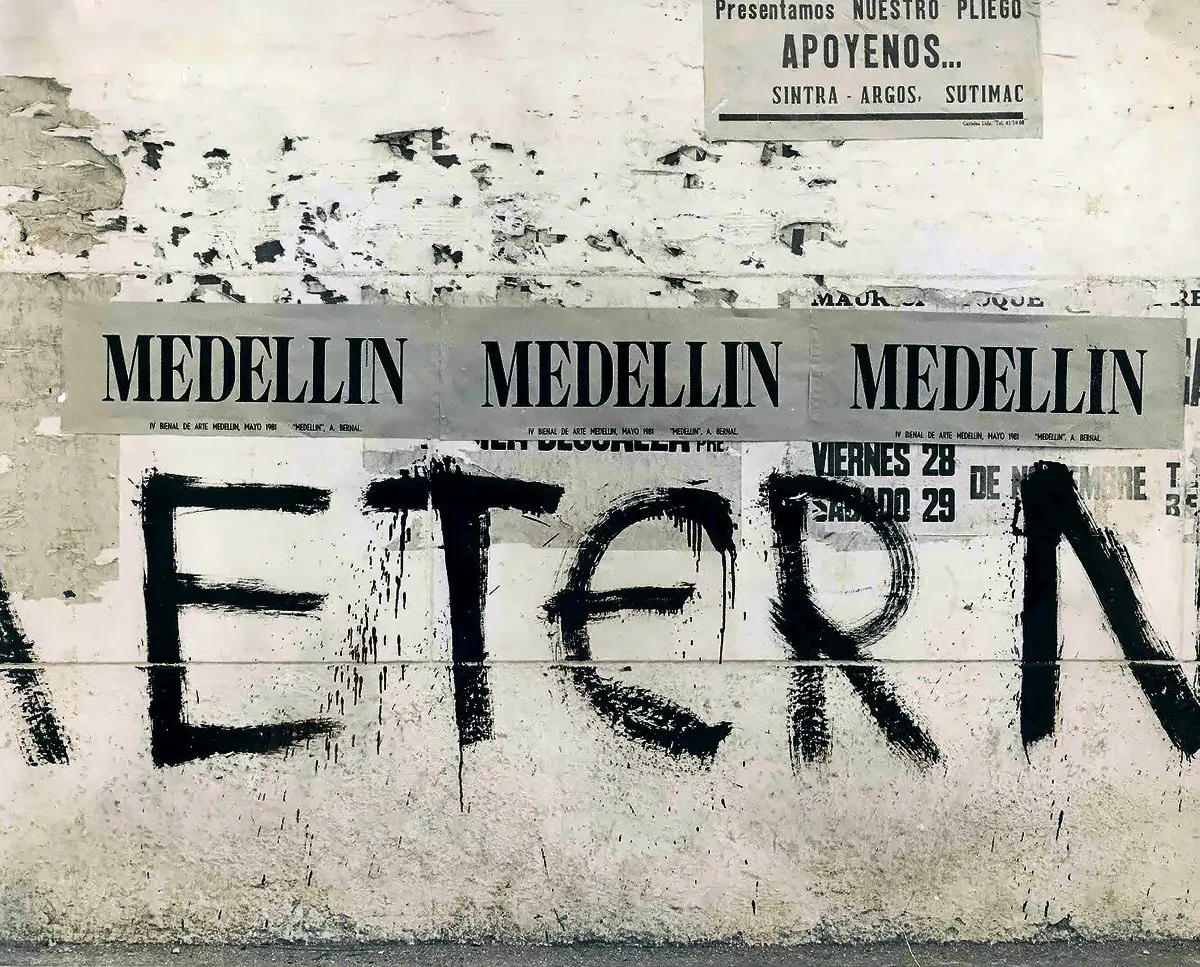
Señal: Medellín. 1981 (Signal: Medellin. 1981) is a title of the poem that was, at the same time, a tripartite signal. Two further initiatives were the central part of the proposal, which remains alive in different ways. For the first Latin American Dialog on Non-Objectual Art and Urban Art in Medellin, convoked by the city’s Museo de Arte Moderno on that year, Adolfo Bernal set the letter that identifies Medellin, MDE, in Morse code. Many understood the Dialog as a counter-Biennial, an event opposed to the initiative of reviving the biennials that, sponsored by a successful textile company of the era, Coltejer, had put the city on the Latin American cultural map since 1968. MDE was broadcast uninterruptedly at 1.650 kHz AM for the duration of the event. The third component of this innovative triptych with which Bernal participated in the Fourth Biennial was the word "Medellín", printed on a poster in the horche technique and used to cover many walls throughout the city overnight. The next morning, citizens were certain to be walking in Medellin, a city that resembled a Macondo labeled everywhere to combat the oblivion brought about by the epidemic of insomnia.
Medellin was and will remain the home for this trailblazing artist, this necessary yet, paradoxically, little known poiet who, like Morandi, was able to erect a world by dint of adverse predictions, a world that remains alive in us despite its modest and anonymous image.
Adolfo passed through, did his work, and stayed as one of the necessary men. Poblareto, a place he named, between the neighborhoods of El Poblado and Loreto, was the vantage point from which he contemplated the large, final still life, one that, in a way, he had painted in his last years with signals and codes, signs of life for a restless city.
“¿No jerto?”.
NOTE
1. Text printed on posters and flyers of the series Obra impresa/urbana, intervención en el espacio público (Printed/Urban Work, Intervention on Public Space), November, 1979, V Atenas Salon, Museo de Arte Moderno, Bogotá.
* From the artist’s archive. Courtesy of the Bernal Henao family.
OSCAR ROLDÁN-ALZATE
Master in Fine Arts, curator, and master in Political Science. Heads the Cultural Extension Department at Universidad de Antioquia.