Two exhibitions by Venezuelan artist Sigfredo Chacón (Caracas, 1950) were presented concurrently in Miami during the months of September and October. Centered on two independent moments in the career of this artist—the early period and the current one—the exhibitions showcased an intelligent and unrelenting artistic production that spans over forty years.
An artist and designer by trade, Chacón has approached creation with a particular interest in conceptual aspects. His entire body of work reveals a tireless search for the mechanisms of fine art, in a process that has revealed and examined the communication strategies of pictorial language. His proposals have been exhibited in multiple series that, in the artist’s own words, are combined or superimposed “by squeezing ideas, weaving a sort of conceptual web that allows for painting to become the means and the end of the entire creative discourse in which any references become the painting itself.”
Chacón became interested in conceptualism very early in his career. Having developed associations with the experimental circles of the 1970s in Caracas and having studied in London in the early seventies, his inquiries were fully informed by the renovation and rupture movements that back then had reached their peak in the Western world.
Titled Situations. Early Works. 1972, the exhibition presented in the Miami Biennale revisited this period of Chacón’s work, reproducing the installation created by him for the Ateneo in Caracas. Back then, the mounting sought to confront and propose an alternative language for Kineticism, a movement that became the official aesthetic of the so-called Saudi Venezuela period. For this purpose, Chacón not only relied on raw materials like canvas and vegetal fiber ropes but also used basic production processes that required simple knots and suspensions that, like in the pieces Situaciones (Res-Rembrandt) [Situations (Res-Rembrandt)] or Situaciones (Situations), closely resembled the quality of Arte Povera.
The ephemeral nature of these works widened the breach with the “fetishization” of the work of art. In fact, all the pieces were destroyed after the event. Likewise, by being conceived as an environment and not as a traditional exhibition, the proposal underscored its experimental nature. In Situaciones, space constituted a whole as viewers were separated from their contemplative role to become an active part of the event, encouraged by those “situations” that also referenced painting (and art) by alluding to its material fragility as a connotative pivot.
The exhibition in Miami was complemented by photographs of the 1972 exhibition mounting. It also included pieces from other relevant periods in the production of Chacón, including the Pinturas parlantes (Talking Paintings), monochromatic planes in which the artist—in a reference to classic conceptualism—writes in relief the name of the color used; or the Pinturas para daltónicos (Paintings for the Color-Blind), the result of a thorough inquiry into the perception of color.
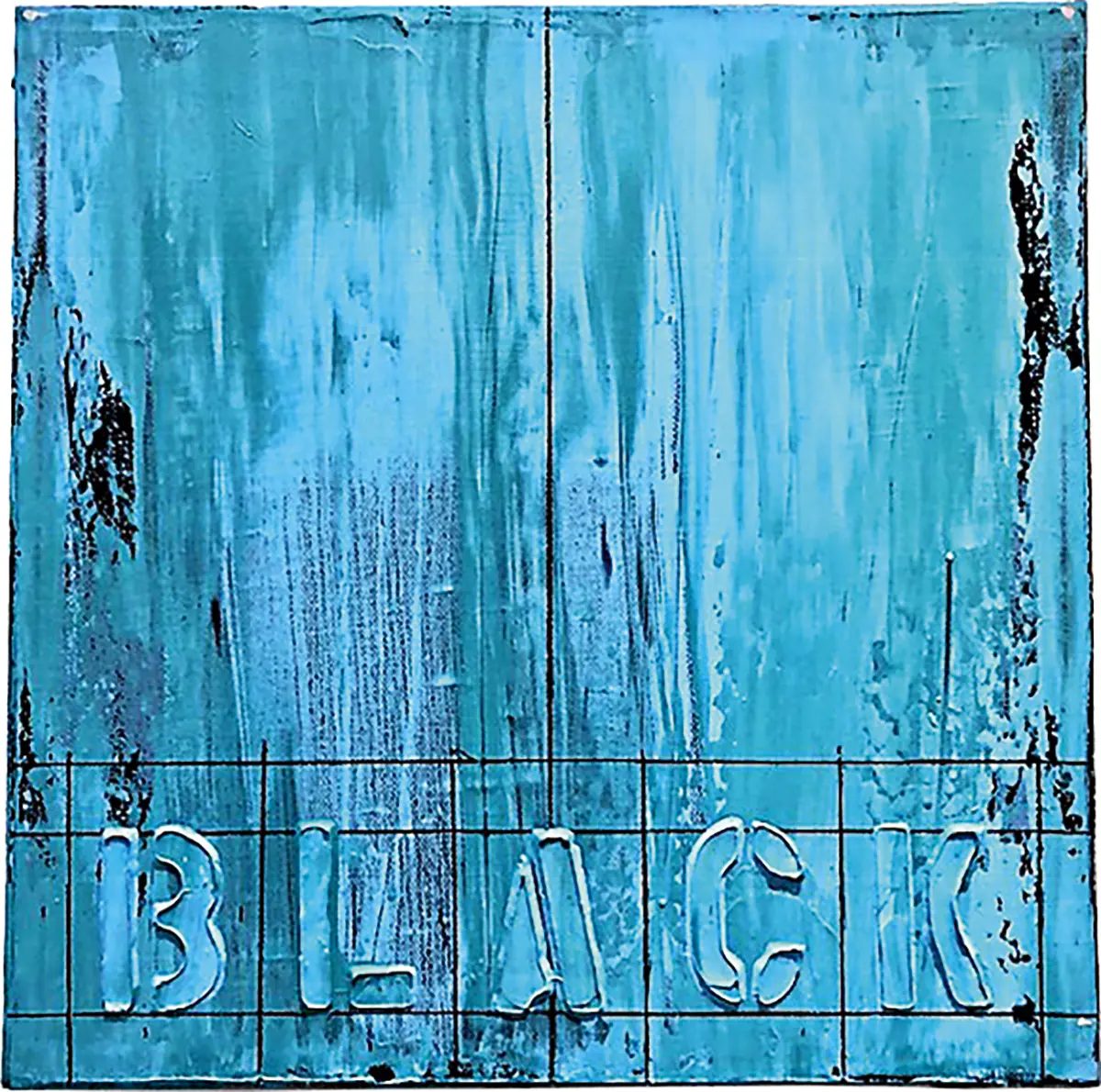
Imago, Art in Action featured a large group of works from his recently created series titled Black Paintings. The pieces closely follow the characteristic configuration already present in many of his series: a painted square with a grid on the lower section in which several letters in relief ironically or cunningly allude to the painting itself. In this instance, the word included in all the works is “black.”
Contrary to its denomination, these “black paintings” seem very colorful at first sight. To create them, Chacón rendered the background of every piece with black pigment. Then he covered it with a layer of bright acrylic color, white or grey. While every painting has a different tone, a few of them used two colors symmetrically arranged in the composition. In these pieces, black contains a great part of the expressive power, acting as a hidden protagonist element whose presence is surreptitiously perceived. It plays a double role: as a primer, silently obscuring from the background the color on top of it; and as overt color, by revealing itself through the random structures rendered through brushstrokes and layers, by leaving the borders of the frame, or through drips.
Chacón establishes in these pieces a tension between his “conceptual” visual training and that which he has been proposing since the series Berlinpaintings: the introduction of a narrative element in his work. That series involved the profound impact that a visit to Berlin and to Nazi concentration camps had on him. They reflect the personal holocaust of someone who, like Chacón, had to emigrate from one country in crisis and must adapt to new realities.
KATHERINE CHACÓN