In the midst of all the commotion caused by the many openings of solo and group shows that took over the city around the recent edition of the São Paulo Biennial, one exhibition at the Ibirapuera pavilion stood out from the rest of the circuit, thanks to the consciousness of an artist whose investigations fine-tune projects in which Brazilian cultures find ample interlocution.
It was a solo exhibition by the Brazilian artist Rochelle Costi, titled Reforma (Reform), an exploratory occupation of the Rino Levi house, an exhibition space of the Luciana Brito Gallery in São Paulo. Costi’s project generated a dialog between the artist’s frank authorial narratives, the architecture of an icon of rationalism, and the inescapable landscape art of Burle Marx.
The space designed by architect Rino Levi for a modernist residence located in a high-traffic thoroughfare that cuts through the city of São Paulo, now home to a thought-provoking, model gallery space focused on new exhibition contexts, found itself intercut by a series of pathways that Rochelle Costi has been proposing in her work for decades.
The trajectory offered by Costi’s show, set up by the artist, was a zone of coexisting temporalities. These temporalities—on the one hand, the logic of 1950s modernist architecture; on the other, the time of contemporary everyday life in deepest Brazil—coexisted in an incomprehension overloaded with experiences that are so distant and at the same time so familiar.
The symbolic imagination of that architectural period practically came to life with Costi’s intervention featuring photographs printed on stretchers, transfers on fabric, and on vinyl sheets.
His exhibition incorporated almost the entirety of the modernist building, moving from the grand living room to areas more reserved for domestic life, and finding in the cellar a fitting space for the exhibition of the show’s only video, Há Casas (There Are Homes), from 2018.
This work, “edited from photographs of the Procession of the Candle of Nazareth (Belém do Pará, 2017),” showed, according to the artist, thousands of congregants carrying small houses “in painted wood, representing their desire for better housing, mixed with images of real homes in Jordão (Acre, 2018).”
Costi’s video records the movements of the faithful with their small wooden houses, votive offerings in the hands of men and women, objects that carry in them the hopes of those who remain steadfast against the greatest adversities—like colorful rooms that proclaim the daily struggle and the desire, almost unreachable, for a home of one’s own.
With a significant presence in the contemporary scene, Costi investigates the different spaces of Brazilian reality by means of installation, photographs, and videos; her incursions into the many levels of meaning present in common life, in folk scenes, in household interiors, in the façades of coastal dwellings, are critical devices materialized in order to provoke thought.
The title of the exhibition, Reforma, refers to the common practice, integrated into the life of innumerable families, of renovating a residence with great effort and creative solutions, combining improvisation with ingenious choices that soften the hard edges of their daily life.
In the gallery’s modernist-house space, Costi’s photographs of façades of Brazil’s most authentic architecture—as seen in Casa Torta (Crooked Home), 2018, and Casa Marrom (Brown Home), 2017—were able to promote a model of coexistence that fluctuated between the rationality of the modern project and the reinvention of living meanings that is so common in the homes of the poor.
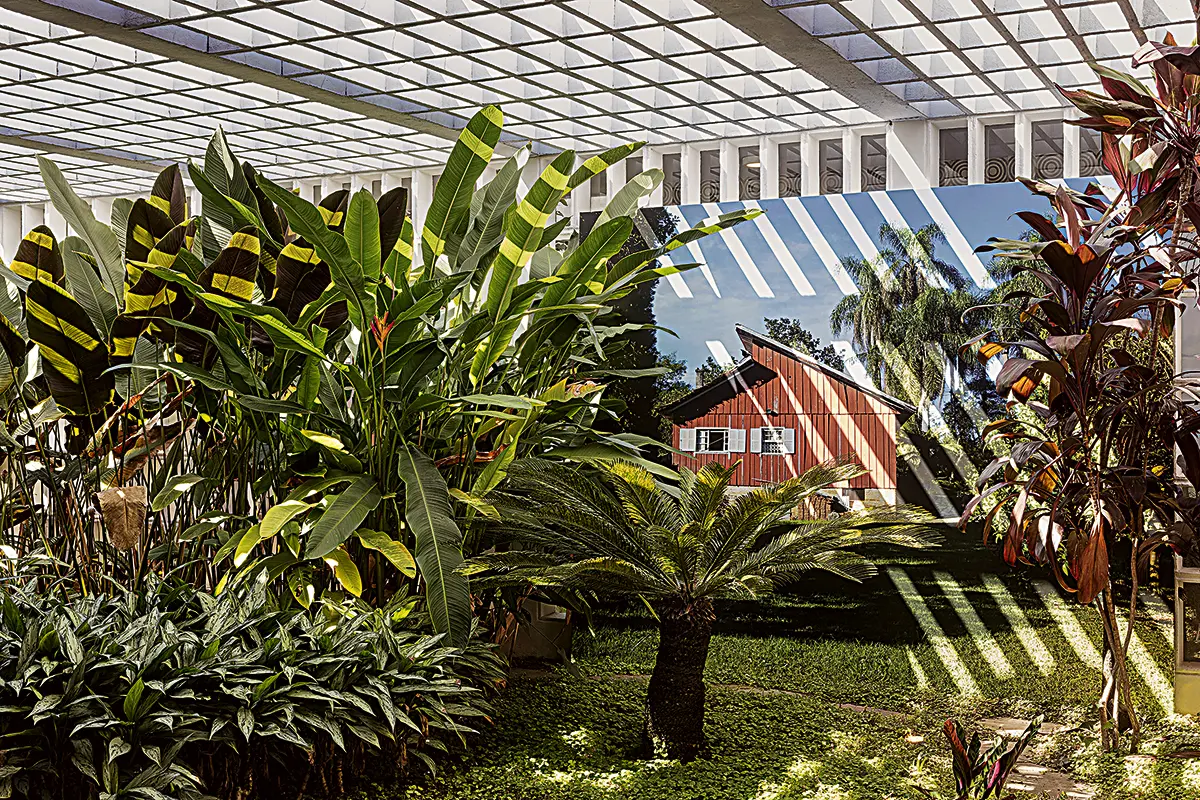
In Casa Torta, the image printed on large-format vinyl canvas, presented outside the gallery, just at the entrance to the exhibition area, even generated a kind of reform of space itself, a reconstruction or reinvention of the site, which, having functioned as a residence in the past, now has a new avocation as a device for art exhibits.
The photographic record of a precarious wooden dwelling, located at the beach, semi-derelict and abandoned to its fate, contrasted powerfully with the exterior area in which it was exhibited, almost covered by Burle Marx’s fantasy garden.
Once inside the residence gallery, in the garden attached to the grand salon, Casa Marrom, also printed on vinyl canvas, transported visitors to the country’s most remote regions, to a delirious environment of untamed nature. The photographic record of a colorful façade salvaged the dignity of a different way of life.
A large portion of the central element in many of Costi’s investigations emerges from popular, folk culture; this is to say, it comes from images that connect with deepest Brazil, a country of contrasts, of creativity driven by scarcity, and of a dazzling tangle of adaptations and improvisations.
Indeed, the itinerary of Rochelle Costi’s creative projects is itself made of successive adaptations and decisions intended to embrace the place of others. In Reforma, Costi’s artistic reasoning was based on a logic of friction between hybrid relationships in the adaptation of dwelling spaces and the necessary rationalism of modern construction.
An expert in the visual maneuvers that are conceived for daily survival, between urban investigations and immersing herself in the lives of many, this artist, erects her particular experience of architecture without ever forgetting her ethical commitments.
CLAUDIA FAZZOLARI