In a proposal reminiscent of a journey of initiation, the exhibition Del Río de la Plata al valle del río Hudson (From the River Plate to the Hudson River Valley”), an exhaustive display of the creative peaks conquered by Rimer Cardillo (Montevideo, 1944) presented in the main galleries of the MNAV, invites us to a pilgrimage through an artistic career spanning fifty years. A metaphor for the trans-migratory condition of the works, but especially of the master printmaker’s destiny in life, the exhibition’s title refers to the swaying gaze of someone who lives between those two distant yet connected shores, and to the negatives generated by a cultural and conceptual transit between their banks. This multiplicity of references fuels a succession of expressive pairings that dominate the monumental constructions, the delicate fragments of shells and carapaces, the mineral traces, and the impossible insects in their detailed closeness. “Everything comes from printmaking,” states the artist as a declaration of principle, and the delicate smithery of the plates, the photographs, the evocative pieces of provocative archaeology, even when they seem to dislocate the boundaries of the graphic register, invariably return to the original matrix.
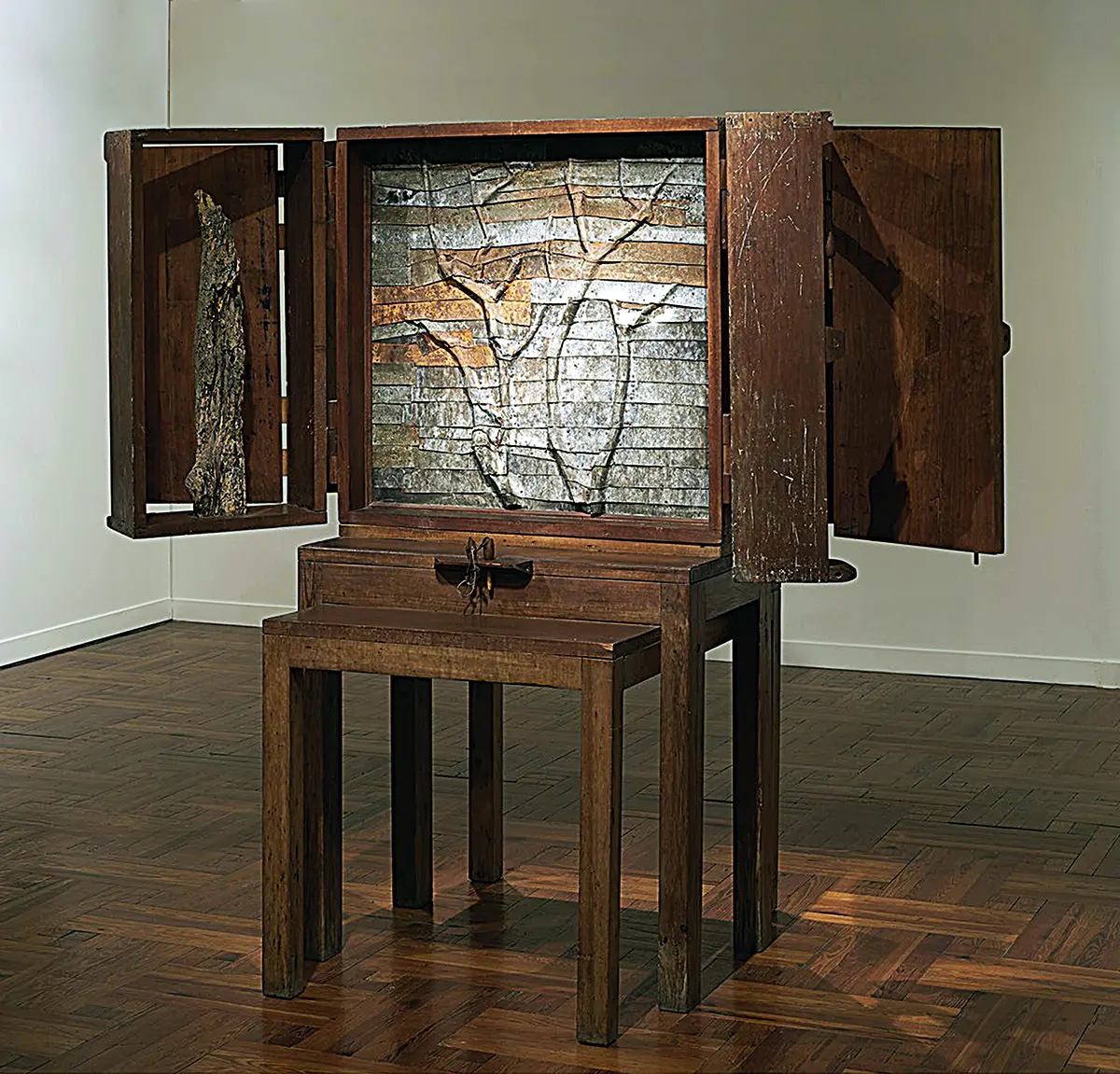
The itinerary and its alternation of chronological and thematic rhythms enhance a sensation of circular time, of eternal return, all of if reinforced by a curatorial script that decides to start the trajectory with Cardillo’s most recent work, La última canción (The Last Song). This photographic series functions then as a threshold to the “sacred chambers” of the first gallery, composing an eerie retinue of inert birds found dead around the artist’s studio, a resignification of the objet trouvé category and an ecological dimension of the memento mori that traverses the entire selection of works. Once these guards of danger and mystery are cleared, the interior space is intriguing, but also diaphanous in its open spatiality, dominated by the chthonic monumentality of the Cupí del MNAV (MNAV’s Cupí), a site-specific installation hat plays with polysemic ambiguity in its most literal reference (cupí refers to ants and anthills in the Guaraní language) and its anthropological implications, connected to the ceremonial mounds of the charrúa people. This work summarizes some of the guiding lines followed by Cardillo’s work, in his interest in a material trace associated with the loss of being. The danger to nature or the extinct ancestral culture is superimposed on the ground in tangible interpretive layers, in dialog with another large work in the gallery: the melancholy Altar del monte criollo (Altarpiece of Mount Creole), the totemic vestige of a space dominated by the intervention of materials (wood, metals), which struggles, in a tension of unpredictable results, between its powerfully natural condition and its forced mutation into the movable property.
In a literal and symbolic ascent towards the upper galleries, the viewer, already an initiate pilgrim, reasserts his or her connection to the mysteries, entering into contact with Cardillo’s early work in the exhibition’s most retrospective segment. The sensual and colorful organic forms of Cardillo’s first prints progressively evolve into creations that push the political and poetic dimension of the work towards maturity, in an increasingly more troubling context during the 1960s. The era’s institutional breakdowns, and especially the social and personal losses derived from the military dictatorship installed in Uruguay, give rise to series of dramatic preciosities, such as Chicharras y mariposas nocturnas (Cicadas and Moths) and the crescendo of deeply felt references to torture and imprisonment that undergird Escenografía para insectos (Scenography for Insects). Later prints like Cajas rituals (Ritual Boxes), produced after the artist left his native country, breathe in the minimal pieces of a fauna controlled in valises, the melancholy of exile, and strategies for the conservation of fragments of identity, personal and cultural heritage, necessarily “portable” in its condition as a safety foothold in an alien context.
The itinerary ends with a game of mirrors in connection with earlier compositions, an ouroboros that reasserts the artist’s alchemical vocation in its apparent vindication of autophagy as a creative constant. This is how what seems to possess, as could be assumed to be the material condition of such graphic artworks, a repetitive intent—those fictional fossils, those plant memories on pressed paper—reveal in close inspection an undeniable uniqueness. Thus reappears on the Museum’s fifth gallery’s aesthetic landscape the cupí, the traces, the carapaces as receptacles, but something has shifted, and the constitutive elements of the constructions gain in visual and material lightness. Large white areas, like space anarchically sequenced by the items that comprise the mural installation Anacahuita (la pimienta de los pobres) (Anacahuita [The Pepper of the Poor]), provide an airy, spatial sensation, while at the same time projecting the disquieting aura of the ephemeral, of the fate to the disappearance, Life and death are revealed as cyclical, and, once again, part of a terrible yet unsettlingly beautiful whole, in this Barthesian dimension of having died but nevertheless remaining persistently alive in the eternal present of such an impressive creative construction.
VERÓNICA PANELLA