Artists who cite Pre-Hispanic cultures in their work face numerous challenges beyond cross-cultural, comparative aesthetics. The most pressing would be the misunderstanding of historical cultures disparate from one’s own. Consequently, there could be a propensity for unintended “orientalism” or even exoticization of the Other. Take, for example, Henry Moore’s famous reclining sculpture based on the Mesoamerican chacmool. The chacmool was a messenger deity that for the Aztecs held a cuauhxicalli or eagle vessel in its hands, which was placed as deific offering the extracted hearts of sacrificial victims. This is never mentioned in the literature on Moore’s sculpture and that might have to do with the potential reactive view of this as savagery rather than understand the logic of Aztec social violence. Other instances of Pre-Hispanic cultural citation that are less dramatic but no less exemplary of cooptation, include Moore’s Modernist colleague Frank Lloyd Wright and his Maya-inspired Ennis House in Los Angeles. While to give the benefit of the doubt that the two aforementioned icons were simply inspired by Pre-Hispanic aesthetics, it’s fundamentally a political question of the dominant culture speaking for the subaltern, whether extant or long gone, vis-à-vis the appropriation of the latter’s cultural signifiers. With this in mind, it was compelling how an exhibition at the Whitney Museum would weave indigeneity with contemporary art without succumbing to reductive essentialism.
Pacha, Llaqta, Wasichay: Indigenous Space, New Architecture, and New Art was the title of the Whitney Museum exhibition that explored, according to its curator Marcela Guerrero, “pacha (time, space, nature, world), llaqta (place, country, community), and wasichay (to build) [and] each point to a decolonial approach of preserving and foregrounding indigenous concepts that transcend the English term architecture.” The exhibition’s title is in Quechua and underscores the limitations of translating indigenous ideas into another language, especially English. The curator was self-cognizant of this as well as the participating Latinx artists that hailed from the U.S. and Puerto Rico: William Cordova, Livia Corona Benjamin, Jorge González, Guadalupe Maravilla, Claudia Peña Salinas, Ronny Quvedo, and Clarissa Tossin. The mixed-media exhibition presented artworks that incorporated a panorama of indigenous concepts in ways that were imaginative yet critical. Although the exhibition’s subtext was a political narrative that has been coined decoloniality, the artworks tended away from this in fleshing out themes around Western epistemology and ontology albeit with a political valence and contrasting them with similar ideas found in their Pre-Hispanic and indigenous antecedents and counterparts.
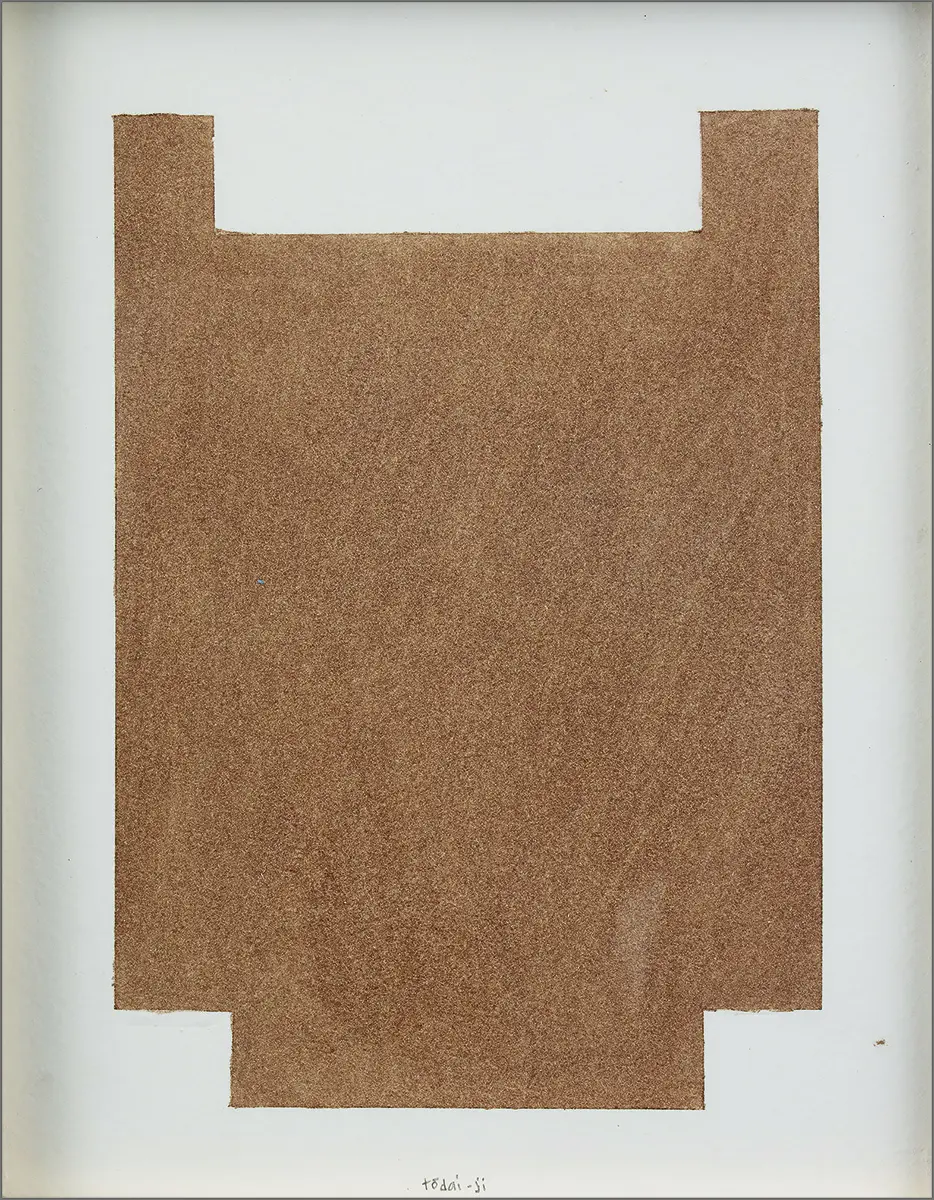
William Cordova’s contribution, for instance, consisted of a series of cacao works-on-paper and a site-specific sculpture. At first glance, the works-on-paper seemed to be overtly formalistic in their sole use of geometric forms. In order to understand the ontological underpinnings of Cordova's works, a passage by the sixteenth-century Peruvian indigene and intellectual Juan de Santa Cruz Pachacuti Yamqui Salcamayhua might be helpful. In his Account of the Antiquities of Peru (1613), Salcamayhua describes an image of Viracocha the creator god in the Inca temple known as the Qorikancha. He states that the representation of Viracocha is in the shape of an oval, but is very adamant to convey at the same time that the image is not Viracocha; for Viracocha is omnipresent thus the delineation of the oval signals the creator god as simultaneously inside and outside and beyond human imagination. In one sense, Cordova's works-on-paper need to be seen within this context. That is, that indigenous ontology is complex and what may be construed as mere Pre-Hispanic superstition is, in fact, a stripping of agency and misconception of the Other arising from Western chauvinism.
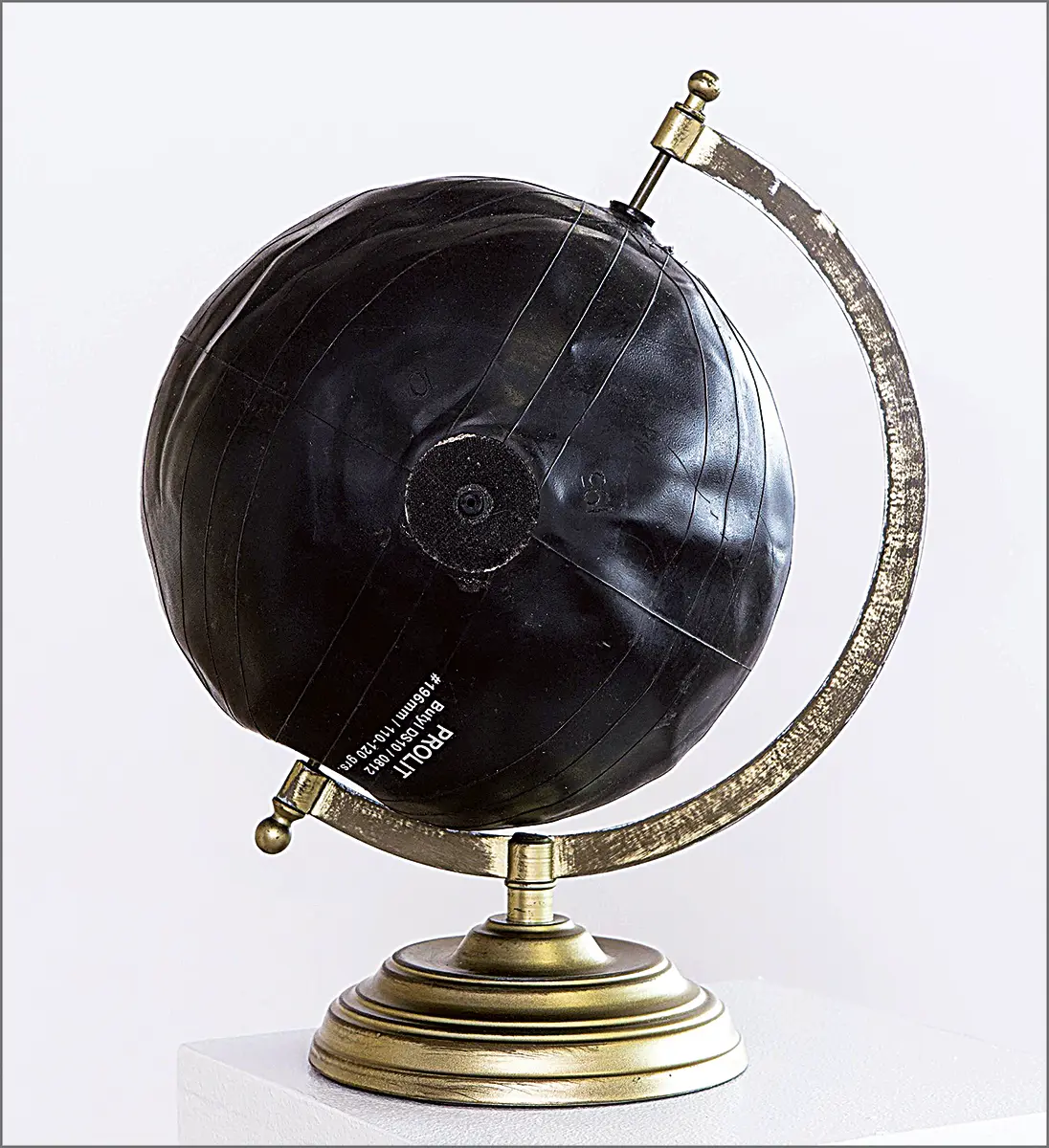
Other artists who worked with less intangible Pre-Hispanic motifs include Ronny Quevedo and his elegant artistic and conceptual citations of the Mesoamerican ballgame, the Inca Quipu, and the Nazca lines. The former entailed three sculptures of which two alluded to the ball court rings at the Post-Classic Maya site of Chichen Itza. Rather than being made in stone as the originals, Quevedo created the rings from empty milk crates possibly conveying the idea of the Mesoamerican game as a form of cultural nourishment. Another sculpture related to the ballgame was The Errant Globe (2015) made from a soccer ball bladder and globe stand. Quevedo could have ostensibly used a rubber ball, but in using the interior of a soccer ball on a globe stand, emphasizes the ubiquitous international sport as Pre-Hispanic in origin with seemingly global reaches. Other artists who also conflated contemporary culture with the past in ingenious configurations include Guadalupe Maravilla, Livia Corona Benjamin, and Claudia Peña Salinas.
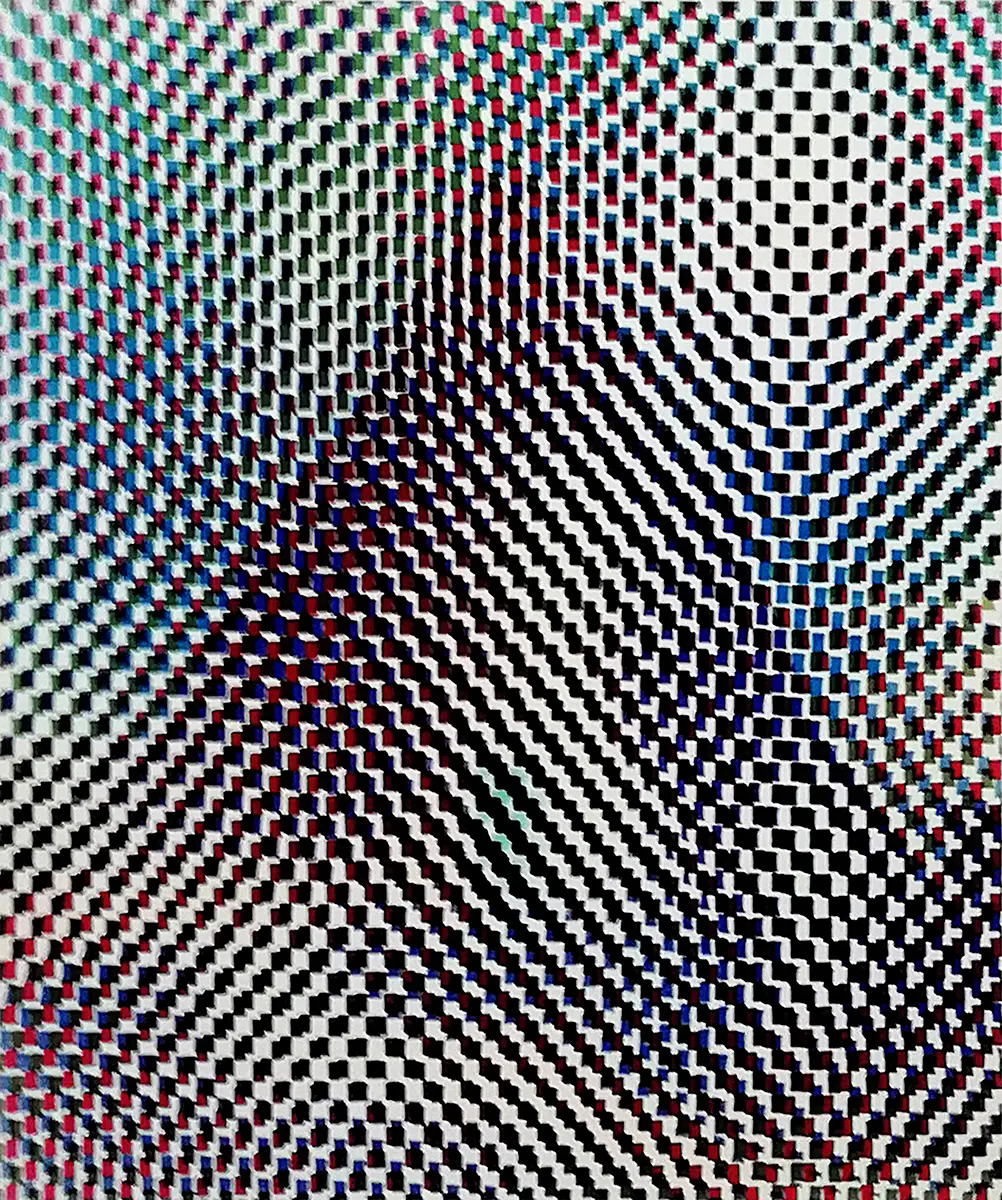
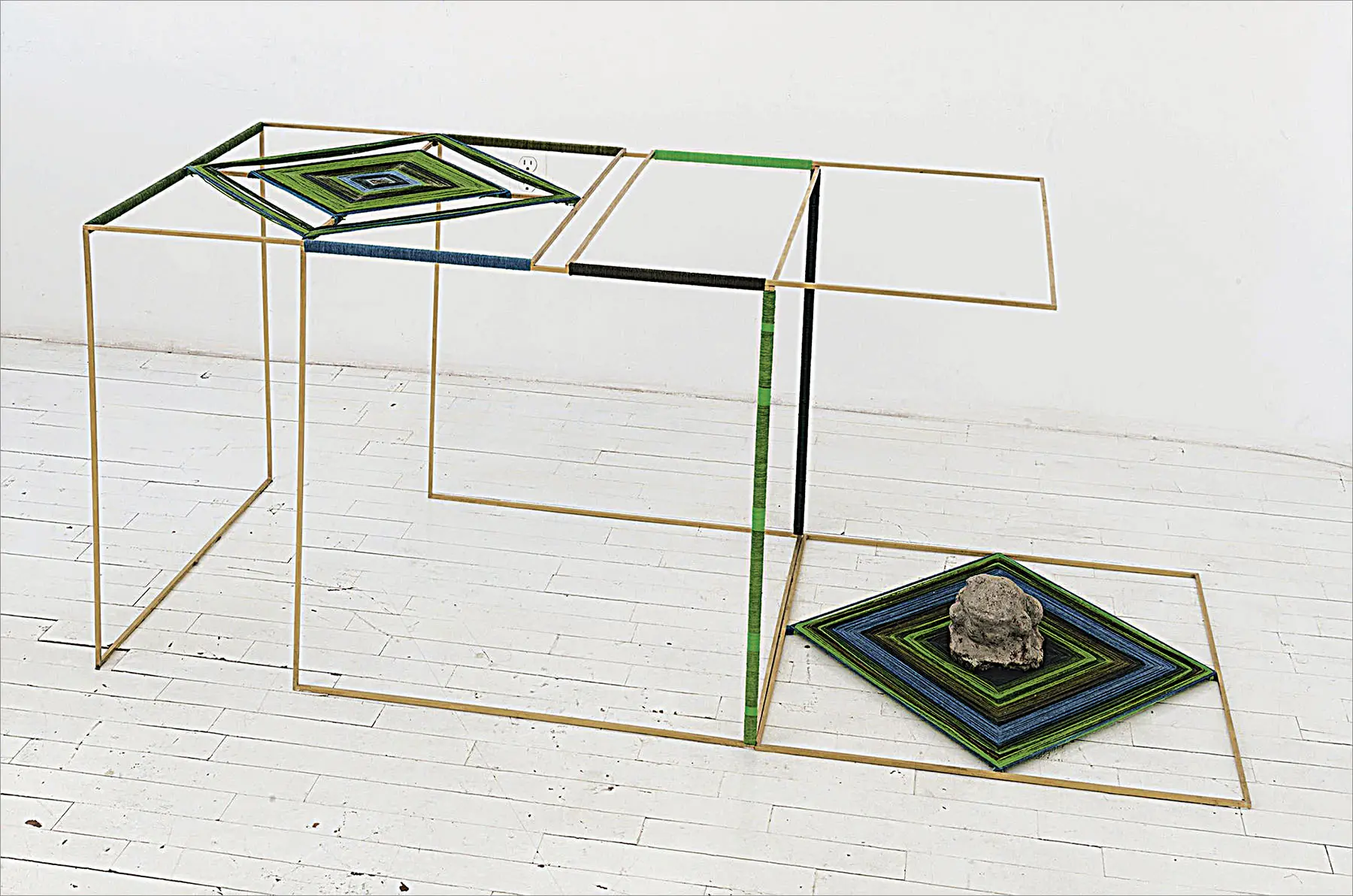
Guadalupe Maravilla re-contextualized maps from the post-Conquest codex Historia Tolteca-Chichimeca (c.1550) as a way to highlight topical issues around undocumented workers and migration. The Historia Tolteca-Chichimeca was written in Nahuatl and Aztec pictography and narrates events from the Pre-Hispanic past to after the Spanish Conquest. A key narrative of the codex is migration by Nahuatl-speaking indigenes including the Aztec from their mythical origins of Chicomoztoc (Place-of-the-Seven Caves). An interesting implication from Maravilla’s work, then, is the notion that contemporary undocumented migration is like Pre-Hispanic religious peregrination, and that movement of communities from one place to another predates colonization of the New World and is an epistemological undertaking to know the world and a community’s place within it. Another artist who dialogued with Mesoamerican cultures was Claudia Peña Salinas whose works seem to collapse space and time. One project entailed a kind of détournement by way of two photographs: one was of a concrete replica of a Tlaloc sculpture superimposed where the original currently resides in Mexico City’s Museum of Anthropology; the second photograph reverses this and returns the real one to its original location. This modus operandi was reminiscent of early, photo-based Conceptualism and gratifying to see Peña Salinas as one of the artistically intelligent heirs of Gabriel Orozco. Peña Salinas’ other works were no less compelling: with their use of wire and string and exploration of the dichotomy of negative and positive within the confines of the “white cube”, were not unlike the yarn and wire sculptures and installations of Minimalist sculptor Fred Sandback. Livia Corona Benjamin’s contribution to the exhibition focused on socially-based art avant la lettre. The crux of her work explored grain silos that were built by indigenes for their communities that were derived from an architectural template designed by Pedro Ramirez Vásquez in 1962. While the grain silos were Modernist in orientation, they were based on pyramidal structures and thus more authentic in borrowing from the Pre-Hispanic past, which may have not been the case with another Frank Lloyd Wright design known as the Hollyhock House based on Maya temple facades.
Clarissa Torrin’s intervention of the Hollyhock House via dancer and collaborator Crystal Sepúlveda was both haunting and mesmerizing. Sepúlveda appears in Torrin’s video titled Ch’u Mayaa (2017) in jaguar print bodysuit enacting a kind of ritual or ceremonial performance throughout the Hollyhock House and environs. Merging both culture (Hollyhock House) and nature (gardens), the female jaguar signifier shifts the narrative beyond that of a neutral backdrop as the jaguar was a Mesoamerican zoomorphic deity par excellence. There is a sense of cultural reclamation and patriarchal subversion as the dancer stealthily engages the space and animates it with a gendered presence. What rounded out the exhibition was another architecturally-based artwork. Mixing genres of installation, design, sculpture and the built environment, relational aesthetics, and art as the social practice was Jorge Gónzalez’s site-specific work titled Ayacuabo Guarocoel (2018).
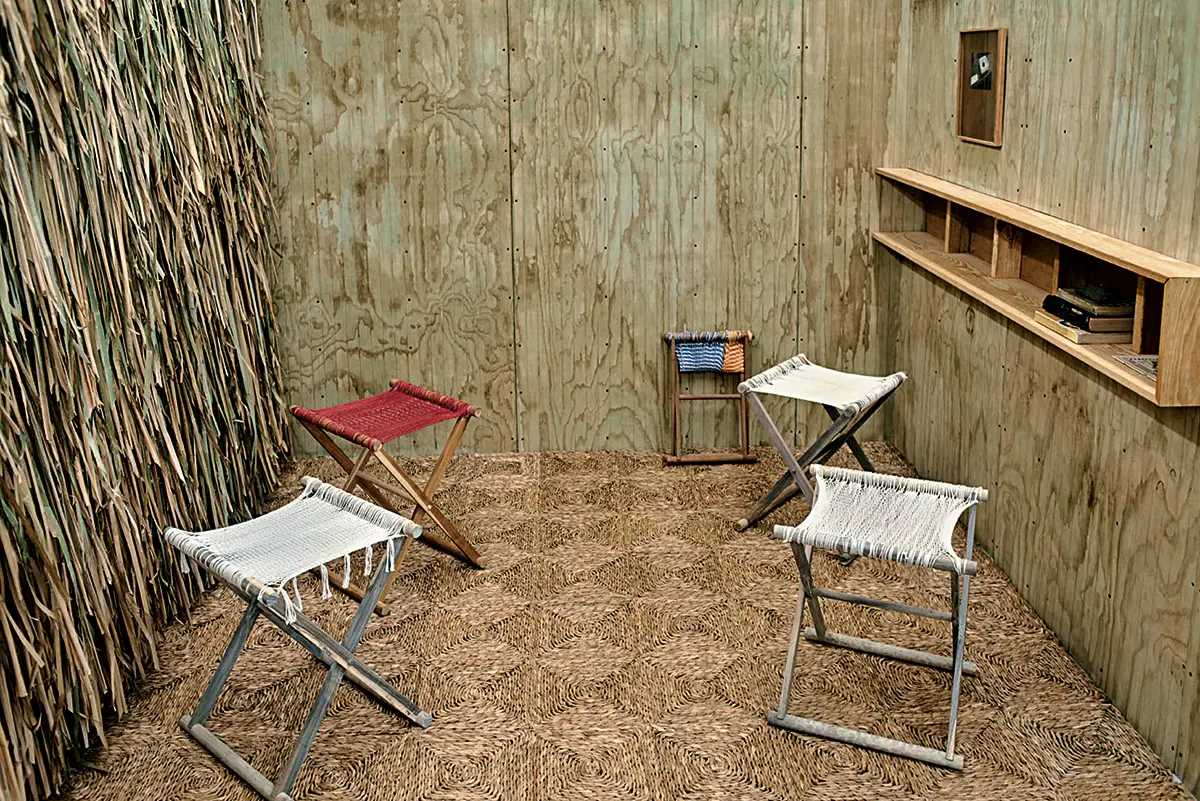
Jorge Gónzalez’s gesamkunstwerk-like architectural installation drew from Puerto Rican and Taíno vernacular and underscores how indigenous cultures were, in one sense, anthropologically spearheading in antiquity what has been the called today as the “educational turn” in contemporary art. This new context for art eschews the Western historical concept of art as one of static, formal contemplation rooted in Enlightenment period aesthetics that would later be cast as an early Modernist art-for-art’s-sake credo. It’s true that there is an artistic dimension to Ayacuabo Guarocoel, and yes it was shown in a museum. But Jorge Gónzalez’s project was more than what Rosalind Krauss termed in her important essay, “Sculpture in the Expanded Field” (1979). Ayacuabo Guarocoel was first and foremost a community in which the artwork became catalyst, mediator, or channel for a myriad of encompassing social activities far afield from the museum’s original mandate. Ayacuabo Guarocoel and the Whitney exhibition that presented indigeneity and contemporary art without clichés and stereotypes reminds us of the two options museums face today: to remain vital as a more inclusive institution for the common good, or become obsolete and irrelevant as just another luxury item for the elite.
RAÚL ZAMUDIO