The title warns that the exhibition has a complex plot: Paradoxon Spirituale (Spiritual Paradox). Why write it in other languages, paradoxon in German or Greek and spirituale in Italian? Perhaps to give a universal dimension to the problems posed by Oscar Murillo and Wilson Díaz in this joint exhibition. By definition, a paradox is a statement that, despite providing apparently valid reasoning, leads to a contradictory or logically unacceptable conclusion. On the other hand, spirituality is related to immaterial, which, although it is present in the works of these two artists, is not easy to perceive due to their strong socio-political content.
Murillo and Díaz are inspired by readings of documents that surpass their historical value and generate symbolic spaces in which the constant concerns of their aesthetic practices are raised. Most of the works presented by Díaz are based on covers of vinyl records of Latin American protest music and on the comic strip magazine Hombres de Acero (Men of Steel), produced and distributed by the Colombian army at the end of the 1990s and the beginning of the 21st century. In this publication, the reality of the country is reduced to a simplistic confrontation between the forces of good, represented by military commandos, and the forces of evil, represented by extraterrestrials or “aliens”. By presenting the army as a defender of the homeland, the cartoon aimed not only to inspire the readers with a sense of admiration but also to promote the affiliation of young people to military service. As in previous works, Díaz analyzes the complex historical, social and political context of the country and criticizes the way in which the population is manipulated through popular or mass media such as music and comics.
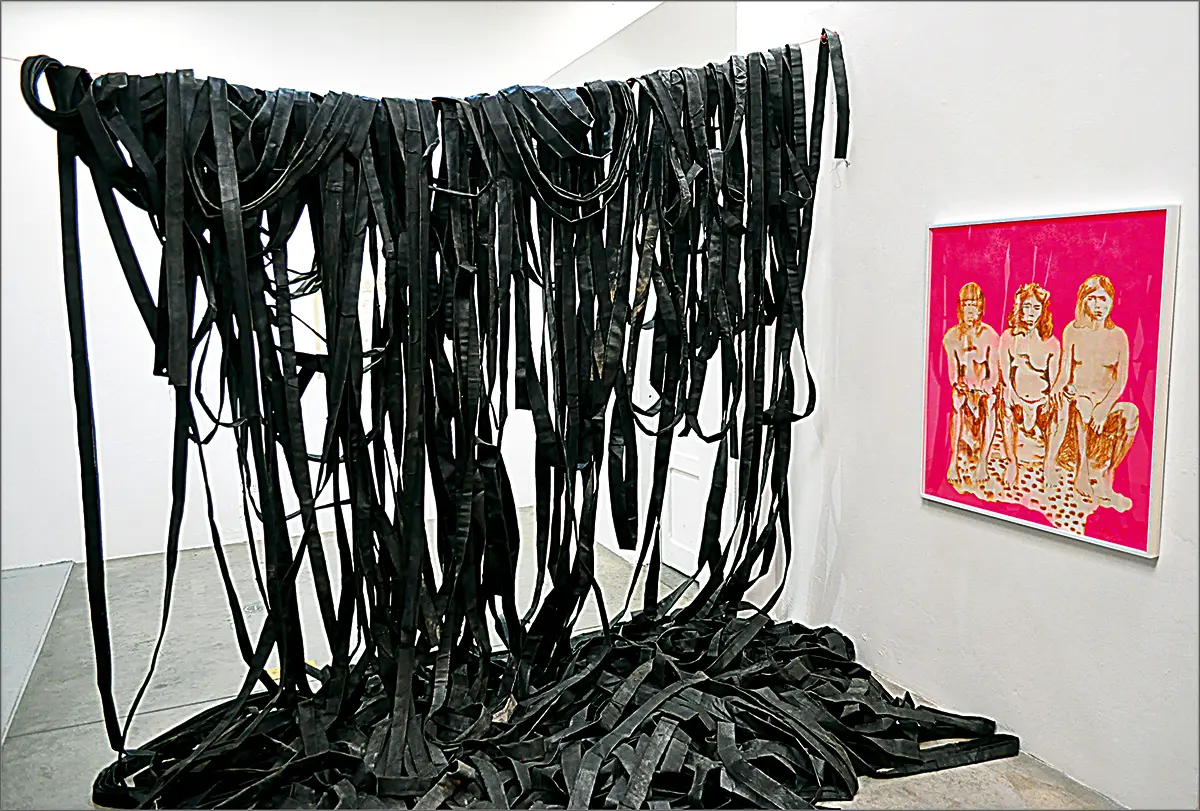
On the other hand, Murillo’s installation, which occupies the central area of the gallery, is inspired by the first Latin American proletarian novel titled Parque Industrial (Industrial Park) (1933), written by Gabriela Galvao, a member of Brazil’s Anthropophagic Movement. The book tells the story of a woman whose body ends up being the territory in which different historical tensions typical of the processes of colonization manifest themselves violently. Through the installation, which served as the setting for the performance executed by the artist, Murillo questions, as in previous works, the different meanings that entail themes such as work, femininity, and violence.
As Beatriz López, the gallery’s artistic director and curator of the exhibition explain, “both in the novel and in the comic the characters are subject to a process of dehumanization. In the case of Industrial Park, the workers—and especially the female workers—thanks to sophisticated manipulation processes, are separated from their essence and objectified (the violent process in which the body is not perceived as public space), while in the fanzine, the enemy is given monster qualities that work as ideological mitigations to excuse their extermination; the alien, politically persecuted, is the stranger, the foreigner or simply the other.”
The theme of the “alien”—which in English means extraterrestrial but also foreign—acquires a personal connotation for Díaz after witnessing a xenophobic experience during his residency at the DAAD, in Berlin (2017-2018). In the case of Murillo, there are also autobiographical references as illustrated by the inclusion of his mother’s photograph in the work Catalyst (1987-2015).
During his stay in Germany, Díaz developed a series of works related to Colombia’s pre-Columbian heritage and especially to San Agustín’s archaeological park, located approximately 30 kilometers from his hometown Pitalito, Huila. In 2013, an exhibition scheduled to be presented at the National Museum of Bogotá that included several monolithic statues from San Agustín was canceled. A local group considered that the sculptures should not be moved because of their sacred nature and demanded that the sculptures that were taken to Germany by ethnologist Konrad Theodor Preuss approximately 100 years ago, housed today at the Ethnological Museum of Berlin, be returned. Diaz establishes connections between this story, the myths related to the site—some people believe UFOs have been observed in the area and others claim that objects of extraterrestrial origin have been found—and the living conditions of the indigenous groups, and develops a pictorial work that fits perfectly within his research on the dividing way in which different societies and cultures are defined and perceived.
At the curatorial level, an interesting counterpoint is created between these works by Díaz and Murillo’s “black” pieces, made with black canvases cut into strips or placed as a curtain on the installation. The way he makes them is a kind of performative or ritual action. According to Omayra Alvarado, executive director of the gallery, the artist “throws the canvas, covers it with oil, then with tar, burns it, walks on it, comes back and paints it, comes back and burns it, makes an exercise to impregnate the piece with energy, and transforms the curtains and strips into energetic blocks, generating tensions in space. These pieces also refer to a Latin American tradition where the construction of thought goes hand in hand with the ritual and the invisible.”
It is interesting to note how Díaz’s works, who resides in Cali but has had the opportunity to work outside of the country, and Murillo’s, who has been most of his life in London but has a strong connection with Colombia, are combined in this exhibition to show that the conflicts and socio-political problems that concern and inspire them to transcend frontiers, and that, in a way that is imperceptible to the eye, they are impregnated with a strong spiritual charge.
FRANCINE BIRBRAGHER PhD